The blank page is one of cinema's most persistent myths: a white field, a solitary writer, and an idea arriving from nowhere. It is also a poor description of how many screenplays begin. By the time words enter a formatted scene, the writer may already have spent months looking, listening, interviewing, collecting, sorting, arguing with the premise, and deciding what the film is actually for.
Screenwriting is therefore less a single act of invention than a chain of transformations. The world becomes notes. Notes become an outline or a field of movable scenes. That structure becomes a deliberately incomplete draft. Revision then asks whether the resulting pages still carry the particular life that first made the story worth pursuing. At every stage, something is gained and something is refused.
Two short Academy portraits make that chain unusually visible.[1][2] Ava DuVernay describes a process fed by being out in the world before it is contained by notes and an outline. Dustin Lance Black opens boxes of research, converts selected moments into color-coded cards, rehearses the movie in his head, and only then writes a first draft he expects to reshape. Their methods are not identical, and neither should be mistaken for a universal recipe. Together, however, they overturn the false opposition between creativity and structure. Structure is not what arrives after inspiration. It is the machinery that lets abundant, unruly material become cinema.
Ava DuVernay: bring the world into the outline
DuVernay's Academy film begins with a productive tension. She wants a strong idea, notes, an outline, fragments of dialogue, and a clear sense of what she is doing before sustained drafting begins. Yet she says that preparation comes from being out in the world.[1] The desk does not manufacture its own raw material. Attention does.
That distinction makes her account more interesting than generic advice to “observe.” DuVernay locates creativity in ordinary acts and relationships, then identifies structure as the difficult conversion point.[1] A real encounter may be emotionally powerful without yet being a scene. A social fact may be urgent without yet supplying a point of view. An overheard phrase may be vivid but belong to the wrong character or moment. Notes preserve possibility; an outline begins making commitments.
The most useful thing to watch for is the order of operations. DuVernay does not romanticize formless experience, but she also does not present an outline as a prefabricated story grid waiting to be filled. Experience supplies pressure and specificity; structure decides how that pressure can move through characters, actions, and duration.[1] The screenplay sits between open attention and hard selection.
Her later account of writing Origin shows how flexible that principle can be. Speaking to the Directors Guild of America in 2024, DuVernay said that she could not simply make an abstract film “about caste.” She found a dramatic form by making the film about a woman writing a book about caste: Isabel Wilkerson's research became a journey, and the movement of thought acquired a human point of view.[3] DuVernay also noted that the project lacked a conventional antagonist and clean central conflict, so the screenplay required her to disrupt familiar expectations rather than obey them.[3]
That example clarifies what an outline is doing in her earlier video. It does not guarantee conventionality. It tests the relationship among idea, person, and cinematic action. A large subject becomes filmable when the writer discovers who encounters it, what that encounter changes, and which images can carry thinking without reducing it to a lecture. The shape follows the problem.
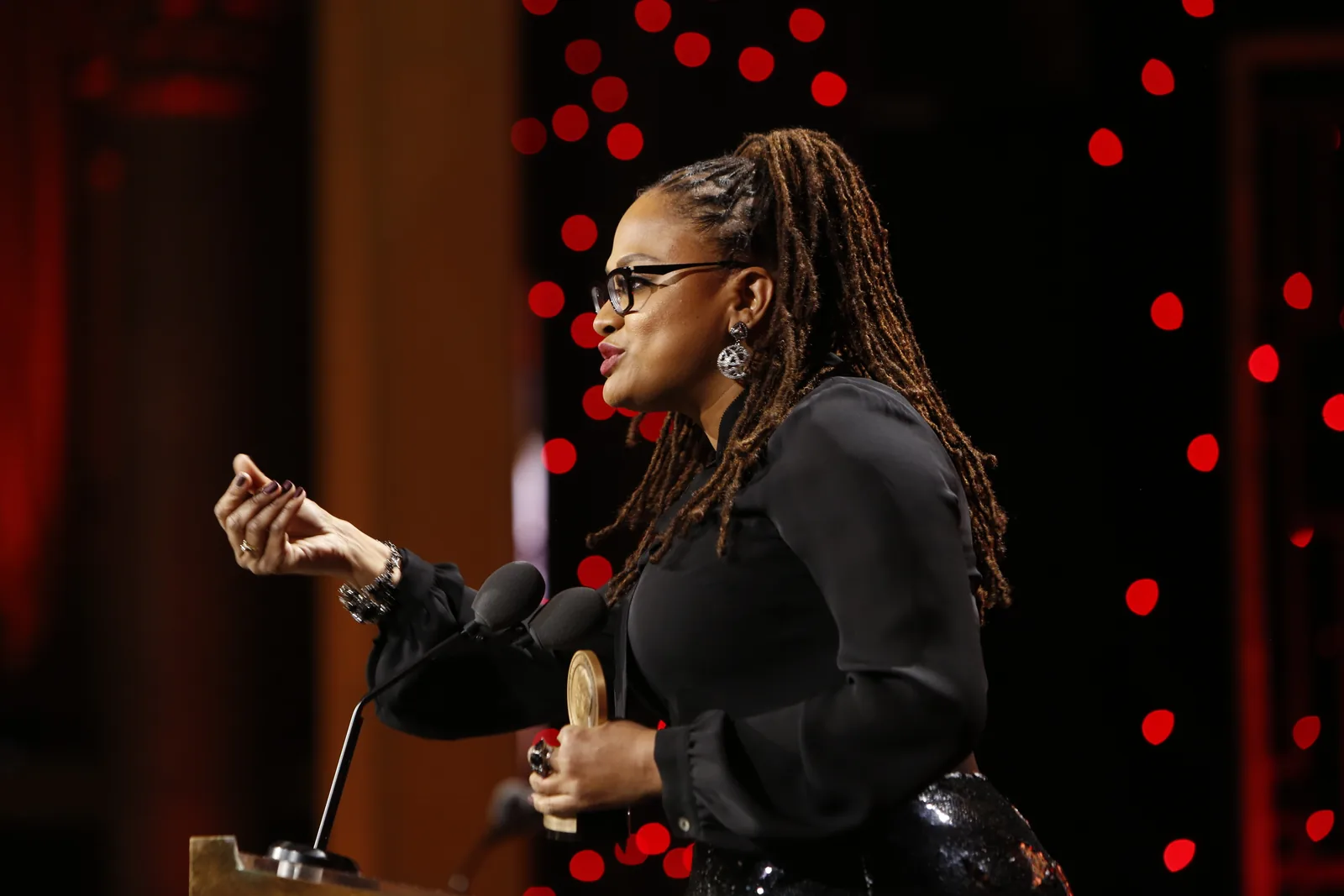
The cover photograph catches DuVernay years after that private labor, accepting a Peabody Award for 13th.[5] It is tempting to treat the podium as the creative destination. The video points backward instead. Public recognition rests on an earlier, quieter discipline: going out, returning with material, and deciding what kind of structure can remain answerable to it.
Dustin Lance Black: make research movable, then cut it
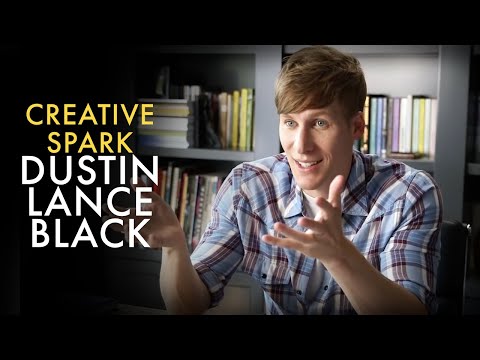
Black begins one step earlier, with purpose. Before deciding what a story will contain, he asks why he is telling it and what cultural movement he hopes it can make.[2] Then he accumulates. The Academy portrait moves through a workspace filled with interviews, photographs, articles, drafts, and project boxes. For fact-based work, he says, research can last a year or more and includes meeting the people whose lives inform the screenplay.[2]
The Writers Guild's account of Milk provides an independent check on that method. It describes the screenplay as grounded in exhaustive research and personal testimony from Harvey Milk's friends and colleagues, including historical consultant Cleve Jones.[4] Research here is not prestige decoration. It is how Black replaces a generic demand for “relatable” characters with people specific enough to resist being smoothed into types.[2]
The center of Black's method is not accumulation but conversion. He extracts moments that seem cinematic and necessary, then gives each note card one relatively pure idea.[2] Color can identify the character being followed. Handwriting may preserve something gathered in an interview; print may point back to a periodical. Those marks keep a scene attached to its evidentiary origin even as the card becomes movable.
Movement matters because chronology is not structure. Black explicitly distinguishes a film from a record of everything that happened.[2] Cards let him place two moments together, separate them, test a new point of view, or remove a scene without losing track of which evidence or character function it served. The huge research archive creates abundance; the finite tabletop creates refusal. In his demonstration, most gathered material never reaches the screenplay.[2]
He then performs a revealing rehearsal. Black reads through the arranged cards and visualizes the movie. If the sequence becomes boring, repetitive, illogical, or stuck, he stops, changes it, and starts again. Only when he can move through the imagined film repeatedly does he call the arrangement an outline.[2] The test is not whether the cards look orderly. It is whether time, attention, and causality feel alive.
The first draft begins after that rehearsal, and Black deliberately lowers the demand for immediate perfection. He describes spilling the draft out, allowing mistakes, improvisation, and play, then treating the result like raw clay to be shaped.[2] This is not carelessness. It separates different kinds of judgment. Cards solve selection and sequence cheaply. Drafting discovers behavior, rhythm, transitions, and language. Revision can then reshape a whole object that actually exists.
The scale of Black's archive should not become a commandment that every writer needs boxes, color codes, or a year of interviews. His stronger lesson is reversibility. A useful process makes major decisions visible and their sources traceable while the whole is changing. Paper cards are one technology for doing that; their value lies in making a scene singular, attributable, movable, and cuttable.
Abundance first, refusal second
DuVernay and Black enter from different doors. DuVernay emphasizes the permeability of the writer: creative material is encountered in people, work, family, place, and the world beyond the desk.[1] Black emphasizes the externalized archive: testimony and documents are kept, labeled, compressed, and rearranged until a film can be imagined.[2][4] One account begins with openness; the other makes selection almost architectural.
Both methods nevertheless pass through three filters. Purpose asks why this story should exist. Specificity asks which lives, details, and contradictions prevent it from becoming generic. Cinema asks what can be staged in images, bodies, sound, and time. An outline is valuable when it keeps those filters in conversation, not when it merely makes the page count look controlled.
This is also the ethical boundary of research-based screenwriting. Interviews and documents do not write the film or remove the writer's point of view. Selection remains interpretation. The more material a writer gathers, the more consequential the omissions become. Black's cards expose that choice; DuVernay's account of Origin shows that even the basic decision about whose journey will hold an idea changes what the audience can know and feel.[2][3]
The blank page, then, is not the beginning. It is a late-stage interface. Before it comes contact with a world larger than the film; after it comes the difficult work of shaping without draining away specificity. A screenplay begins once in attention and again in refusal—when the writer accepts that most of what made the story possible will not fit, but the right structure can make what remains feel fully alive.
Sources
- The Academy, “Creative Spark: Ava DuVernay,” YouTube video, June 23, 2014 — DuVernay on observation, notes, outlining, dialogue, and bringing lived creativity into structure.
- The Academy, “Creative Spark: Dustin Lance Black,” YouTube video, May 26, 2014 — Black on purpose, research, interviews, scene cards, outlining, provisional drafting, and revision.
- Directors Guild of America, “Origin: A Conversation with Director Ava DuVernay,” February 21, 2024 — DuVernay on turning an abstract subject into a writer's journey and building a nonlinear screenplay without a conventional antagonist.
- Writers Guild of America West, “Dustin Lance Black (Milk),” February 3, 2009 — screenplay context, historical research, firsthand commentary, and the role of consultant Cleve Jones.
- Wikimedia Commons, “Ava DuVernay - 13th” — Stephanie Moreno's photograph of DuVernay accepting a Peabody Award for 13th on May 20, 2017.