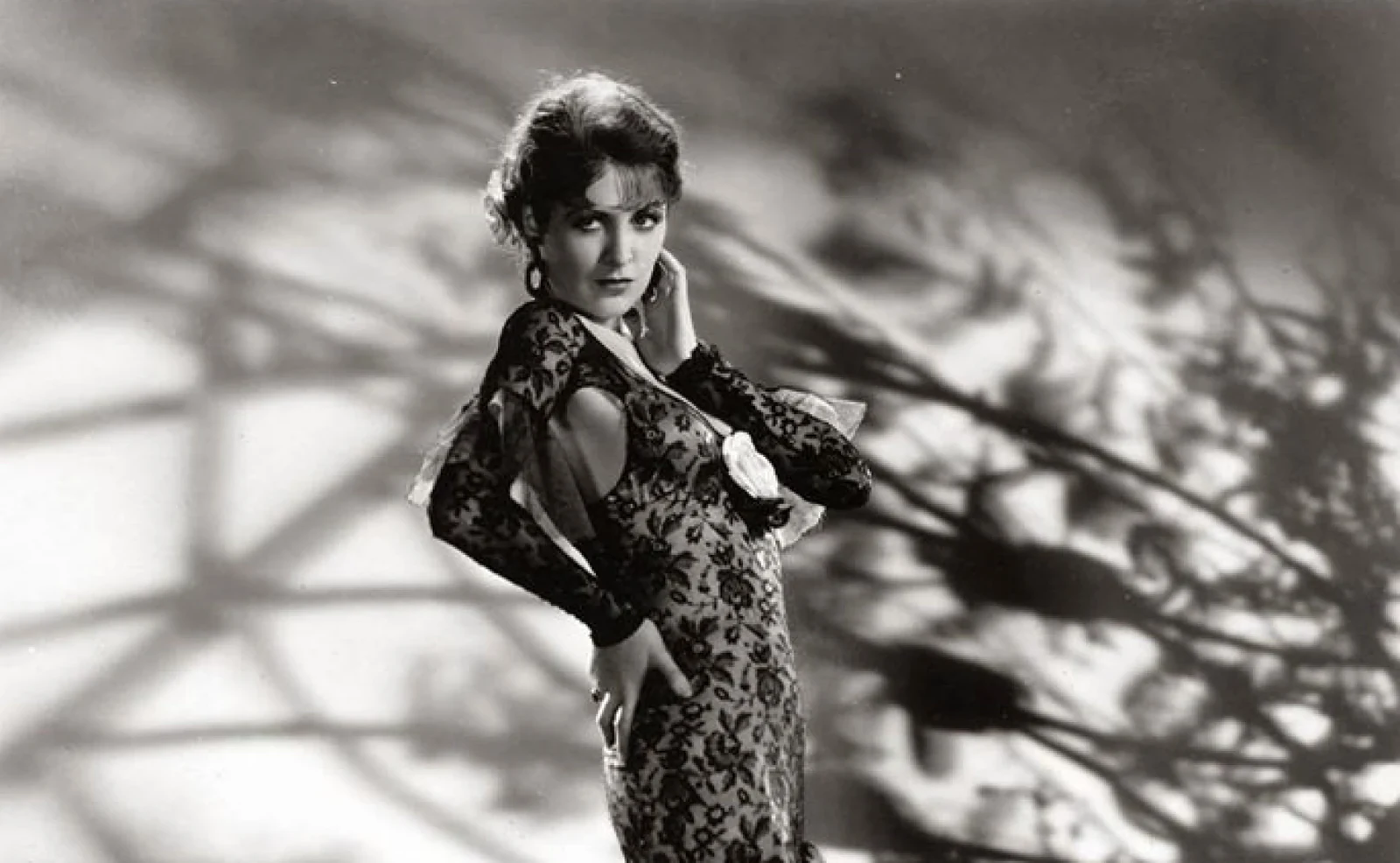

The hardest film-restoration problem is not always decay. Sometimes the evidence survives in incompatible pieces. A picture can remain intact while its soundtrack records a censor's scissors; a script can preserve words that no surviving voice speaks. In that situation, cleaning and scanning are not enough. The archive has to decide whether returning what was removed will also invent something new.
Cock of the Air makes that dilemma unusually concrete. The 1932 aviation comedy, directed by Tom Buckingham and produced by Howard Hughes, follows French performer Lilli de Rosseau (Billie Dove) and American pilot Roger Craig (Chester Morris) through a battle of seduction and mistrust. It was made before strict Production Code enforcement, then altered for rerelease: censors changed or eliminated dialogue in its risqué scenes.[2] The Academy Film Archive eventually held an uncensored 35 mm nitrate fine-grain picture master, but the available 35 mm nitrate soundtrack negative belonged to the censored version. The bodies and lip movements survived; some of their words did not.[2]
The Academy's short documentary, uploaded by its official channel, follows the 2016 restoration's audacious answer: cast present-day performers to speak the missing lines, edit those recordings into the surviving track, and mark every reconstructed passage for the audience.[1][2] It is worth watching less as a victory lap than as a compact ethics case. The restoration does not pretend to recover an untouched original. It asks how a film can become more complete while remaining honest about where completion became conjecture.
Two versions survived inside one set of elements
The video's first important lesson is material rather than moral: “the film” did not survive as one complete object. The uncensored picture and censored sound came down through different elements.[1][2] That mismatch explains why a modern viewer cannot simply demand the original version and expect an archive to retrieve it from a shelf. Film history often reaches us as a distributed record—negative here, print there, soundtrack elsewhere, script and censorship file in another collection.
The asymmetry also makes the censor's work strangely visible. Had both picture and sound been cut in exactly the same places, the missing jokes might have disappeared without leaving a moving mouth behind. Here the uncut image becomes evidence against the soundtrack paired with it. The gap is not silence in the abstract; it has duration, gesture, and a face. A surviving script can supply the words, but it cannot supply Chester Morris's or Billie Dove's lost breath, timing, pitch, or microphone presence.
That is the point at which ordinary restoration language becomes inadequate. Dirt removal can be checked against adjacent frames. A broken splice can sometimes be repaired by matching physical edges. A voice performance has no mechanical fit. It requires interpretation. The Academy's Casting Branch selected performers including Hamish Linklater, Ever Carradine, and JB Blanc to render the excised dialogue in the style of the original actors.[2] Sound engineer John Polito then had to make new voices inhabit an old recording environment; reporting on the project also notes that he supplied missing piano music for a damaged seduction sequence.[3]
A convincing imitation is not the same as recovered evidence
The reconstruction succeeds only if the viewer can hold two ideas at once. Dramatically, the new lines should join the scene well enough for its comic timing and sexual argument to work. Historically, they must never be mistaken for audio recorded in 1931 or 1932. Perfect invisibility would therefore be a failure of documentation.
The archive solved that conflict with a small on-screen icon whenever contemporary sound enters.[3][4] The mark works like brackets in a critical edition: it lets the sentence run while telling the reader which words were supplied by an editor. Heather Linville of the Academy Film Archive explained that the team feared the signal might pull viewers out of the film, but audiences instead valued being let into the process.[4] The interruption creates trust. Rather than asking us to believe in a miraculous recovery, it shows exactly where restoration crosses into recreation.
This is more than a disclaimer attached after the fact. It changes how the restored version can be read. When the icon appears, censorship becomes part of the viewing experience. The audience encounters the flirtation that authorities tried to mute and, simultaneously, the later labor required to make that absence speak. The soundtrack now carries at least three historical moments: the original production, the censor's alteration, and the archive's 2016 response.
The distinction matters because a plausible voice can acquire false authority very quickly. Once a reconstruction is copied, streamed, excerpted, or separated from its notes, it may be heard as an original recording. FIAF's ethics code therefore treats documentation, reversibility, source integrity, and clear identification of interventions as central archival duties.[5] Cock of the Air turns those principles into something a general audience can see without reading a laboratory report.
The icon protects both immersion and doubt
There was another possible solution: leave the missing passages silent, perhaps with explanatory titles. That would keep contemporary acting outside the work, but it would also turn a sound comedy into a stop-start demonstration of loss. Because the complete moving image survives, silence would detach mouths, glances, and reactions from the rhythm for which they were staged. Reconstruction restores the scene's usable dramatic shape, even though it cannot restore the exact original performance.
The choice is defensible because it does not destroy the competing evidence. The censored soundtrack remains an archival element; the newly assembled track is a presentation version. The icon preserves a boundary within that version, and records can preserve the identities and methods behind it.[2][4][5] Restoration here is not a single master that replaces every predecessor. It is a new, explicitly labeled relationship among the surviving picture, surviving sound, written dialogue, modern performance, and audience.
That layered answer is more valuable than the fantasy of purity. An “original” release can itself be unstable: films were recut for territories, rereleases, censorship boards, exhibitors, and changing technologies. The task is not to declare one composite eternally authentic. It is to identify what survives, explain what was done, and keep future researchers able to separate source from intervention.
What to listen for after the novelty fades
The tempting way to watch the documentary is as a dubbing challenge: can contemporary actors match old lips and old star voices? The more revealing question is how many kinds of judgment sit beneath that match. Casting determines vocal weight and comic temperament. Performance determines pauses and emphasis. Editing aligns syllables to gestures. Mixing tries to place new recordings inside the noise, frequency range, and spatial character of an early optical soundtrack. Documentation decides when the audience must be alerted.[1][2][3]
No department can make the new material identical to what was lost. Together they can make the limits of the reconstruction intelligible. That is why Cock of the Air is a stronger restoration story than a simple before-and-after comparison. The finish is not the point. Accountability is.
The restored film had its world premiere at the Academy in August 2016 as an uncensored pre-Code release version.[2] What premiered was neither an untouched survivor nor a free remake. It was an argument, built from nitrate, paper, performance, digital sound work, and a visible sign of doubt. The picture could speak again because the archive refused to ventriloquize it anonymously.
Sources
- The Academy, “Academy Close-Up: The Restoration of ‘Cock of the Air,’” YouTube video, August 15, 2016 — official documentary on the surviving elements, recasting, recording, and soundtrack reconstruction.
- Academy of Motion Picture Arts and Sciences, “The Front Page (1931) and Cock of the Air (1932)” — official 2016 screening record, restoration elements, production credits, missing-dialogue method, and contemporary cast.
- Beth Accomando, “Academy Film Archive,” KPBS, April 26, 2019 — interview and reporting on the mismatched elements, John Polito's sound work, replacement voices, disclosure icon, and source of the Billie Dove film still.
- Kyle Westphal, “One Movie Worth a Fight: Restoring The Front Page,” Chicago Film Society, January 23, 2017 — interview with Academy preservationist Heather Linville on the recreated Cock of the Air track, disclosure icon, and preservation choices.
- International Federation of Film Archives, “FIAF Code of Ethics,” revised 2025 — principles for source integrity, documentation, reversibility, restoration, and identifying new creation.