Josef von Sternberg's The Scarlet Empress looks at first like a Catherine the Great costume picture that has been invaded by a nightmare. That is the point. The 1934 Paramount film, directed and produced by Sternberg and starring Marlene Dietrich, John Lodge, and Sam Jaffe, takes the rough outline of Catherine's imperial rise and pushes it away from polite biography toward something stranger: a world where every carved face, candle, uniform, corridor, and body seems to be part of the state apparatus.[1]
The film belongs to the Dietrich-von Sternberg cycle, but it is not simply another star vehicle wrapped in exotic decor. Criterion's Robin Wood places it late in the collaboration, the sixth of seven films, and stresses how far it stands from Hollywood realism.[2] TCM's production account is useful on the commercial problem: the screenplay was a highly fictionalized version of Catherine's life, originally carrying more sensational working titles before censorship pressure helped reshape the public-facing package.[3] The result feels like a studio prestige film that has stopped trusting prestige. Its palaces do not certify civilization. They look hungry.
That is why the film still feels radical. Many historical dramas use architecture as proof that the past was grand. The Scarlet Empress uses architecture as evidence that power has teeth. Its central idea is not that Catherine enters a barbaric court and becomes corrupted by it. The sharper idea is that she learns to read a world already organized as spectacle, appetite, and intimidation. She survives by mastering the same visual language that first traps her.
The Palace Watches Before Anyone Speaks
The most important character in The Scarlet Empress may be the palace itself. Criterion's essay describes the Imperial Palace as a hyperreal nightmare of gargoyles, grotesque carved figures, enormous doors, candle shadows, and ceremonial pressure.[2] Those details are not decorative overload. They are political grammar. Before Catherine understands the Russian court as a set of alliances and threats, she has to experience it as an environment that looks back.
Sternberg makes the court feel less built than grown from fear. Wooden saints and monsters jut into rooms. Stairways and portals seem designed to reduce human scale. Banquet spaces are crowded not only by people but by objects that refuse neutrality. The film keeps telling the viewer that empire is not just exercised through law, family, succession, or military force. It is also exercised through surroundings that train people to accept distortion as normal.
This is where the movie breaks from ordinary costume biography. A conventional film might contrast innocent Sophia with a dangerous court through dialogue: warnings, court gossip, a wise mentor, a political explanation. Sternberg lets the set do more brutal work. Sophia enters rooms that already explain the bargain. She has been brought to Russia to produce an heir, and the architecture makes that function visible before the plot has to underline it. Everything around her is ceremonial, sexualized, religious, and punitive at once.
Dietrich Learns Stillness As A Weapon
Dietrich's performance is often remembered through glamour, but the film's real interest is in changing what glamour does. Early Sophia is not weak; she is unprepared for a world that treats femininity as dynastic equipment. Her face carries alertness before it carries command. Sternberg photographs that alertness against rooms that seem to dwarf, frame, and inspect her.
The transformation into Catherine works because Dietrich does not simply become larger. She becomes more controlled. The film's power arc is not a march from innocence to loud domination. It is a tightening of surface. Catherine learns when to withhold reaction, when to let costume speak, when to let the gaze do what pleading cannot, and when to turn sexual attention into political leverage. Roger Ebert's Great Movies essay calls the film a visual extravaganza and notes how it repeatedly sets grotesque forms against Dietrich's face.[4] That juxtaposition is the mechanism. Her face becomes the one surface in the film capable of answering the carved world without being swallowed by it.
This makes the film's gender politics more severe than a simple empowerment fable. Catherine does not find a clean route out of patriarchy. She learns how to operate inside a monstrous system by becoming a more exact reader of its signs. Criterion frames the broader Sternberg-Dietrich cycle around the question of how a woman asserts herself in a male-dominated world and at what cost.[2] In The Scarlet Empress, the cost is visible in the way triumph starts to resemble the machinery that made triumph necessary.
Pre-Code Excess Is Not Just Permission
The film's 1934 release matters because it sits at the edge of Hollywood's changing censorship climate. Ebert notes that it arrived as the Hays Office began more aggressively policing studio films, and TCM records that the more provocative working title Her Regiment of Lovers was changed after Hays Office complaints.[3][4] AFI's catalog preserves the title history too, listing Catherine II, Catherine the Great, and Her Regiment of Lovers among the alternates.[5]
That context can make the movie sound valuable mainly because it got away with things later Code-era films could not. It did, but the excess is more than permission. Sternberg does not use Pre-Code latitude simply to be frank about sex, illegitimacy, and court depravity. He uses it to make politics feel inseparable from appetite. Desire is never safely private here. It is recruited, displayed, exchanged, and weaponized.
The famous bluntness of Catherine adding the army to her conquests works because the film has spent so long making bodies and uniforms part of the same visual order.[4] Soldiers do not enter as neutral instruments of state power. They enter as surfaces, ranks, torsos, boots, lines, and available force. Catherine's rise depends on seeing that the army is not only an institution but also a theater of loyalty. She does not merely command men; she converts spectacle into allegiance.
History Becomes A System Of Surfaces
AFI's production record notes the film's large scale, including the credited supporting cast of 1000 players and a reported production cost of 900,000 dollars.[5] Numbers like that can imply grandeur, but The Scarlet Empress turns grandeur sour. The size is felt not as patriotic sweep but as crowding. Sternberg packs the frame until luxury becomes pressure. Even the film's historical liberties serve this design: factual compression matters less than the sense of a society whose symbols have become more truthful than its official explanations.
That is why the film's departures from sober history do not make it feel frivolous. It is not trying to teach Catherine's biography as a civic lesson. It is trying to imagine how power might feel if every institution showed its appetite openly. The court wants an heir, Peter wants humiliation and cruelty, Elizabeth wants continuity, officers want access, and Catherine wants survival before she wants dominion. The film turns those wants into physical textures: fur, wood, candle smoke, metal, fabric, faces, and doorways.
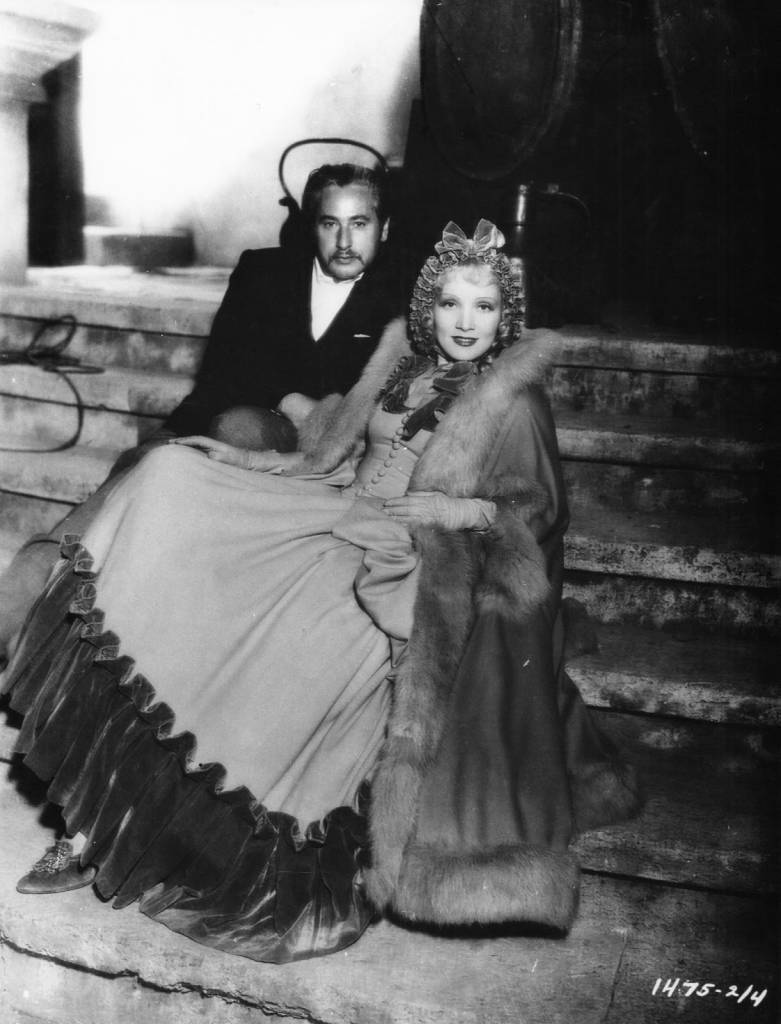
The archival production photograph used for this article helps clarify that achievement. On the Commons file page, the image is identified as Sternberg on set with Dietrich as Princess Sophia for Paramount's 1934 film.[6] It is not a random portrait. It shows the director and star inside the manufactured world whose artificiality is the subject. The visible costume, pose, and production context matter because The Scarlet Empress is a film where constructed surfaces do not hide meaning. They are the meaning.
The Triumph Is Frightening Because It Works
The ending can be exhilarating if read only as Catherine seizing power. It is more disturbing if read as the completion of her education. She has learned the court's language: intimidation, display, erotic strategy, military alignment, ceremonial image. The girl once inspected by the palace has become someone who can make the palace answer to her.
That is not liberation in any simple sense. It is mastery inside a damaged form. Sternberg's brilliance is that he refuses to clean up the feeling. Catherine's ascent is thrilling because Dietrich makes command beautiful; it is frightening because the film has shown us what beauty can do when it becomes an administrative tool. The grotesque carvings do not disappear. The world does not become humane. The person who once seemed most endangered by the spectacle becomes its most lucid operator.
This is why The Scarlet Empress survives better than many better-behaved historical dramas. It does not ask the viewer to admire period detail for its own sake. It asks what period detail is doing to the people inside it. A throne room, a wedding chamber, a uniform, a candlelit corridor, a carved monster, a jeweled costume: each object becomes part of a political education. The film's excess is not clutter. It is argument.
Sternberg and Dietrich made a Catherine story in which empire is not an idea above the frame but a pressure inside every surface. Power is carved, worn, lit, staged, desired, and finally performed. Catherine wins by learning that lesson better than anyone else in the room. The nightmare does not end. It changes owners.
Sources
- BFI, "The Scarlet Empress (1934)" film page - credits, country, year, director, producer, writer, and principal cast.
- Robin Wood, "The Scarlet Empress," The Criterion Collection, May 7, 2001 - essay on the film's modernist style, Sternberg-Dietrich cycle, palace design, and gendered power.
- Lorraine LoBianco, "The Scarlet Empress," Turner Classic Movies, November 2, 2009 - production background on the fictionalized biopic, Dietrich-von Sternberg collaboration, and Hays Office title pressure.
- Roger Ebert, "The height of visual extravagance," RogerEbert.com, January 16, 2005 - Great Movies essay on the film's visual excess, grotesque design, Dietrich close-ups, and release-era censorship context.
- AFI Catalog, "The Scarlet Empress" - production and release record covering alternate titles, supporting cast note, reported cost, production dates, credits, and source basis.
- Wikimedia Commons, "File:The Scarlet Empress (film) 1934 Josef von Sternberg, director. On set with Marlene Dietrich as Sophia.jpg" - archival Paramount production photograph used as the article image.