Buster Keaton and Clyde Bruckman's The General is often praised as a silent-comedy monument, but the word "comedy" can make the film sound lighter than its machinery. The gag structure is funny because the engineering is strict. Johnnie Gray does not move through a flexible cartoon world. He moves through track switches, bridges, cowcatchers, boxcars, hills, woodpiles, telegraph lines, and an engine whose forward motion cannot be negotiated once the wheels commit. The movie's deepest craft idea is simple: suspense gets sharper when space has rules.
The production facts explain why the film feels unusually heavy for a comedy. AFI records The General as a Buster Keaton Productions feature released by United Artists, based on the Civil War's 1862 locomotive raid, shot in part around Cottage Grove, Oregon, with historically styled locomotives, sets, costumes, a constructed bridge, Oregon National Guard extras, and Keaton performing dangerous stunts himself.[1] The result is not comedy decorated with trains. It is comedy generated by what trains can and cannot do.
The film's politics need a boundary note. Johnnie is a Southern engineer trying to recover his locomotive from Union raiders, and modern viewers do not have to treat the Confederate point of view as innocent scenery. The craft achievement sits beside that discomfort, not outside it. What makes The General worth returning to is not a romantic Civil War fantasy but the way Keaton converts a morally loaded historical premise into a kinetic problem: one man, one engine, one line of track, two directions of chase, and a landscape that keeps making movement visible.
The Track Gives The Chase A Grammar
Most chase films ask whether the pursuer can catch the pursued. The General adds a better question: what does pursuit mean when everyone is trapped on rails? Johnnie can accelerate, reverse, stop, switch tracks, decouple cars, clear obstacles, and improvise with tools, but he cannot simply cut across the field. The track turns the chase into grammar. Direction, distance, and delay are legible before the intertitles explain them.
That is why so many gags are also route-management problems. Wood falls from a tender and has to be cleared. A cannon points the wrong way. A boxcar must be uncoupled. A switch must be thrown at the right instant. The joke is rarely "Keaton does something random." The joke is that the object has a rule, Johnnie misreads or exploits it, and the track refuses to pause while he catches up. Britannica's overview calls the film ambitious because it combines historical fact, stunts, heroism, and an inventive story line; the better word may be integrated.[3] Nothing feels detachable. Plot is logistics; logistics is comedy.
Peter Bradshaw's Guardian review describes The General as a film that more or less invented the action movie, and that claim works best if "action" means a system of readable physical consequences rather than speed alone.[4] Keaton's cutting is not frantic. The camera often holds long enough for the viewer to understand where Johnnie is, where the train is pointed, what object is in the way, and how little time remains. The suspense depends on orientation. If the audience cannot read the track, the gag loses its fuse.
Keaton's Body Is The Measuring Device
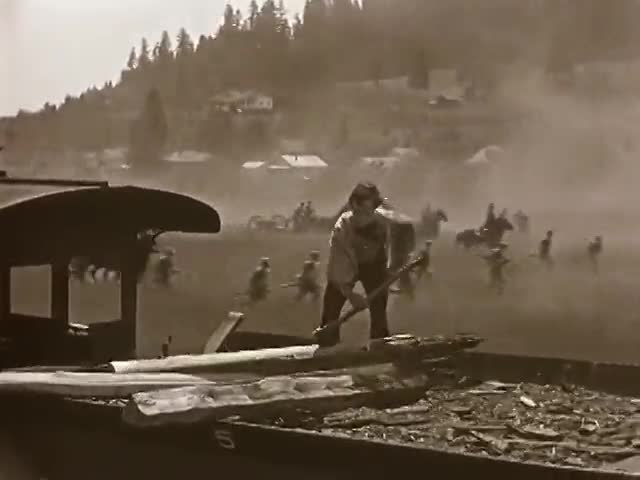
Keaton's face is famous for stillness, but in The General his whole body becomes a measuring device for industrial scale. He sits on the cowcatcher, climbs over cars, crosses the tender, handles coupling hardware, and leans into the engine as if trying to make himself part of its mechanism. The image used for this article, extracted from the Internet Archive copy of the film, shows that principle clearly: Keaton is not framed apart from the locomotive; he is set against wheels, planks, dust, and moving bodies so the human figure can be compared against the machine's mass.[2]
This is why the stunts still feel different from later spectacle. The film does not merely present danger as a burst of thrill. It makes danger spatially accountable. When Johnnie stands near moving wheels or rides the front of the engine, the shot gives the viewer enough information to understand the risk. The body is small, the locomotive is large, the track is fixed, and the timing has to be exact. Keaton's calm does not reduce the danger. It sharpens it, because panic would turn attention inward while his composure keeps attention on the physical problem.
The International Buster Keaton Society's credit listing is plain but useful: Keaton is credited as co-director with Bruckman and as Johnnie Gray, with Marion Mack as Annabelle Lee, on an eight-reel release dated December 31, 1926.[5] That dual role matters formally. The performer and director are solving the same problem from opposite sides of the camera. The body in the frame knows the gag; the camera outside the frame knows how much of the mechanism the audience needs to see.
The Locomotive Is A Partner, Not A Prop
The title has a double force. "The General" is a locomotive, but the film treats it almost like Johnnie's professional identity. AFI notes that the historical source involved Union soldiers stealing a train from Marietta, Georgia, and trying to damage track and bridges to block Confederate troop movement.[1] Keaton's version shifts the emphasis from military operation to personal pursuit, but the film keeps the practical intelligence of rail work. Johnnie's love for the engine is comic, romantic, and occupational at once.
That occupational quality matters. Johnnie wins not because he becomes a conventional soldier but because he understands the machine. The opening rejection from military service is therefore not only a romantic humiliation. It sets up a craft argument: the army misreads usefulness because it cannot see engineering competence as heroism. The chase reverses that judgment. Throwing switches, feeding the engine, reading track, handling cars, and improvising repairs become forms of action.
The film's best gags often let the locomotive seem to think with him or against him. It starts, stops, slips away, refuses convenience, and magnifies small mistakes. Yet Keaton never anthropomorphizes it fully. The engine is funny because it remains matter: hot, heavy, directional, and indifferent. It cannot bend to a gag. The gag has to bend around it.
Scale Keeps Expanding Without Losing The Bit
The astonishing bridge collapse late in the film is sometimes remembered as a production legend: AFI notes that Keaton had a bridge built for the crash, with modern sources placing the scene's cost above $42,000.[1] What keeps the moment from becoming mere excess is the way the film has already trained viewers to read scale. A single plank, a switch, a log, a cannon, a car coupling, and a bridge all belong to the same chain of rail consequences. By the time the locomotive drops, the movie has earned the escalation.
AFI records the same afterlife paradox: contemporary response and box office were disappointing, but by the 1960s the film had been critically reclaimed, and in 2007 it ranked eighteenth on AFI's tenth-anniversary list of the greatest American films.[1] "Understatement" is the key. Even at its largest, the film rarely insists on emotional inflation. Keaton's face does not announce the greatness of the stunt. The image does the work. The bridge goes, the train drops, the war machinery continues, and Johnnie has to keep solving the next problem.
This is also why the battlefield material does not swallow the comedy. Troops, smoke, cannon, and dust widen the frame, but Keaton keeps returning scale to usable objects. A sword, a uniform, a lever, a piece of wood, a train car, a doorway: the film lets historical spectacle matter only when it can be converted into action grammar. The Civil War setting gives the chase stakes and visual size; Keaton's craft keeps reducing that size back to timing.
Why The Machine Still Runs
Many silent films now require a viewer to adjust to lost rhythms. The General still feels immediate because its rhythm is not only period style. It is mechanical logic. The viewer understands pursuit, inertia, distance, obstacle, and timing without needing modern speed. The shots are patient because the world is dangerous enough when read clearly.
That is the film's most durable lesson for action cinema. Movement is not automatically suspenseful. Movement becomes suspenseful when the audience understands the rules binding it. Keaton's achievement is to make those rules visible and then keep finding comic exceptions that do not break them. Johnnie can be foolish, lucky, brave, vain, devoted, and technically competent in the same sequence because the track gives each trait a test.
By the end, The General has turned a chase into an engineering language. The locomotive is not a background attraction. It is the film's meter, partner, obstacle, and title object. Keaton does not conquer the machine by overpowering it. He survives by learning its timing so precisely that comedy and suspense become the same motion. The train goes forward, the gag tightens, and the viewer laughs because the rails have left no easy way out.
Sources
- AFI Catalog, "The General (1926)" - production record covering credits, historical basis in the 1862 Andrews raid, Oregon locations, constructed bridge, dangerous stunts, and release history.
- Internet Archive, "The General (complete & clearer) (1926)" - public-domain archival video item used to extract the article's locomotive frame image.
- Lee Pfeiffer and Britannica Editors, "The General," Encyclopaedia Britannica - overview of release context, Civil War setting, Johnnie Gray premise, stunt work, and production notes.
- Peter Bradshaw, "The General - review," The Guardian, January 24, 2014 - modern critical account of Keaton's precision, action-movie grammar, and cowcatcher stunt presence.
- International Buster Keaton Society, "The General" - filmography record with date, credits, reel length, cast, and public-domain note.