Plenty of films combine documentary and fiction. In Sara Gómez's work, the combination is not a badge of authenticity or an elegant blur between categories. It is a way to prevent one kind of knowledge from becoming too comfortable. A romance begins to explain a society, and an interview cuts in. An official account promises transformation, and a voice from inside that transformation adds friction. A character speaks for a position, then behaves with all the inconsistency that a position cannot contain.
That is why Gómez's only feature, De cierta manera—usually titled One Way or Another in English—feels larger than the slender career that preceded it. The film moves among professional actors, non-actors, reenactment, documentary passages, multiple narrators, and competing points of view. Its subject is not simply post-revolutionary Cuba. Its subject is the difficulty of changing daily conduct at the same speed as housing, work, education, and public language.[1][6]
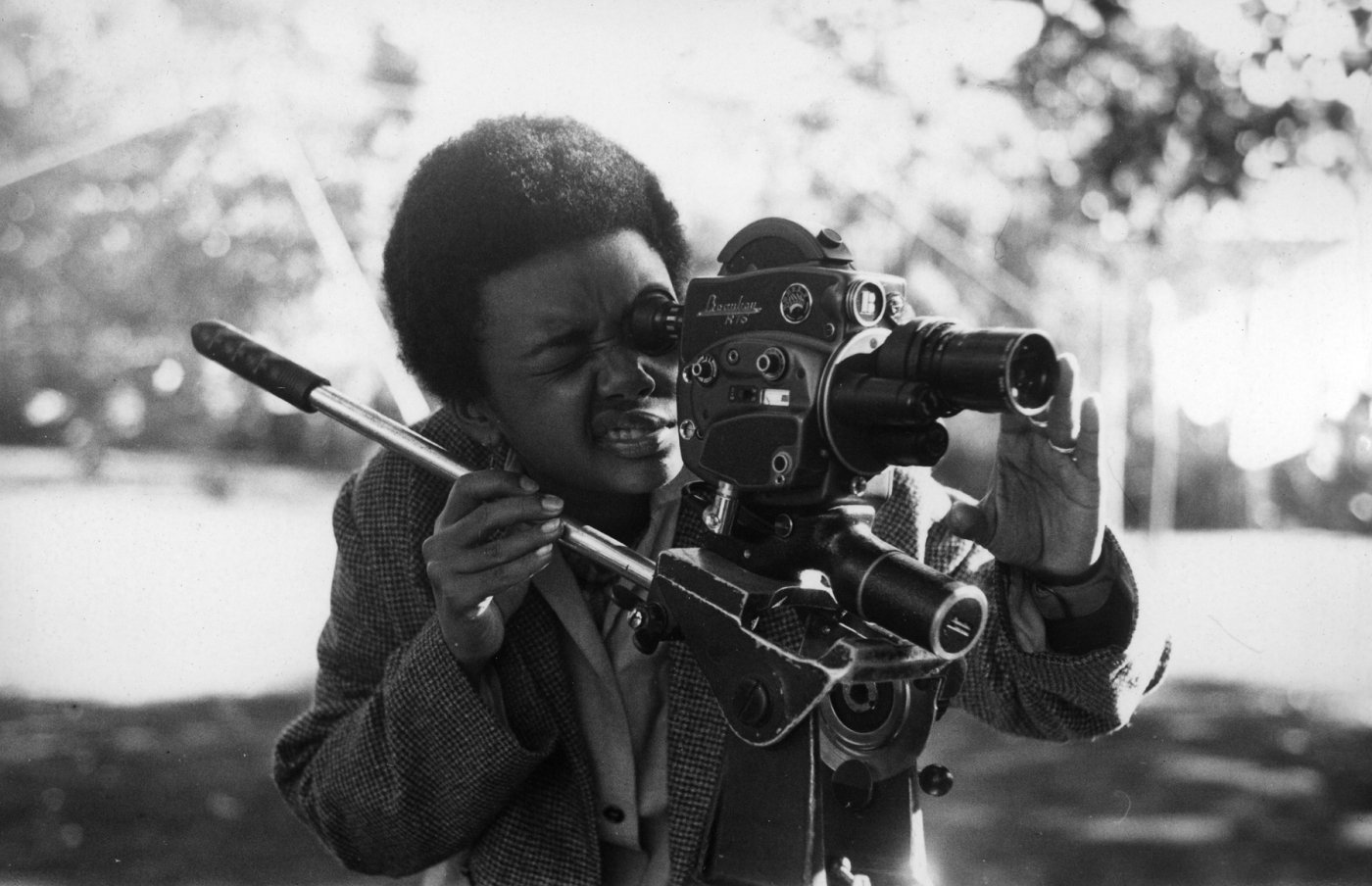
The lead photograph catches Gómez looking through a camera rather than posing beside one. It is an apt image for a filmmaker whose authority came from proximity: she entered institutions, neighborhoods, workplaces, and family history with questions, but she did not pretend that the person asking had disappeared.[8]
The shorts made the question audible
Gómez grew up in Guanabacoa, Havana, and studied music, literature, and Afro-Cuban ethnography. At the Cuban film institute ICAIC she worked with filmmakers including Agnès Varda and Tomás Gutiérrez Alea, then directed roughly twenty short documentaries before making her feature. Those shorts are sometimes treated as an apprenticeship. They are better understood as the workshop in which her mature method became exact: place a voice inside a social claim, keep the encounter audible, and let the answer complicate the terms of the question.[1][2]
In I'll Go to Santiago (1964), a city portrait opens onto the African and Caribbean histories carried in Santiago de Cuba's streets and culture. In Guanabacoa: Chronicle of My Family (1966), Gómez turns closer to home. Relatives, family photographs, memory, and her own voice make Black Cuban history at once intimate and public. Marina Cavalcanti Tedesco's study calls the film a pioneering work of autobiographical nonfiction because Gómez's self-inscription gives her access to a family story while allowing that story to address Black life before and after the revolution.[2][3]
The distinction matters. An invisible interviewer can make testimony look as though it simply arrived, complete and unprompted. Gómez leaves more of the encounter in view. Her great-aunt's recollection of segregated Black social clubs in Guanabacoa does not become a sealed anecdote from the past; Gómez's response turns it into a live question about class aspiration, racial hierarchy, and what revolutionary change has or has not removed. The interview does not certify a thesis. It lets history push back on the filmmaker in real time.[2][3]
Her later documentaries widen that practice. On the Other Island (1968) listens to people in an Isle of Pines reeducation setting, including a Black opera singer describing racism within cultural institutions. Its seven titled interview sections retain clapperboards between encounters and allow Gómez's voice and body into the exchange. Those production traces matter: the testimony appears not as raw truth harvested by an absent camera, but as an agreement between a particular questioner and a particular speaker.[2][7]
My Contribution (1972), about women and work, goes further by making editing itself a counterargument. After Gómez and three professional women discuss gender and labor, a group of working women watches the recorded conversation and answers it. Differences of class, race, occupation, and family position break apart the idea that one panel could produce a single representative “woman's” view. Gómez's cinema is revolutionary without treating revolution as a finished answer. The distance between a collective promise and an individual account becomes material for the film.[2][7]
The feature refuses a clean border
Gómez shot De cierta manera in 1974 with a handheld 16 mm camera, working with amateur and professional performers and extensive documentary material. She died at thirty-one during postproduction; colleagues, including Gutiérrez Alea, completed the film, which entered circulation in 1977. It was the first Cuban feature directed by a woman. The factual frame is important, but the film's form is what keeps that frame from hardening into a commemorative plaque.[1][2][4][5]
At its center are Yolanda, an educated teacher working with children in a newly built Havana neighborhood, and Mario, a bus-factory worker whose attraction to her strains against the masculine codes he shares with his friends. Their relationship gives the film warmth, embarrassment, flirtation, and conflict. It also gives social transformation somewhere difficult to live: inside desire. Mario can support a new collective order and still rely on older ideas of male loyalty. Yolanda can speak with political clarity and still have to negotiate the emotional costs of that clarity.[1][6]
Gómez does not keep this love story inside a protected fictional lane. Documentary accounts of housing and marginalization, workplace discussion, direct address, historical explanation, and the recurring destruction of old slum structures enter the film alongside the couple. The wrecking ball may remove a building faster than anyone can unlearn hierarchy. By cutting material reconstruction against behavior, Gómez turns a familiar political metaphor inside out: new housing is real progress, but concrete cannot by itself remake intimacy, status, or habit.[1][4]
This is where the interview interrupts the fiction in the strongest sense. It does not stop the story; it changes the standard by which the story can be understood. Mario and Yolanda are neither representative case studies nor private lovers floating above politics. Other voices keep redrawing the field around them—coworkers, teachers, parents, neighbors, and people speaking from experiences the protagonists cannot absorb on their behalf. The workers' assembly that opens the film returns near the end, but its verdict generates more debate rather than closure. The feature becomes a chorus without pretending that a chorus always sings in agreement.[1][7]
Listening is an argument, not a retreat
There is a tempting but weak way to praise this method: call Gómez a generous listener and leave it there. Listening in her films is not passive virtue. It is an arrangement of power. Someone chooses whom to ask, what to retain, where an answer enters, and which image follows it. Gómez's achievement is not that she escapes those choices. It is that she makes them answerable to the people and contradictions on-screen.
Her editing repeatedly prevents abstraction from having the last word. "The people," "women," "workers," and "the marginalized" are necessary political categories, yet every interview threatens to split a category into different needs and histories. A Black singer's account of exclusion cannot be dissolved into a general success story. Women's participation in paid work does not make class or domestic power vanish. A factory worker can understand solidarity in one setting and defend machismo in another. These are not gotcha revelations meant to discredit collective change. They are evidence that collective change has to pass through uneven lives.[2][6]
The same principle governs Gómez's use of fiction. Fiction gives contradiction duration. An interviewee may formulate a conflict directly; Mario and Yolanda have to carry one through glances, quarrels, attraction, pride, and revision. Their love story does not soften the politics. It shows why politics becomes hardest at the scale of conduct, where no slogan can substitute for another person's freedom.
That makes De cierta manera distinct from a drama that occasionally borrows documentary authority. Its components do not merge into a smooth hybrid. They retain their edges. A didactic passage can be questioned by the messiness around it. An intimate scene can be opened by a public history. A seemingly factual voice can be marked as constructed. The film's intelligence lives in those seams, because the seams keep viewers alert to who is speaking and what kind of claim an image is making.[1][4]
Even the ending withholds synthesis. Mario and Yolanda continue their argument, but their words drop out beneath music while images of demolition, makeshift housing, and incomplete new construction compete with the couple for attention. The device does not declare communication impossible. It refuses to let their final exchange summarize a transformation that extends far beyond them. The last word belongs neither to romance nor to redevelopment, but to an unfinished relation between the two.[7]
The film's survival carries the same unfinishedness
The material history of De cierta manera adds another layer without supplying a neat ending. Arsenal, which presented the film at Berlin's International Forum of New Cinema in July 1977, records that the negative was damaged during laboratory processing. Its later restoration had to return to the original 16 mm material and the film's complicated chain of versions, prints, and posthumous completion.[4][5]
Restoration cannot tell us exactly how Gómez would have settled every edit. Nor should her death be used to turn the film into a romantic fragment, as though unfinished authorship were its principal beauty. The more useful fact is that the work survived through collective custody while retaining a form committed to collective argument. Its afterlife depends on collaborators and archives, just as its drama depends on the refusal to let one voice impersonate a whole society.
Sara Gómez's career is brief only as chronology. As a method, it is remarkably complete. Start close enough to hear a person rather than a category. Keep the question inside the answer. Let documentary test fiction and fiction test public language. Most of all, do not confuse a revolution's declared destination with the difficult, contradictory movement of people trying to reach it.
Sources
- Harvard Film Archive, "One Way or Another" — program essay on Gómez's background and the film's actors, non-actors, narrators, relationships, and documentary-fiction structure.
- Richard Brody, "The Brief and Brilliant Career of Sara Gómez," The New Yorker, January 31, 2025 — career profile and close discussion of Gómez's short documentaries, interviews, and political form.
- Marina Cavalcanti Tedesco, "Guanabacoa: Crónica de mi familia — o pioneirismo de Sara Gómez no documentário autobiográfico," Imagofagia 23 (2021) — peer-reviewed study of autobiography, self-inscription, family access, and Black Cuban history in the film.
- Arsenal, "De cierta manera / Al ahlam al mumkinna / Ughniyat Touha al hazina" — archive program note on the feature's handheld 16 mm photography, amateur and professional performers, documentary footage, and multiple narrative voices.
- Arsenal, "Workshop report: The restoration of 'De cierta manera'" — premiere, print history, damaged negative, posthumous completion, and restoration provenance.
- Janus Films, "One Way or Another" — official distributor page on the film's romance, documentary footage, community scale, and critique of persistent machismo.
- La Virreina Centre de la Imatge, Sara Gómez: My Contribution exhibition catalogue (2025) — museum study of Gómez's testimony-driven short films, interview structures, editing, and the unresolved oppositions in De cierta manera.
- Wikimedia Commons, "File: Sara Gomez Alta.jpg" — ICAIC archival photograph of Sara Gómez behind a motion-picture camera, used as the article image.