In 1947, Emerson Romero took a problem the movie industry had treated as somebody else's and put it on an editing bench. He acquired prints of sound films, cut into them, and inserted cards carrying dialogue or explanatory text. The action stopped; viewers read; the action resumed. The joins interrupted rhythm, the available prints were poor, and the method could not preserve a useful soundtrack. It was less like the captions now layered over an image than a return of the silent-era intertitle.[1][2][3]
As a mass-market format, Romero's splice was a dead end. As an act of film engineering, it changed the terms of the problem. A Deaf viewer was no longer merely asking a studio to make dialogue accessible. A Deaf former actor was altering the physical commodity, circulating the result through Deaf schools and clubs, and demonstrating that access involved more than putting words on a screen. It required a whole chain: permission to obtain a print, editorial judgment about what sound meant, a reproducible technique, money, and a route to an audience.[2][3][4]
That chain—not a tidy lone-inventor story—is the real beginning of modern movie captioning. Romero's rough cards made one link visible. Laboratories, Deaf educators, community organizers, fundraisers, lawmakers, and projection systems would have to build the rest.
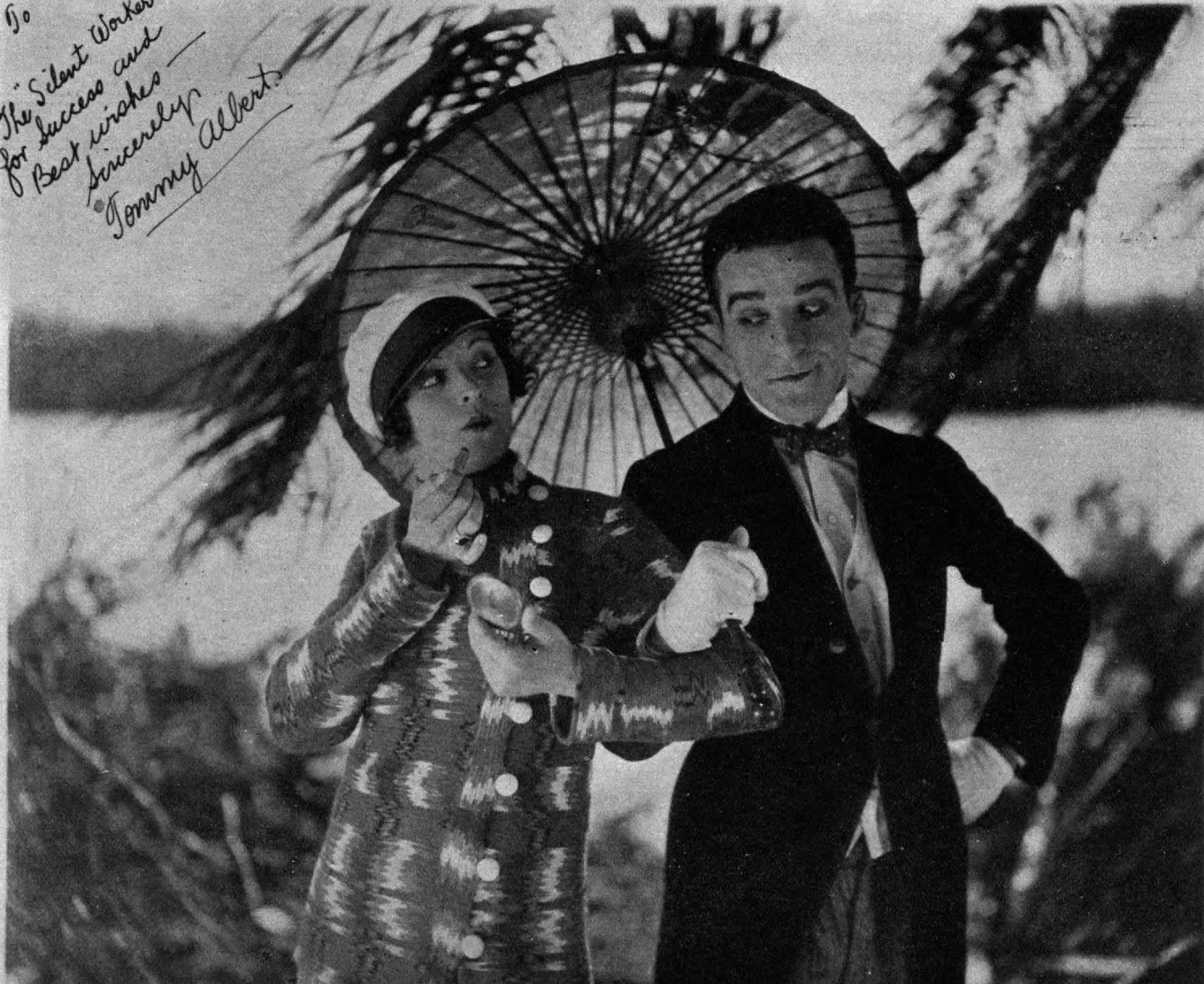
The archival image above catches Romero before that work, performing under the screen name Tommy Albert beside Carmen de Arcos in the 1927 two-reel comedy Great Guns. Its handwritten dedication is addressed to The Silent Worker, the Deaf periodical that published the photograph. Romero was not approaching cinema as an outside technician. He had worked inside its images and production routines—and he belonged to a Deaf film culture that survived Hollywood's technological turn toward sound.[1][4][6][7]
Sound moved the missing cause off the screen
Silent cinema was never a perfectly accessible utopia. Intertitles varied in density, literacy could not be assumed, and much information still lived in performance, musical accompaniment, or exhibition context. But dialogue and exposition routinely appeared as text between shots. Deaf actors including Romero could work within a visual performance system, while Deaf spectators could receive crucial narrative information from the same screen as everyone else.[6]
Synchronized sound redistributed that information. Once spoken dialogue migrated to the soundtrack, an action could remain visible while its cause disappeared. In a recollection from 1947, American School for the Deaf superintendent Edmund Boatner described taking the school's basketball team to The Son of Monte Cristo. Men converse around a table, then leap up and draw swords. The Deaf students could see the fight but not the exchange that motivated it. Nothing was wrong with the projection. The exclusion was functioning exactly as the film had been designed.[2][3]
That example explains why captions are not an ornamental transcript. They preserve causality, tone, identity, and off-screen information that editing may assign to sound. The talkie did not become less visual when it acquired a soundtrack; it made part of its visual logic dependent on hearing.
Romero knew both sides of that transition. Gallaudet University's biographical index records that the Havana-born actor, deaf since childhood, appeared as Tommy Albert in silent films from 1926 to 1928. When he returned to film access in 1947, he reached for a tool whose grammar he already understood: the title card.[4] His intervention was technologically old and socially new.
The splice was a retrofit, not a caption track
Romero did not print letters over moving pictures. He placed blocks of text between sections of action, reproducing the silent era's “stop and read” pattern. Each card therefore cost screen time. Every added explanation changed pacing, and each physical cut made the adapted print a distinct object rather than a switchable version of an unchanged film.[1][3]
The work began before the blade. Romero favored films with enough action to remain entertaining and as little dialogue as possible, reducing the number of interruptions he would have to make. His wife, Emma C. Romero, who was also Deaf, helped translate dialogue for viewers who did not use English fluently. Preparing one film could demand at least a week of eight-hour days: select and condense speech, make the cards, photograph them, then find a place for each block in the reel. Accessibility here was writing, translation, timing, photography, and film splicing compressed into a home-scale workflow.[1]
The constraints went beyond aesthetics. Boatner's historical account says Romero was then employed by an aircraft manufacturer on Long Island and did the film work in his spare time. Producers, worried that usable prints could be bootlegged, supplied only poor ones. Romero had to procure, prepare, circulate, and maintain his small collection without adequate financing. His films traveled among Deaf schools and clubs, but the method had no practical route to enough titles or enough copies.[3]
Calling that a failure is accurate only if the test is seamless reproduction at scale. Magdalena Zdrodowska's study of Romero offers a more revealing frame: an obsolete medium can acquire a new use and value when it is carried into a changed technological environment. The inserted card did not solve sound cinema elegantly. It turned silent cinema's discarded device into evidence that Deaf audiences could redesign the conditions under which movies were watched.[1]
There is also a productive contradiction in the damaged soundtrack. The cards made the audio unnecessary for many intended readers, yet the loss made the prints far less useful to hard-of-hearing and hearing viewers, mixed audiences, and ordinary exhibitors. The dominant copy was treated as universal; the accessible copy became a specialized alteration. That division would haunt later caption systems. Should words remain permanently visible to everyone, or should viewers need special equipment to call them up? Who pays for the extra version? Which copy enters the main distribution circuit?[1]
Romero could not answer those questions with a splicer. He made them impossible to ignore.
Putting text on the picture solved one problem and exposed three more
The experiments that followed are easiest to understand as a series of tradeoffs. Around 1949, British producer J. Arthur Rank tried projecting caption text from glass slides onto a small second screen. The film print stayed intact, but a skilled operator had to synchronize two projections and Deaf viewers had to look away from the main image to read. At the Lexington School for the Deaf in New York, a similar experiment confirmed the weakness of splitting attention between screens.[2][3]
A Belgian process changed the equation by etching captions directly onto a finished print, then making a negative from which more captioned copies could be struck. The text could remain with the action, and duplication no longer meant cutting every release print by hand. Titra Film Laboratories obtained the United States franchise for that process.[3]
The laboratory method was a genuine technical advance, but it immediately exposed the next three constraints: rights, scripts, and capital. Someone still had to acquire films legally. Someone had to decide what words should appear, how long they should remain, and how speech and significant sound should be identified. Someone had to pay a lab to produce copies. Captions had moved onto the image; access had not yet moved into the industry.
That is why the work of Deaf vocational teacher J. Pierre Rakow and school superintendents Edmund Boatner and Clarence O'Connor matters as much as the etching process. Boatner and O'Connor organized Captioned Films for the Deaf in Hartford, while Rakow helped persuade a commercial laboratory to take on its films. The Junior League of Hartford supplied early grants, volunteers transcribed scripts, and the nonprofit assembled a circulating collection. By the time the private organization gave its library to the federal government, it held twenty-nine captioned films.[2][3]
No single element was sufficient. A beautiful captioned master without circulation was a demonstration. A loan network without film rights was an empty catalog. A transcription without timing and image placement was a document, not a movie. Captioning became viable when editorial labor, photochemical reproduction, licensing, and distribution were treated as one system.
The decisive invention was a public loan service
On September 2, 1958, Public Law 85-905 authorized the U.S. Department of Health, Education, and Welfare to establish a nonprofit loan service of captioned films. Its operational language is strikingly concrete. The department could acquire films or rights, pay for captioning, distribute prints through schools and regional centers, and use other government facilities. Congress authorized up to $250,000 annually.[5]
The law did not declare a new artistic principle. It built logistics. In 1959, the federal program began with a $78,000 appropriation and the twenty-nine-film collection donated by the Hartford nonprofit. Later amendments widened its educational and technical scope, but the foundational move was already clear: if the commercial market would not serve a dispersed audience, public infrastructure would connect captioned copies to groups of viewers.[2]
This was the part Romero's workshop could never fabricate. His cards proved that a sound film could be made legible again. A durable program had to make access repeatable across titles and geography. It needed a catalog, rights administration, standards, laboratories, shipping, local exhibitors, and continuing funds. The technology of captioning was also the technology of getting the right print to the right room.
The distinction still matters in digital cinema. Timed text may now travel as a separate file or data stream rather than as ink, etching, or a spliced card. That makes captions optional and preserves the underlying picture, but it does not make delivery automatic. A caption can exist at the studio and disappear at the player, the festival, the streaming platform, or the screening venue. Romero's history warns against confusing a technically possible layer with an audience's actual access.
The rough cut remains the sharp lesson
It would be easy to turn Romero into the inventor of today's caption format. He was not. His films paused rather than overlaid the action; they did not scale; and more practical open-caption processes came from other people and institutions. Giving him sole credit would flatten the very history that makes his work important.[1][2][3]
His achievement was different. He treated exclusion as a production problem that users could act on. He cut a finished film, accepted an inelegant seam, and built a small circulation route through a community Hollywood had ceased to imagine as part of its audience. The retrofit did not conceal its compromise. Every interruption announced that the original print had left someone out.
The Great Guns photograph holds that argument in miniature. Romero stands inside a movie image; the dedication and magazine reproduction place that image inside Deaf public life. Twenty years later, he would cut text back into sound films so that Deaf audiences could follow them again. What began as a rough splice became a demand on laboratories, distributors, and eventually the state.
Captions did not advance because words found a better place on the frame. They advanced because Deaf viewers, makers, teachers, and organizers kept widening the system around those words. Romero's reel was not the final technology. It was the cut that revealed how much of the industry had to change.
Sources
- Magdalena Zdrodowska, “Emerson Romero's Film Title Cards—an Attempt to Restore Cinema to Deaf Viewers,” Quarterly Journal of the History of Science and Technology 66, no. 3 (2021), via the Jagiellonian University Repository—peer-reviewed analysis of Romero's intertitle method as an obsolete technology given new social use.
- Malcolm J. Norwood, “Captioning for Deaf People: An Historical Overview,” Gallaudet Research Institute conference proceedings (1988), hosted by the Described and Captioned Media Program—Romero's splice, the Hartford nonprofit, federal program, and later captioning infrastructure.
- Edmund Burke Boatner, Captioned Films for the Deaf (1980), Described and Captioned Media Program—first-person institutional history covering Romero's prints, competing projection methods, the Belgian etching process, laboratories, financing, and distribution.
- Gallaudet University Library, “Romero, Emerson ‘Em’,” Guide to Deaf Biographies and Index to Deaf Periodicals—biographical record of Romero's silent-film work and caption-frame experiments.
- Described and Captioned Media Program, “Public Law 85-905”—the September 2, 1958 statutory text establishing a federal captioned-film loan service and its acquisition, captioning, and distribution authority.
- PBS American Masters, “How the portrayal of Deaf people in film has evolved over time” (2025)—context on Romero, Deaf performers, and the access lost in cinema's transition from silent film to sound.
- Wikimedia Commons, “File: Great Guns.png”—archival still of Carmen de Arcos and Emerson Romero in Great Guns, sourced to page 162 of the March 1927 issue of The Silent Worker.