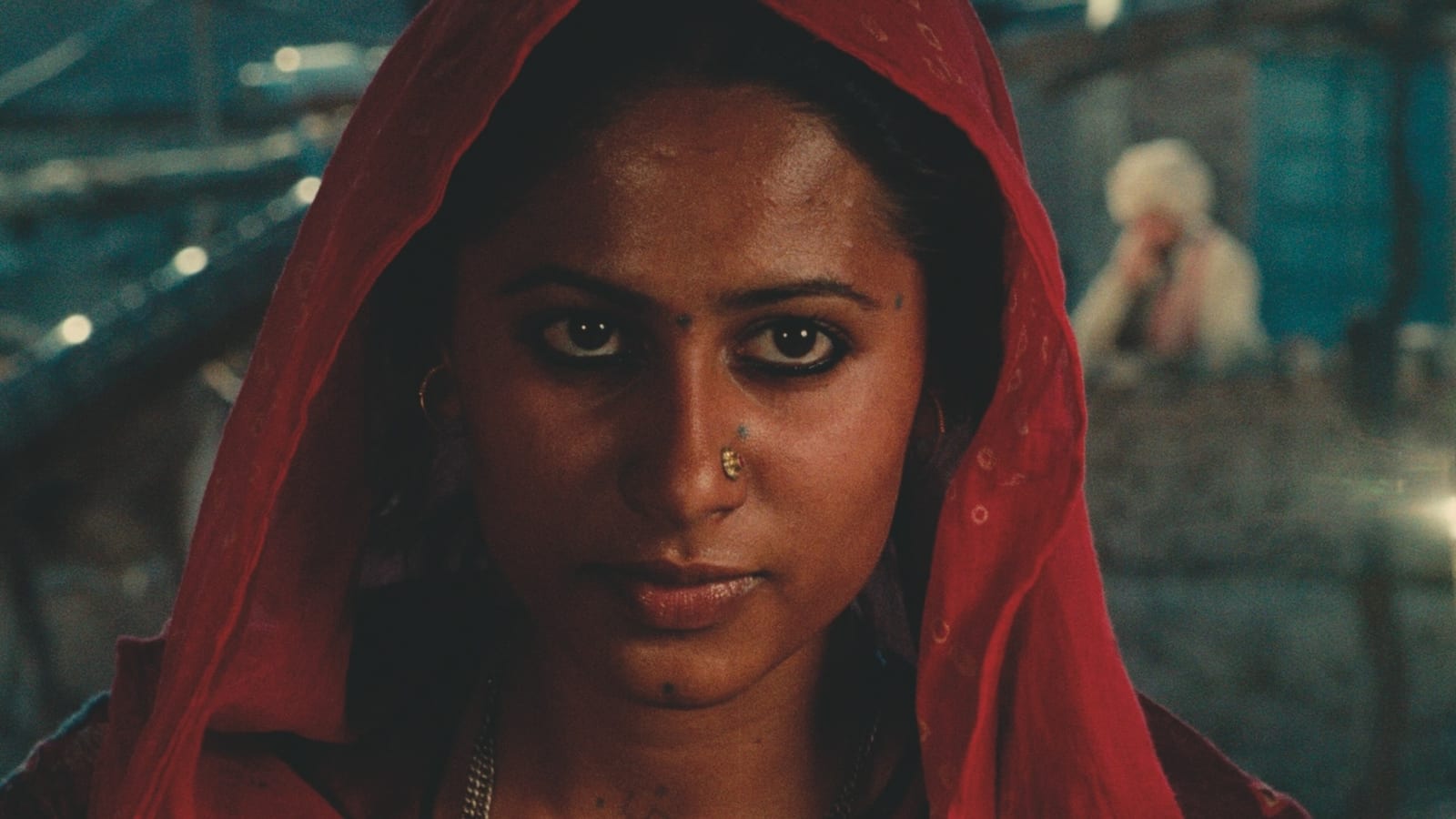
“Parallel cinema” can sound like a description of what appears on screen: sober acting, rural locations, political themes, fewer songs, a camera allergic to spectacle. That shorthand turns a history of argument into an aesthetic preset. Indian Parallel Cinema did not acquire its force because hundreds of filmmakers agreed on how a serious movie should look. It acquired force because a loose infrastructure—film societies, classrooms, public loans, regional production cultures, festivals, cooperatives, and stubborn viewers—made room for films that disagreed with commercial convention and with one another.
The distinction matters when looking at the close-up above. Smita Patil's Bindu in Shyam Benegal's Manthan (1976) belongs to the social-realist side of the movement, but she cannot stand in for its entire visual world. Parallel Cinema also contained Mrinal Sen's satirical collisions, Mani Kaul's fractured duration, Ritwik Ghatak's wounded melodrama, G. Aravindan's quiet observation, and experiments that moved between fiction, documentary, music, painting, and regional performance. BFI's history places the movement's acceleration in the late 1960s, when film-society culture, Film Finance Corporation risk-taking, and a manifesto for a new cinema converged; over the following decades, that opening produced more than 200 films across India.[1]
The useful question, then, is not “What did a Parallel Cinema film look like?” It is “What had to exist so these incompatible films could be made, seen, and argued over?”
A parallel is a route, not a look
The label first risks inventing a single “mainstream” for a country with several large language-based industries. A Hindi social drama made outside Bombay convention, a Bengali modernist film shaped by Partition, and a Malayalam work drawing on local theatre did not begin from the same center or travel toward the same margin. “Parallel” is most accurate when it names a second route through production and circulation, not one rail carrying a uniform cargo.
The Asian Film Archive's 2024 program Parallels: Indian New Cinema (1965–1981) makes that plurality visible through programming rather than definition. Its selection placed Ghatak's Bengali Subarnarekha beside Sen's playful Hindi Bhuvan Shome, Kaul's painterly Duvidha, Aravindan's Malayalam Thamp, John Abraham's Tamil satire Agraharathil Kazhuthai, and Aparna Sen's English-language 36 Chowringhee Lane. Social realism is present, but so are metaphysical romance, bitter comedy, episodic observation, and post-Partition melodrama.[4] The shared achievement is not a texture. It is the right to pursue a form that its subject demands.
Satyajit Ray and Ghatak had already demonstrated in the 1950s that Indian films made beyond dominant studio formulas could join an international conversation without ceasing to be locally exact. They are essential precursors, but the late-1960s shift was institutional as well as artistic. What changed was the density of connections among people who wanted another cinema and the appearance of mechanisms that could occasionally pay for it.[1]
In 1969, three doors opened in different directions
Curators at Il Cinema Ritrovato trace a theoretical marker to a 1968 New Cinema Movement manifesto by filmmakers Arun Kaul and Mrinal Sen. The following year is commonly treated as a hinge because the Film Finance Corporation backed Bhuvan Shome, Mani Kaul's Uski Roti, and Basu Chatterjee's Sara Akash.[2] Grouping the films is historically useful. Watching them as a matched set is impossible.
Sen makes bureaucracy comic and unstable. Bhuvan Shome interrupts its story with freeze frames, abrupt edits, graphic play, and an impudent voice-over; a low-budget rural excursion behaves like a movie discovering new punctuation as it goes. Uski Roti moves the other way. Kaul stretches waiting, separates gesture from conventional dramatic payoff, and turns a roadside landscape into a field of duration. Chatterjee's Sara Akash presses marital disappointment and generational authority into a crowded urban household. One film teases narrative open, another pares it down, and a third redirects accessible realism toward domestic suffocation.[1][2]
The significant common fact sits behind the camera: public finance absorbed risks that commercial producers were unlikely to accept. A state loan did not dictate a state style. It temporarily allowed three incompatible ideas of cinematic value to enter production. A contemporary India Today account from 1976 credited the Film Finance Corporation with setting the parallel movement in motion through Bhuvan Shome, while also describing the variety of work that followed through both corporate and independent financing.[5] Even in the movement's own decade, its origin story was being negotiated.
The counter-cinema learned inside an old studio
Money alone could not create a working culture. Filmmakers also needed time with cameras, editing tables, teachers, prints, and one another. The Film Institute of India—later the Film and Television Institute of India—was established by the government in 1960 on the former Prabhat Studios campus in Pune. Prabhat had moved there in 1933, and its old production buildings remained in use by students.[3] The physical overlap is almost too neat: a generation associated with breaking studio convention trained on the floor of an earlier studio system.
FTII did not manufacture a doctrine. It made sustained formal debate practical. Graduates such as Mani Kaul and Kumar Shahani could treat editing, sound, performance, and pictorial composition as choices with histories, not merely as cheaper substitutes for commercial polish. Cinematographer K. K. Mahajan, another central collaborator in the new cinema, could move from Sen's comic discontinuities to other directors' very different demands. The school supplied a meeting place and a technical language; disagreement supplied the films.[1][2]
That combination corrects another lazy opposition. Parallel Cinema was neither industrial filmmaking's pure outside nor an amateur rebellion against craft. It was partly enabled by public institutions, housed in inherited production spaces, and made by rigorously trained workers. Its radicalism often lay in redirecting professional means toward lives, rhythms, languages, and formal questions that established markets undervalued.
Public support created an opening, not a complete circuit
The Film Finance Corporation solved one problem at a time: it could help a project reach a set. It could not guarantee that the finished film would find screens, publicity, or a durable audience. BFI notes that Sen and Arun Kaul argued for an alternative distribution-and-exhibition system as well as alternative production.[1] Their concern identifies the movement's structural weakness. A second cinema cannot remain parallel for long if it must rejoin the same bottleneck at release.
Film societies and festivals helped by creating spectatorship before a stable art-house circuit existed. They placed Indian work beside Italian neorealism, the French New Wave, and other modern cinemas, then returned those comparisons to local arguments. But a festival success, a loan repayment, and broad public access were different achievements. Some films traveled internationally while remaining difficult to see at home; others found regional audiences without entering a global canon.
The later idea of “middle cinema,” often applied to directors such as Benegal, exposed the tension. Was a legible narrative that reached ordinary theaters a compromise with the mainstream, or a solution to Parallel Cinema's circulation problem? The question is more revealing than a verdict. Benegal's work could use stars, strong dramatic arcs, and recognizable genres without abandoning conflicts around caste, labor, gender, and political power. Accessibility was not automatically surrender. It could be another formal and logistical experiment.[1]
Manthan put its audience in the opening credits
No film makes the infrastructure argument more tangible than Manthan. The film dramatizes the formation of a village dairy cooperative and the conflicts it activates across caste, class, gender, and local economic power. Its financing echoed its subject: 500,000 farmers contributed two rupees each toward the production. Benegal later recalled that the film's largest audience was also its body of producers; after the Gujarat release, 16 mm prints traveled with teams using screenings to discuss cooperative organizing elsewhere.[6]
This was not the standard Parallel Cinema funding model, which is precisely why it clarifies the larger movement. A production could assemble its public before the first ticket was sold. Finance, subject, audience, and circulation became parts of the same design. The farmers were not an abstract demographic waiting to be reached by an enlightened film. Their pooled contribution materially enabled it, and their presence at screenings completed the route.
The arrangement did not make the film politically frictionless. Manthan is attentive to suspicion within reform: an urban professional arrives with a plan, village elites defend existing power, Dalit farmers have reason to distrust benevolent authority, and Bindu's choices are constrained by men who claim competing versions of progress. Patil's close-up belongs here. Her face does not decorate an essay about institutions; it reminds us that infrastructure matters because it changes whose ambivalence can occupy the center of a movie.
Preservation is the last production stage
The same story continued long after release. Film Heritage Foundation's 4K restoration used the original camera negative preserved at the NFDC–National Film Archive of India and a 35 mm release print held by the foundation. The sound negative had deteriorated, so sound was digitized from the surviving print; restoration joined conservators and laboratories in Mumbai, Chennai, and Bologna with Benegal and cinematographer Govind Nihalani. After a Cannes Classics premiere, the restored film returned to 101 cinemas in 51 Indian cities in June 2024.[6]
That chain is not an afterthought to the movement. A parallel route disappears if prints decay, rights become opaque, subtitles vanish, or programming reduces a many-sided history to three internationally familiar directors. Archives and retrospectives produce the movement again for each generation, recovering regional connections that first-run distribution often failed to sustain. The Asian Film Archive program, supported by India's national film institutions, did exactly that by placing several languages, regions, and methods in one temporary conversation.[4]
Indian Parallel Cinema therefore survives best as a history of enabling conditions, not a shelf labeled “serious films.” Film societies cultivated attention. A school made technique debatable. Public loans moved unlikely scripts toward cameras. Regional traditions kept the category from hardening around Hindi cinema. Farmers briefly fused production and audience. Archives reopened the route decades later.
The films did not need those systems so they could agree. They needed them so disagreement could become visible—in satire and silence, melodrama and documentary, accessible narrative and formal refusal. The most important parallel line was never a look. It was the possibility of another way through.
Sources
- Omar Ahmed, “Indian Parallel Cinema: 5 essential filmmakers from a seismic Indian cinema revolution,” BFI, September 18, 2024 — movement origins, film societies, Film Finance Corporation support, distribution debates, major filmmakers, and source of the Manthan still.
- Il Cinema Ritrovato, “Rebellious Poets and Radical Spirits: Indian Parallel Cinema” (2021) — the 1968 manifesto, the 1969 Film Finance Corporation triptych, FTII connections, and the movement's contested definition.
- Film and Television Institute of India, “About Us” — official institutional history of FTII's 1960 founding on the former Prabhat Studios campus in Pune.
- Asian Film Archive, “Parallels: Indian New Cinema (1965–1981)” (2024) — a cross-regional program demonstrating the movement's linguistic, thematic, and formal range.
- “A Case for the Parallel Cinema,” India Today, April 15, 1976 — a contemporaneous account of Film Finance Corporation support, Bhuvan Shome, and the movement's early production landscape.
- Film Heritage Foundation, “Film Heritage Foundation restores Shyam Benegal's Manthan” (2024) — cooperative financing, traveling 16 mm exhibition, cast and production context, restoration elements, and 2024 theatrical rerelease.