Rejection takes time in Roy Andersson's films. In A Pigeon Sat on a Branch Reflecting on Existence (2014), two novelty salesmen fail to interest a retailer in their wares, then have to pack everything away. The camera stays with the awkward retreat. As Film Quarterly observes, the scene gives unusual attention to what remains after the conversation has effectively ended.[1]
That lingering is a useful introduction to the Swedish director. An unsuccessful pitch has a practical aftermath: objects must be gathered, bodies must find the door, dignity must somehow accompany them. The joke does not release the people who have supplied it. Andersson leaves them in a room that we must continue to look at.
A career rebuilt around the image
Born in Gothenburg in 1943, Andersson trained at the Swedish Film Institute's film school. His first feature, A Swedish Love Story (1970), was followed by Giliap (1975). Then came a long interval in which advertising became central to his work. The official Studio 24 biography records his return to features with Songs from the Second Floor in 2000, followed by You, the Living in 2007 and Pigeon, which won Venice's Golden Lion in 2014.[2]
The change was artistic as well as professional. In a 2009 interview with Ignatiy Vishnevetsky, Andersson explained that the naturalism of his first feature had begun to feel exhausted to him. He wanted greater simplification and abstraction. Commercial clients, he recalled, accepted a style he proposed; they did not simply dictate it.[3]
Advertising thus belongs inside the account of his authorship. Brief commissions offered occasions to make an image communicate quickly, while a longer film could let that image become uncomfortable through duration. The apparent contradiction—a director of consumer advertising making films about human vulnerability—was part of the working life from which this cinema emerged.
Studio 24, established in Stockholm in 1981, gave that life an institutional home. Its activities extended across features, shorts, commercials, books and exhibitions.[2] Such a base helps explain why these films feel like sustained investigations: a recognizable way of looking could develop across different kinds of work.
What a room knows
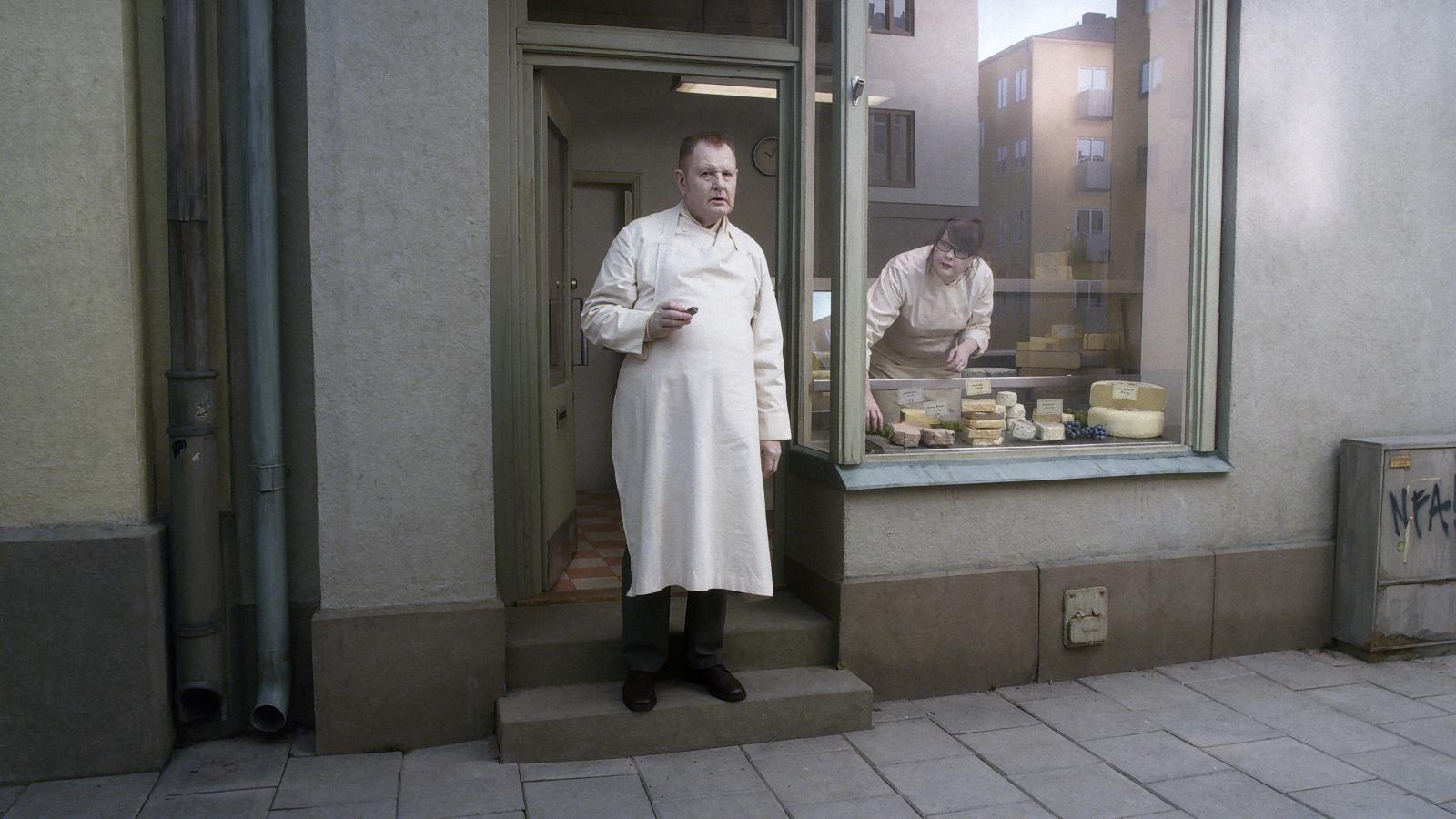
The later films' pale faces and carefully arranged interiors are immediately recognizable. The BFI's Nadin Mai describes their fixed camera and painstakingly constructed studio settings.[4] Their stillness makes even a small adjustment of posture conspicuous. Looking away, waiting or standing too close to someone can become an event.
Andersson gave a more personal reason for keeping his distance. Speaking to Vishnevetsky, he argued that a wide shot can disclose a person's life through the room around them, including a room that is not their own. He also described his preference for illumination that leaves people nowhere to hide.[3]
The room becomes evidence. A face can ask for sympathy; the surrounding space lets us examine the conditions under which that request is made. Who has a chair? Who must stand? How far is the exit? These are questions his compositions invite, even before we know much about the people in them.
Distance therefore has an emotional double effect. It can make a figure look small and ridiculous, while revealing how much that figure must contend with. Our attention can move around the frame, but the person cannot escape the situation so easily. The image gives the spectator freedom and makes that freedom faintly embarrassing.
Precision without a finished answer
This apparent simplicity takes work. Film Quarterly describes repeated rehearsals, dialogue adjusted to the performers and many takes. It also notes that Andersson can begin with a partially completed script, allowing ideas to develop during production.[1]
Those practices are compatible. He can remain uncertain about what the film will discover while being exact about how a particular encounter appears. A pause must last long enough to become uncomfortable; an exit must take the time the body needs. Precision gives the uncertainty a shape that other people can see.
There is a risk in such control. Pale faces and subdued rooms can make different lives seem interchangeable, as though everyone has already been assigned the same diagnosis. The films are most affecting when a particular obligation resists that generalization: finishing an unwanted demonstration, carrying out a small task, staying beside another person. The predicament becomes specific again.
History walks into the bar
Andersson's abstraction also permits collisions that a strictly naturalistic film would need to explain. In his published comments for About Endlessness, he recalls bringing the eighteenth-century Swedish king Charles XII into a contemporary bar in Pigeon. The army passes through this ordinary setting on its way to war and returns defeated.[5]
The shared space matters more than the surprise. Historical power has acquired nearby customers, furniture and bodily inconveniences. The people of the present occupy the same image as an imperial adventure; history has lost its protective distance. That is my reading of the encounter, rather than a claim that its absurdity supplies a complete historical argument.
In About Endlessness (2019), another change arrives through a woman's narration. Andersson told James Mottram that the voiceover drew inspiration from Hiroshima mon amour, and described the individual scenes as small stories that collectively expand the film's view of existence.[6] The voice supplies a witness who can move between lives without making one protagonist their measure.
The film also allows room for a father tying his daughter's shoelaces in the rain, an incident included in the studio's synopsis.[5] The task is modest, but someone has to stop and do it. After so much exposed foolishness, care remains visible at the same unheroic scale.
Andersson told Mottram that humor helps people survive.[6] His cinema gives that belief an awkward physical form. We laugh, then remain with the person after the laugh. The room is still there. So are the witnesses.
Sources
- Film Quarterly, “The ‘Trivialist Cinema’ of Roy Andersson: An Interview,” 24 September 2015 — the salesmen's retreat, rehearsals and the evolving script.
- Roy Andersson Film Production, “Studio 24” — official director biography, studio history and feature-film chronology.
- Ignatiy Vishnevetsky, “Figurative and Abstract: An Interview with Roy Andersson.” MUBI Notebook, 9 August 2009 — Andersson on advertising, abstraction, lighting and the expressive role of a room.
- Nadin Mai, “Where to begin with Roy Andersson.” BFI, 2 November 2020 — studio staging, visual style and the Studio 24 still reproduced here.
- Roy Andersson Film Production, “About Endlessness” — official synopsis and director's comments, including the historical encounter in Pigeon.
- James Mottram, “‘In my pictures you can't hide’: Roy Andersson on humour and truth.” Sight and Sound, 3 November 2020 — interview on narration, individual scenes and humor.