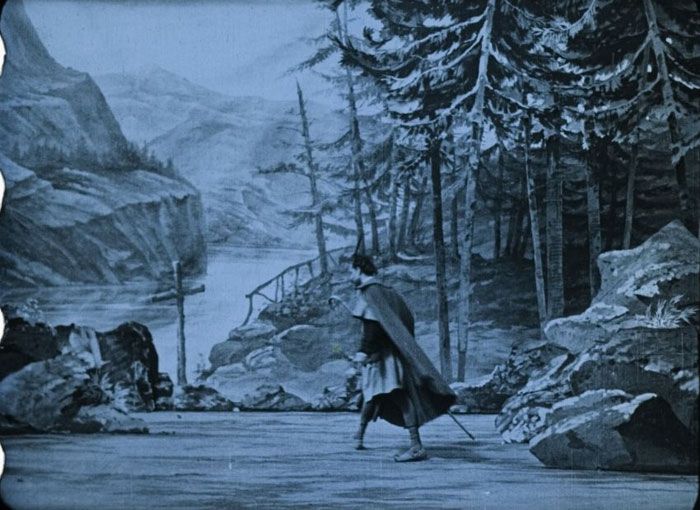
The night in the image above is made partly in the laboratory. The National Film and Sound Archive of Australia identifies this frame from Pathé's Guillaume Tell (1903) as a blue-tinted night scene.[1] The color belongs to the film's historical presentation. It changes how we read the photographed world before anybody moves.
Recovering that experience poses a peculiar problem. A restorer may have a sharp photographic image and unreliable color, or a damaged print whose color is precious evidence. Desmetcolor offers a way to handle those elements separately. Developed by Noël Desmet at Belgium's Royal Film Archive, it uses a black-and-white duplicate and controlled exposures onto color print stock to simulate tinting and toning.[1] Its ingenuity lies in making color adjustable without requiring the whole image to be copied directly in color.
Where the color lives
Two processes that look similar on a small screen do different things to film. Tinting colors the strip overall, including its transparent areas. Toning changes the material forming the photographic image, coloring its darker areas while leaving clear areas uncolored. Stencilling applies color locally, allowing several colors to occupy distinct objects within one frame.[2]
Eye Filmmuseum illustrates all three through Alfred Machin's De molens die juichen en weenen (1912). That variety matters: “restore the color” can describe several different jobs even within a single film.[2] A wash across the image cannot reproduce every arrangement of colored shadows, luminous backgrounds and individually colored details.
It also changes the questions we bring to a restoration. Where does the color sit? Does it fill the light, inhabit the shadows, or follow an object? Those are questions about the construction of the image, as useful as asking whether a particular blue looks attractive.
Printing with light
For a simulated tint, the Desmet approach can establish a neutral image on color stock and add color through a separate exposure, called flashing. The printer controls the exposure through its red, green and blue settings. Toned effects use the photographic image to shape the color exposure.[6]
Think of the black-and-white duplicate as preserving the picture's pattern of light and dark. The color-printing stages then determine how that pattern will appear. This separation gives the laboratory room to work on the relationship between detail and hue; it does not give the operator historical permission to choose any hue.
The distinction becomes concrete in Il processo Clemenceau, Alfredo de Antoni's 1917 feature starring Francesca Bertini. According to the Institut Valencià de Cultura's restoration record, two nitrate copies were identified in 1991, one in its Filmoteca and another in Zaragoza. Both had serious physical and color deterioration. Working with the Cineteca di Bologna at L'Immagine Ritrovata, the restoration team used Desmetcolor to reconstruct a film that had employed fourteen colors.[3]
That is a different assignment from giving an old film a generally antique appearance. Fourteen colors require decisions about individual passages. The film's restoration also involved reconstructing intertitles: color recovery belonged to a larger effort to make surviving fragments and damaged materials function as a film again.[3]
A convincing match to what?
The difficult decision comes before the printer setting. Paul Read's account of restoration practice distinguishes copying a faded print's present appearance from attempting to recover the appearance of its original dye. Direct color duplication can faithfully carry fading into the new copy. Desmetcolor allows adjustment, but the target still has to be established.[4]
A laboratory experiment at the NFSA makes the uncertainty unusually tangible. For Leonard Corrick's The Bashful Mr Brown (1907), only one frame of the original orange-tinted opening title survived. Technicians extended that frame into a readable title sequence and tested dyes against it. Their report acknowledges that a close match could reproduce a faded color rather than the color audiences originally saw.[5]
The same experiment also exposed the distance between matching and preserving. Liquid food dyes could approach the surviving orange, yet washed out readily; earlier copies made with them had deteriorated. A tested powdered dye behaved more consistently, but its red was wrong for that particular title.[5] The material that handles well and the material that looks right need not be the same.
These accounts suggest why a restoration credit deserves close reading. “Color restored” names a result, while leaving open the evidence, reference material and compromises behind it. A beautiful print can be carefully argued; beauty alone cannot supply the argument.
The limits remain visible
Read describes another boundary: modern color print stocks cannot necessarily reach the saturation of every historical dye. Some reds and possibly some greens exceed what their subtractive color system can reproduce. He also notes that fading in toned material can destroy image detail itself. A new color cannot restore detail already lost from the source.[4]
Nor should every color be forced into a fixed emotional dictionary. Eye's account of a 1995 conference records an inconclusive verdict on universal color meanings: early coloring could support narrative, suggest natural appearances or provide visual pleasure.[2]
Desmetcolor's achievement is therefore best understood as a practical freedom within limits. It gives restorers control over how a surviving image meets color again. The evidence must still guide that meeting. For viewers, the reward is immediate: a night scene can recover its blue, while the restoration record tells us how confidently we should see that blue as part of the past.
Sources
- Steve Clark, Trevor Carter and Bruce Cowell, edited by Pam Carter, “Dying light – Part 1: Restoring tinted films,” National Film and Sound Archive of Australia, October 25, 2012 — Desmet's printing method and the archival Guillaume Tell image.
- Eye Filmmuseum, “The use of colour in early Dutch film” — tinting, toning, stencilling, Alfred Machin's 1912 film and the debate over color meanings.
- Institut Valencià de Cultura, “Il processo Clemenceau (El proceso Clemenceau)” — film credits, rediscovered nitrate copies and the Desmetcolor restoration undertaken with Bologna.
- Paul Read, “Original Tinting and Toning Techniques and Their Adaptation for the Restoration of Archive Film,” hosted by film-restoration specialist Brian Pritchard — sections 2.1, 2.2 and 2.12.7 on restoration targets, fading and color limits.
- Steve Clark, Trevor Carter and Bruce Cowell, edited by Pam Carter, “Dying light – Part 2: tinted film projects,” National Film and Sound Archive of Australia, October 26, 2012 — The Bashful Mr Brown title reconstruction and dye experiments.
- Noël Desmet and Paul Read, “The Desmetcolor Method for Restoring Tinted and Toned Films,” June 1996 — sections 5–6 explain the duplicate negative, printer settings and separate exposures for tints and tones.