Discusses early and middle scenes, including the characters' bereavements, without revealing the ending.
Joe keeps finding solutions to a problem Fin has not asked him to solve. An invitation to the bar meets a refusal. Joe offers to bring beer over instead; another refusal follows. When Fin mentions a walk, Joe offers to accompany him. Fin must clarify that walking alone is a preference. Each answer closes a door; Joe searches for another entrance. The exchange, excerpted in Tom McCarthy's 2011 Fresh Air interview, makes an invitation feel briefly like a negotiation over access.[2]
That negotiation gives The Station Agent its shape. McCarthy's 2003 debut follows Fin McBride, played by Peter Dinklage, into an inherited, disused railway depot. There he encounters Bobby Cannavale's talkative Joe and Patricia Clarkson's troubled painter Olivia.[1] A home chosen for withdrawal becomes a place other people keep approaching. The question is how much room they can occupy without crowding out its inhabitant.
Let a refusal remain a refusal
The opening exchange works because Fin's short answers remain intelligible. He gives Joe enough information to understand him. Joe's eagerness keeps converting that information into a fresh proposal. Cannavale supplies the momentum; Dinklage supplies the stopping points. When Joe finally accepts the refusal, the possibility of another meeting survives.[2]
There is a useful discomfort inside the comedy. We can enjoy Joe's persistence while recognizing the effort it costs Fin to be understood. The scene gives sociability two different tempos. A friendship between these men will have to accommodate both.
The depot gives everyone somewhere to return
The building preceded the story. In an interview originally published by SAGindie in January 2004, McCarthy recalled finding the depot near his brother's home and meeting its owner, a railway enthusiast who introduced him to that community. He also described the dramatic problem he set himself: two central characters wanted to be left alone, so he needed a third who would bring them into contact.[4]
Those two decisions fit together. A fixed place makes repeated encounters plausible; Joe gives those encounters their restless energy. The depot can remain Fin's address even as its social meaning changes. Nobody needs to organize a grand occasion for another meeting to happen.
This is part of the film's economy. The location holds the characters within reach, while their different appetites for company keep the situation unsettled. Familiarity can accumulate before anyone knows what to call the relationship.
A group with space inside it
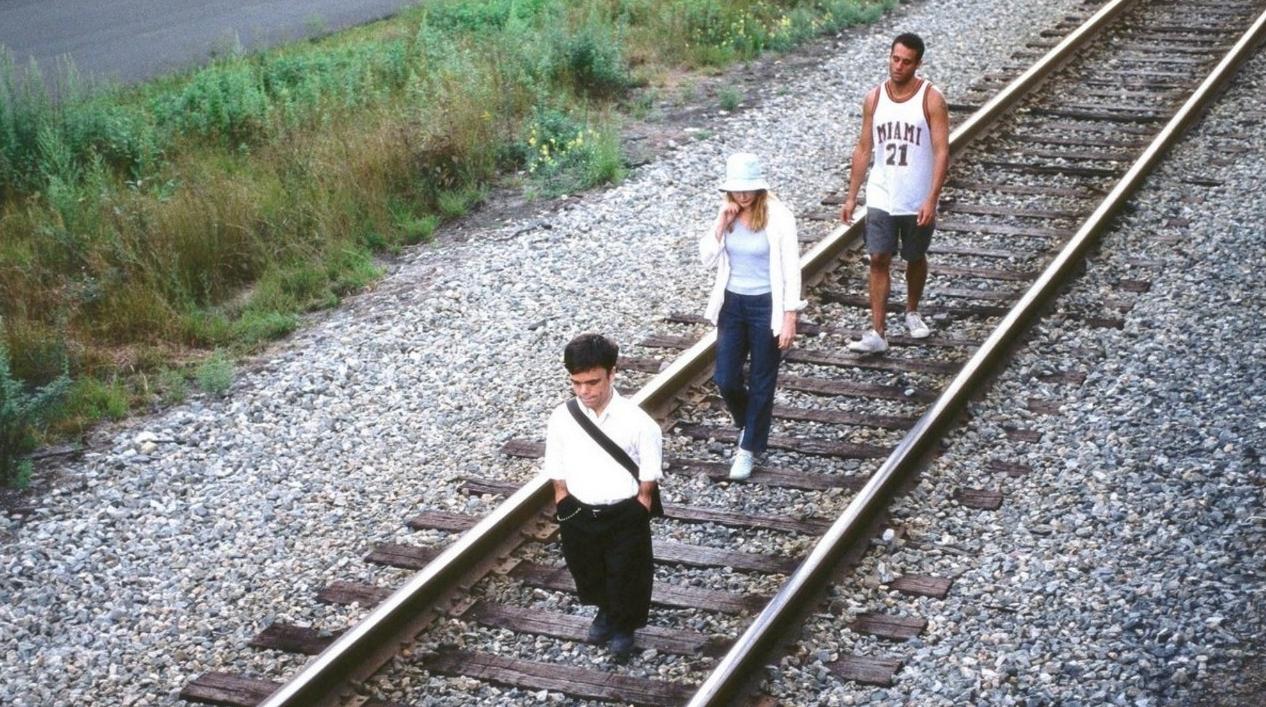
Look at the railway still reproduced above. The shared route puts the three figures into one composition, but the landscape has room around them. The image makes their companionship legible without requiring an embrace or a face-to-face exchange.[3] Walking gives the gathering a modest purpose: keep going in the same direction.
Read this way, the railway offers a particularly generous form of social space. People can accompany one another while looking ahead. They do not have to supply a conversation's next line at every step. Fin's existing interest becomes something others can enter; his world remains recognizable as it becomes less private.
The gaps matter as much as the grouping. A picture of friendship can preserve the separate bodies that make it up. That is the visual pleasure here: company has arrived, and there is still air in the frame.
The kitchen is just far enough away
A dinner scene gives the same problem a comic variation. Cooking at Olivia's house, Joe asks for a garlic press. Olivia's clipped replies leave him to manage without one. As she and Fin begin talking, Joe calls for them to come nearer: he cannot bear to be excluded from the conversation he helped make possible. David Edelstein's 2003 Fresh Air review preserves the exchange.[5]
The humor depends on the temporary arrangement. Joe creates an occasion for intimacy, then discovers that intimacy can proceed a short distance away from him. Fin, meanwhile, makes a dry joke that his move was motivated by wanting to live near Joe. His reserve has acquired enough ease to become teasing.[5]
This is a persuasive measure of change. A person who earlier had to explain his wish for solitude can now risk a joke about companionship. Joe is still demanding, Fin still economical. Their differences have become material they can use together.
The film's small encounters make a demanding idea feel ordinary: closeness involves learning how another person likes to spend time. An invitation can be declined; a familiar route can be shared; a conversation can wander beyond its host. Friendship takes shape through those adjustments, in the space people gradually learn to leave each other.
Sources
- Miramax, The Station Agent — official film page; release year, writer-director, cast, and premise.
- Dave Davies, “'Win-Win': Tom McCarthy Wrestles With Morals,” Fresh Air, March 15, 2011 — interview transcript, including the Station Agent invitation scene.
- Scott Jordan Harris, “10 great films set at train stations,” BFI, July 14, 2022 — The Station Agent entry and the identified photographic film still reproduced above.
- SAGindie, “Filmmaker Interview: Tom McCarthy, writer/director of The Station Agent” — January 2004 interview, republished July 14, 2017; depot inspiration and the three-character dynamic.
- David Edelstein, “Movie Review: The Station Agent,” Fresh Air, October 17, 2003 — review transcript with the dinner scene and its dialogue.