Rialto's restoration trailer for Rififi is only 111 seconds long, but it understands the movie's deeper shape better than a lot of longer promos understand their own films.[1] It does not treat Jules Dassin's 1955 classic as a single clean burglary with a famous payoff. It treats the film as a pressure system. Someone watches from above. Men gather under lamps and awnings. A nightclub turns danger into public display. Tools, ropes, and faces matter more than speeches. By the time the trailer reaches its last close-up, the glamour has already been burned off.
That emphasis is exactly right for a film that still functions as one of the genre's load-bearing structures.[2][3][4][5] Criterion calls Rififi the ultimate heist movie, and that shorthand is useful as long as it does not flatten what Dassin is doing.[2] The Cannes record matters because the film earned him the 1955 Best Director prize.[3] The BFI's heist overview matters because it still singles out the midnight-to-dawn raid, with its near-total silence, as one of the form's founding acts.[4] Put those signals together and the trailer starts to look less like an advertisement and more like a miniature critical argument. It is selling not only a plot but a method: suspense will come from procedure, patience, and the way public surfaces keep hiding private strain.
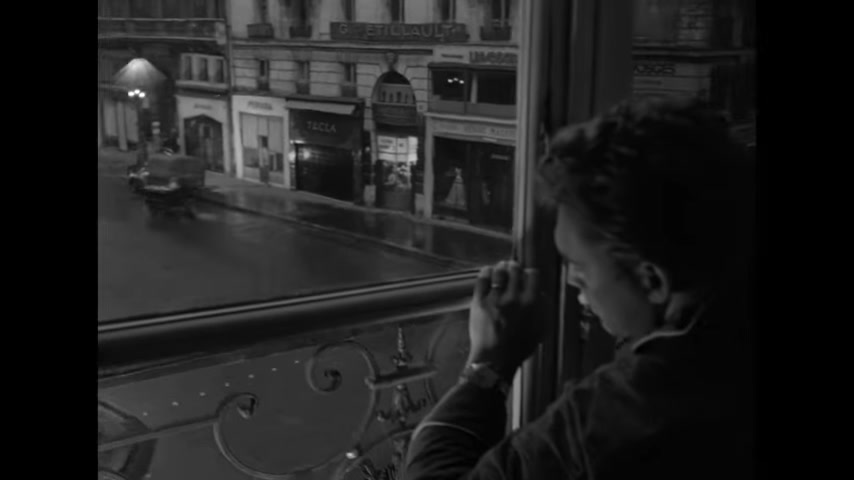
Image context: the lead image is a frame extracted from Rialto's trailer itself. It fits this article because the trailer's first lesson is architectural and moral at once. A wet street seen from upstairs immediately turns the city into a map of watchers, routes, exits, and risks rather than a picturesque Paris postcard.[1]
At 0:00, the trailer begins with surveillance before it gives us swagger
The opening image is almost quiet enough to miss: an upstairs window, a child leaning out, a car moving along a wet street.[1] For a crime trailer, this is a strange first choice and a very intelligent one. It does not open on a jewel display, a pistol, or a crew assembling around a plan. It opens on someone looking down. That means the world of Rififi is introduced as a world of angles before it becomes a world of action.
This matters because Dassin's film is built on the idea that crime is never simply what happens at the center of the job.[2][4][5] It also happens in the margins: on stairs, across courtyards, through windows, in the pause before someone decides whether to speak. The trailer's opening street view prepares us for exactly that kind of suspense. Paris appears not as a romantic backdrop but as a legible field of exposure. Every doorway can be entered, every facade can be studied, every upper floor can become a lookout post. The film may be famous for its burglary mechanics, but the trailer insists that mechanics only work because the environment has already been converted into a system of observation.
That is why the first close-ups feel so severe. When the trailer moves to Tony le Stéphanois's face, it does not frame him as a glamorous mastermind in the modern caper sense.[1] It frames him as a man already carrying weather. Even before the plot clarifies, the cut from street-watching to face-reading tells us what kind of experience this will be. We are being asked to watch for strain, not simply for surprises.
Around 0:18, the trailer advertises procedure by way of objects, hands, and delay
One of the sharpest cuts in the trailer arrives when it starts showing desks, telephones, tools, and concentrated gestures rather than explaining the burglary in detail.[1] There is no need for a tidy blueprint voice-over. The video understands that Rififi became canonical because the labor itself is gripping. The audience does not need a slogan saying "this is meticulous." It only needs a telephone receiver, a magnifying glass, a rope, and a few men who look as if they know that one bad movement will ruin everything.
That visual strategy points directly toward the film's lasting place in heist history.[4][5] Britannica's capsule on Dassin still isolates the robbery sequence for its extraordinary lack of dialogue and music, which is another way of saying that the film trusts bodies under pressure more than explanatory chatter.[5] The trailer cannot reproduce the full stretch of that famous silence without ceasing to be a trailer. What it can do is preview the discipline behind it. It keeps cutting to gestures that imply planning, balance, entry, and control. Instead of promising the rush of chaos, it promises the opposite: tension generated by people trying not to make noise.
That choice is why the trailer still feels modern. Many contemporary heist previews sell competence as flashy ease. Rififi sells competence as grim concentration.[1][4] The men do not look liberated by expertise. They look trapped inside it. The trailer knows that is more exciting.
Around 0:40, the nightclub turns criminal reputation into a stage performance
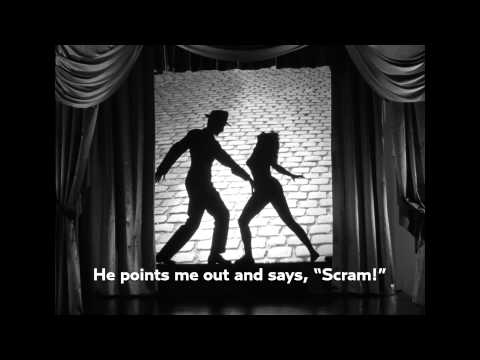
The nightclub passage is the trailer's most revealing detour.[1] A singer moves before a projected shadow figure, tables glow in the dark, and the room becomes a theater where criminal status is read publicly rather than whispered privately. This is not filler between action beats. It tells us that Rififi cares about performance as much as it cares about technique.
That insight keeps the movie from shrinking into an instruction manual.[2][4] A heist needs secrecy, but an underworld also runs on display: who enters the room, who rises from the table, who is being watched, who can be humiliated, who can command silence. The trailer expresses this with unusual economy. It cuts from shadow-play onstage to men measuring each other in restaurants and corridors, so that entertainment and threat begin to share the same visual grammar. A silhouette can be glamorous; it can also be a warning. A dinner table can be social; it can also be a checkpoint.
This is the point where the trailer shows how much of Rififi depends on public surfaces.[1] Hats, drapes, mirrors, lamplight, club decor, polished tables: all of them make the world look dressy enough to relax into, while the editing keeps proving that every surface is also a place where danger can be read too late. The result is a very French kind of noir tension. What looks elegant is never safe. What looks leisurely is usually the moment when the pressure is quietly shifting shape.
In the final stretch, the trailer stops selling the score and starts selling the cost
The last movement is the crucial one. Instead of ending on a triumphant image of loot, the trailer drives toward fatigue, violence, and Tony's sweat-soaked close-up.[1] That close-up is the whole argument in miniature. The face is no longer a cool criminal emblem. It is a damaged surface where effort has become visible.
This is what keeps Rififi from aging into a mere ancestor.[2][4][5] The film certainly helped define the modern screen robbery, but the trailer is smart enough to advertise the film's harsher gift. Precision matters in this world because exposure is waiting on the far side of it. The heist is not a fantasy of perfect control. It is a temporary pocket of control carved out inside a much larger field of betrayal, weakness, vanity, and time. The trailer's ending understands that if viewers leave only wanting the robbery, they have been sold the wrong movie. They should leave wanting to know what that robbery does to the people who manage it.
That is why this short promo remains worth watching on its own.[1] It gives Rififi back its proper temperature. Not just stylish, not just influential, not just the old master of silent burglary, but a film where every act of control is already leaning toward consequence. The window, the shadow stage, the rope, the table, the sweating face: each image teaches the same lesson in a different register. Underworld cool is real in Rififi, but it only matters because strain keeps breaking through it. The trailer knows that. That is why it still works.
Sources
- Rialto Pictures, "RIFIFI - Trailer," YouTube video, August 6, 2015.
- The Criterion Collection, "Rififi (1955)" film page.
- Festival de Cannes, "Jules DASSIN" profile page, listing Du rififi chez les hommes and the 1955 Best Director award.
- BFI, "10 great heist films."
- Encyclopaedia Britannica, "Jules Dassin" biography.