Michelangelo Antonioni's Red Desert (1964) is often praised for being beautiful in a new way, but the harder achievement is that its beauty feels administered rather than spontaneous.[1][2][3] This was Antonioni's first color feature, and he did not treat color as a decorative bonus added to an already finished method. He treated it as a new control system. The film's anxiety does not come from dramatic shocks or from a plot designed to expose secrets. It comes from a world whose surfaces have already been processed: factories, docks, fog, pipes, walls, bottles, coats, smoke, and even patches of nature arrive as if someone has adjusted them to a calibrated emotional register.[1][3][4]
That is why Giuliana's crisis never reads as purely interior.[1][4][5] Antonioni gives Monica Vitti a character who is fragile, watchful, difficult to settle, and perpetually trying to find a livable distance from the industrial landscape around Ravenna.[1][5] Yet the film's technique keeps refusing the idea that the environment is just backdrop. BFI's Antonioni landscapes essay notes the director's famous manipulation of the location itself, including painted trees and grass, in order to darken the land into a more diseased palette.[2] The MUBI essay on Carlo Di Palma's cinematography adds that even the smoke was tinted and that color in Red Desert often appears only where human systems dictate it.[4] Put those observations together and the method becomes clear: Antonioni does not photograph a damaged world and then ask Giuliana to react. He builds a world whose visible order already behaves like damage.
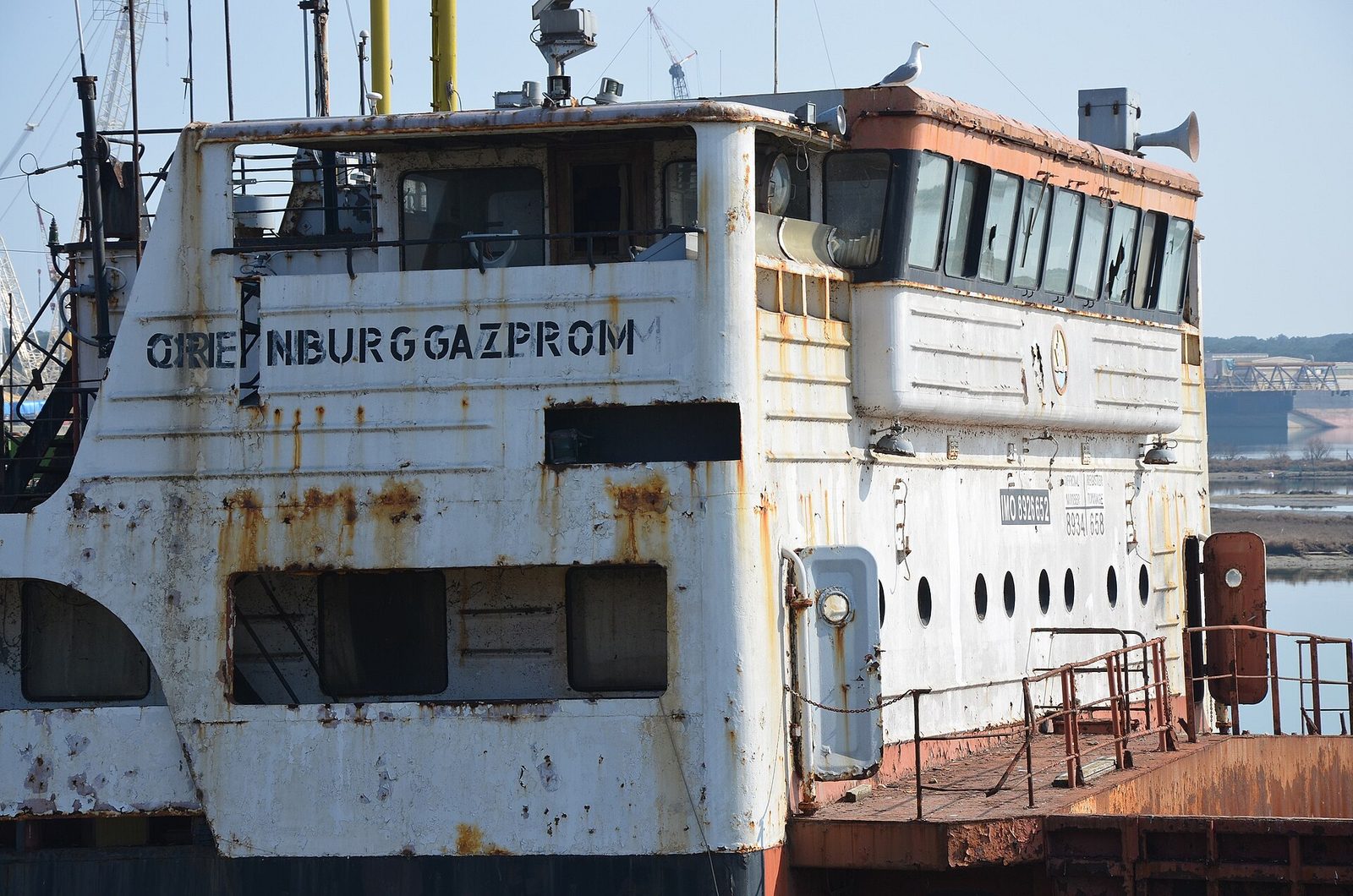
Image context: the cover uses a real photograph of Ravenna's industrial area rather than a film still, poster crop, or abstract color panel. That choice fits the article because Antonioni's method begins with location-world pressure: factories, docks, smoke, painted ground, and processed atmosphere become the film's emotional machinery.[6]
Antonioni turns color into industrial weather
The most important craft decision in Red Desert is that color rarely behaves like natural abundance.[2][3][4] Even when the image is vivid, it feels rationed, placed, or contaminated. Giuliana's green coat, a red wall, a yellow plume, or a band of blue industrial glass does not open the frame into sensuous overflow. Each accent looks as though it has been installed inside a larger field of ash, mud, rust, and grey water.[2][4] Antonioni's gift is to make that installation legible without reducing it to a symbol chart. The film does not say "red means danger" or "grey means alienation." It makes color feel as if it has passed through labor, chemistry, and design before reaching the eye.
That is what separates Red Desert from more familiar psychological expressionism.[3][4] The environment does not merely mirror Giuliana's state; it keeps manufacturing the conditions under which her state remains unstable. Factories vent steam into the air. Structures cut the horizon into hard segments. Muddy ground and dark trees look less organic than post-processed.[2][4] The result is not simply that Giuliana feels bad in an ugly place. It is that the place has been reorganized so thoroughly by industrial production that even beauty arrives with a metallic aftertaste. Antonioni turns landscape into weather, then turns weather into management.
The film's rooms are pressure devices, not safe interiors
Antonioni extends that logic indoors. The famous red shack sequence is often remembered because it is the film's most openly saturated interior, but its function is more precise than that.[3][4] The red does not create warmth in any generous sense. It creates compression. Bodies gather there because the space is enclosed, windswept outside conditions are temporarily held off, and color itself seems to thicken the room's air.[4] What could have become erotic refuge remains nervous. The scene gives the characters proximity, but not ease. Antonioni uses the room to show that intimacy in this film is always conditional, always temporary, and always staged against an outside world ready to reassert itself.
He does something equally sharp with colder spaces. Corridors, apartment walls, waiting areas, and modernist windows are frequently pale, hard, and acoustically unforgiving.[1][4] The white hallway associated with Corrado's building feels less like cleanliness than like institutional overexposure, a place where Giuliana's nervous system has nowhere to hide.[4] Horizontal windows frame ships and industrial structures the way display cases frame specimens. Even when Giuliana is inside, the image keeps binding her to machinery, trade routes, and exhausted air. Antonioni refuses the classical contrast in which exterior space threatens while interior space shelters. In Red Desert, the inside has already absorbed the outside's logic.
That technical choice matters because it keeps the film from collapsing into a simple story about one woman's breakdown.[1][3][5] Giuliana is distressed, but Antonioni never films her as if she alone were malfunctioning. The rooms around her have already been tuned to a world where stability feels overengineered and therefore brittle. Her crisis becomes readable as a form of failed acclimatization to a modernity that has reorganized perception itself.[4][5]
Performance, objects, and distance keep making ordinary life feel uninhabitable
Antonioni's control of color would mean less if Vitti did not know how to move through it. She performs Giuliana as someone always testing whether a space can be occupied without cost.[1][5] One of the film's most revealing moments is the sandwich scene, where she impulsively buys food from a striking worker at the chemical plant and then eats in a furtive crouch, as if appetite had become a private emergency.[5] The action is small, but it changes the scale of the whole film. We are no longer only watching a woman surrounded by factories. We are watching someone whose relation to ordinary acts, even eating, has been deranged by the atmosphere she inhabits.
Objects intensify that derangement. The film's bottles, pipes, robots, metal surfaces, and viewing apertures do not feel like realistic clutter added for plausibility.[1][3][4] They feel like a parallel cast of hard things that keep outlasting human adjustment. Antonioni frames people beside them, behind them, or beyond them so that the line between emotional mood and material design begins to dissolve. The point is not that machines are evil. The point is that industrial form has become the medium through which perception is organized. Giuliana has to think, desire, speak, and falter inside that medium.
This is where Antonioni's distance becomes crucial. He often places Giuliana in frames that seem to grant visibility without granting security: long docks, empty lots, sparse rooms, windows facing ships, and pathways cut by rails or piping.[1][2][4] The space around her is open, but the openness is not liberating. It is segmented, monitored, and drained. Freedom becomes a problem of exposure.
The island tale works because it shows what the rest of the film has withheld
The famous story-within-the-story on the pink beach matters because it reveals the rest of the film by contrast.[3][4] In the Carlo Di Palma essay, the island sequence is described as the exceptional passage where the color was not manipulated in the same way as elsewhere.[4] That exception is decisive. The beach, water, rocks, and near-abstract serenity do not function as a sentimental escape hatch. They function as a control sample. Antonioni briefly shows what unpressured color and sensuous continuity might feel like, and by doing so he clarifies how thoroughly the rest of Red Desert has been built out of managed atmospheres.
That is why the film still feels ahead of so much later cinema about modern unease.[1][3][4] Many movies tell us that industrial society is alienating. Red Desert goes further and asks what kind of visual technique is required to make alienation perceptible without explaining it away. Antonioni's answer is severe and exacting: paint the landscape, tint the smoke, drain the safe interiors, let color arrive as administration rather than release, and give the central performance to an actor who can register every failed attempt to settle. The result is a film in which anxiety looks engineered because the visible world has in fact been engineered first.
Sources
- BFI, "Red Desert (1964)" film page with credits, synopsis, and production context.
- Samuel Wigley, "The 5 loneliest landscapes in the films of Michelangelo Antonioni," BFI.
- Fernando F. Croce, "Il Deserto Rosso (Red Desert, Michelangelo Antonioni, 1964)," Senses of Cinema.
- Brian Eggert, ""Red Desert" & "Husbands and Wives": Two Visions from Carlo Di Palma," MUBI Notebook.
- Elissa Suh, "Against Nature: Feral Eating and Feminist Performance," MUBI Notebook.
- Wikimedia Commons file page for the Ravenna industrial-area photograph used as the cover image.