Albert Lamorisse's The Red Balloon looks simple because it has the courage to stay simple. A boy finds a red balloon. The balloon follows him. Adults disapprove. Other children envy it. The city becomes a route of small permissions and refusals. The story lasts only 34 minutes in the Janus and BFI listings, nearly wordless and scaled to a child's walk through Paris.[1][2] Yet the film's craft is not naive. Its whole achievement is technical discipline hidden inside apparent effortlessness: color contrast, practical object movement, real streets, sparse sound, and a camera that treats a balloon as a body with attention.
That is why the movie remains more than a beloved children's short. Janus frames it as an Academy Award-winning film with a "glorious palette" and allegorical clarity, while BFI's record fixes the practical facts: France, 1956, Albert Lamorisse, Pascal Lamorisse, color, 34 minutes.[1][2] Those facts matter because The Red Balloon does something unusually hard inside a small runtime. It makes a prop behave like a companion without turning the film into a trick-show demonstration.
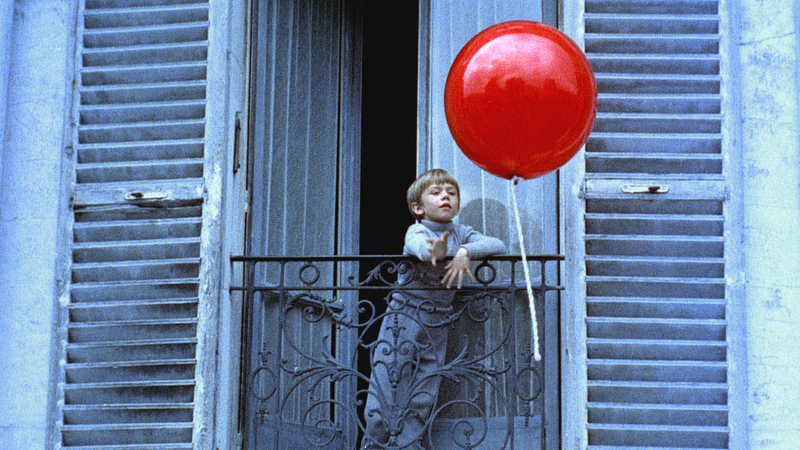
The cover still makes the method visible.[6] Pascal leans from a balcony, the shutters and facade pushed toward blue-gray, while the balloon sits beside him as a perfect red circle. The image is not busy. It is engineered around one contrast. The boy is not swallowed by spectacle; he is placed in relation to it. The string remains visible enough to keep the object in the real world, but the balloon's position gives it an attitude: waiting, hovering, listening.
The color is the first performance
The film's famous red is not merely decorative. It is the casting decision. David Cairns's Criterion essay on Lamorisse notes how carefully the director planned the film's palette, including the practical decision to put orange balloons inside red ones so the object would shine more strongly on-screen.[4] That production detail explains why the balloon feels alive before it does anything narratively magical. Its color has behavioral force.
Most films would be tempted to make fantasy louder: more glow, more optical punctuation, more explanation. Lamorisse does the opposite. He drains the surroundings toward weathered blue, gray, brown, and stone, then lets one round surface carry the impossible. The balloon becomes legible from across streets, under umbrellas, against shutters, above cobblestones, and in crowds. Its difference from the city is not an afterthought. It is the mechanism by which the viewer tracks desire, danger, and tenderness.
The palette also protects the film from sentimentality. If the world were equally bright, the balloon would become one cute object among many. If the world were purely bleak, the balloon would become a crude symbol of hope. Instead, the contrast remains physical. The red is not an idea pasted onto Paris. It is a color trying to survive inside Paris.
The trick works because it behaves
The central illusion is not that a balloon can float. Balloons float anyway. The illusion is that this balloon chooses where and how to float. Cairns points to the film's discreet wirework and argues that the balloon becomes a screen personality because its movement seems to reveal thought.[4] That is the key craft lesson. Lamorisse does not need the balloon to do complicated stunts. He needs it to pause, retreat, follow, tease, wait outside a window, dodge grasping hands, and return after rejection.
Those actions are small, but they are timed like acting beats. A balloon that simply follows the boy would become mechanical. This balloon has spacing. It lingers outside thresholds. It keeps just enough distance to imply shyness or mischief. It rises above adult control, but not so far that the boy loses intimacy with it. Its movement is therefore relational. It is always answering a person, a doorway, a street, a rule, or a threat.
That is why the film's practical effects have aged so well. Modern viewers can sometimes spot the means, or at least feel that the object had to be controlled from outside the frame. But visible practicality does not break the film. It strengthens it. The balloon feels like a real object being coaxed into personality, and that coaxing belongs to the movie's tenderness. The illusion is not perfection. The illusion is attention.
The city is not a backdrop
The Red Balloon is often remembered as if it floated through a timeless Paris of childhood memory. The film itself is more specific. Janus's synopsis places the action on Paris streets; BFI identifies it plainly as a French 1956 film; CineMontage emphasizes the gray-blue atmosphere of the Paris setting and the way the short's images hold childhood fear and wonder together.[1][2][5] The streets matter because they give the balloon rules to test.
Every route is a negotiation. A school can punish the boy for bringing delight into discipline. A church can reject the balloon as disruption. A bus, a stair, a bakery, a market, and an apartment window each turn into a question of access. The film is almost wordless, but it is full of social grammar: where a child may stand, what an adult may forbid, when other children may envy, and how public space can change when one fragile possession attracts attention.
This is also why Lamorisse's real locations matter more than studio polish would have. The city has texture: uneven streets, damp walls, shutters, railings, narrow passages, shopfronts, and open lots. These places create a believable obstacle course for something as vulnerable as a balloon. The more ordinary the setting feels, the less the film has to argue for magic. The magic is the behavioral difference the balloon introduces into a recognizable street world.
Sound keeps the magic from becoming mime
The film is nearly wordless, but it is not silent. Brian Selznick's Criterion essay is especially useful on this point because it stresses Maurice Le Roux's score, the ambient traffic and transport sounds, footsteps on cobblestones, the screams of bullies, and the way sound effects and minimal dialogue were added after filming.[3] That slight separation between image and sound helps the film feel both documentary and dreamlike.
The sound design gives the balloon space to act without speech. Music can suggest curiosity or panic. Footsteps can make a chase feel bodily. Street noise can keep fantasy attached to the city. Silence can make injury feel unbearable. The film does not need the balloon to talk because everything around it is already listening.
Selznick's point about the death scene is important here: the balloon's destruction hurts because Lamorisse has spent the film training us to understand its surface as a living presence.[3] The technique is patient. Color makes the balloon visible. Movement gives it intention. Sound gives its world pressure. By the time the object is attacked, the audience does not see rubber losing air. It sees a companion being harmed.
The ending works because the film earned gravity first
The famous final lift, in which other balloons gather and carry Pascal above the city, can sound weightless when summarized. On screen it works because the film has been so committed to gravity. The boy walks. The balloon tugs against string and weather. Adults pull things down into rules. Bullies bring the red object to earth. The streets are full of obstacles. Only after that downward pressure has been established does the upward movement feel like release.
Cairns notes that Lamorisse's broader cinema returned obsessively to children, animals, flight, practical risk, and the desire to free the camera from earth.[4] The Red Balloon is the cleanest version of that impulse because it keeps flight at child scale before enlarging it. For most of the film, liberation is not the sky. It is having one companion who will wait outside a window.
That is the craft reason the movie still lands. Lamorisse does not begin with transcendence. He begins with a red circle beside a child, a city that does not know what to do with tenderness, and a set of practical filmmaking choices precise enough to make an object seem loyal. The film's magic is not separate from its technique. It is the technique, made gentle enough that a balloon can appear to choose love.
Sources
- Janus Films, "The Red Balloon" film page - official synopsis, country, year, runtime, color format, and distribution details.
- British Film Institute, "The Red Balloon (1956)" - film record with director, producer, writer, cast, country, year, and running time.
- Brian Selznick, "The Red Balloon: Written on the Wind," The Criterion Collection, 2008 - essay on the film's childhood perspective, soundscape, silence, and emotional structure.
- David Cairns, "Head in the Clouds: The Cinema of Albert Lamorisse," The Criterion Collection, 2023 - career essay with production details on color planning, practical balloon effects, location work, and Lamorisse's flight imagery.
- Nancy Frazen, "Albert Lamorisse's 'The Red Balloon'," CineMontage, 2017 - short-form appreciation covering the film's Paris atmosphere, nearly wordless storytelling, awards context, and classroom afterlife.
- Janus Films / Criterion S3 still, "The Red Balloon" official color still used as the article image.