Spoiler note: this essay discusses major plot turns in Rebecca, including Maxim's confession, the costume-ball humiliation, and the fire at Manderley.
The deepest technical trick in Alfred Hitchcock's Rebecca (1940) is that its most powerful character has already died before the film begins.[1][2][4][5] The movie is famous as Hitchcock's Hollywood debut, as David O. Selznick's prestige adaptation of Daphne du Maurier's bestseller, and as the only Hitchcock film to win the Academy Award for best picture.[1][2][4] All of that matters, but it can distract from the precision of the movie's method. Rebecca does not simply tell a gothic story about a shy second wife entering a house haunted by a glamorous predecessor. It builds a system in which architecture, scale, and narration keep recreating that predecessor long after her body is gone. The haunting is not an atmospheric garnish laid over the plot. It is the plot's delivery mechanism.
That is why the film still feels so unnerving even when one already knows its revelations.[1][2][5] David Thomson's essay for Criterion is especially useful here because it insists that Manderley is not background but one of the film's most potent characters.[2] MoMA's program note usefully reduces the cast list to essentials, but it also points back to the film's practical elegance: screenplay, stars, and 35 mm presentation are all organized around a house that keeps redistributing authority.[5] BFI, meanwhile, calls the picture Hitchcock's chillingly beautiful adaptation of du Maurier, and the phrase is exact because beauty in Rebecca is never passive.[4] It is managerial. Rooms, corridors, windows, and staircases keep deciding who may belong, who may move, and who must feel small.
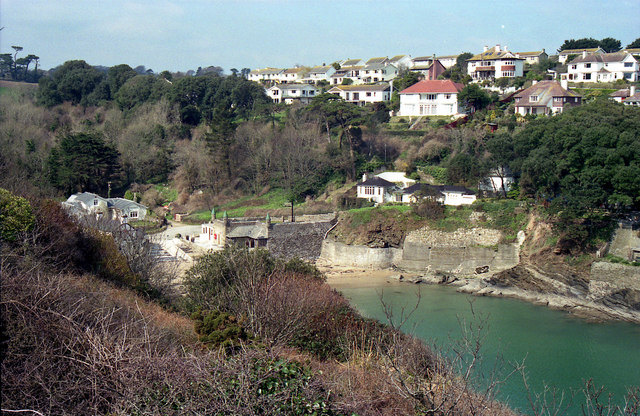
Image context: the lead image uses a real photograph of Readymoney Cove near Fowey, Cornwall, close to the du Maurier landscape that shaped the imaginative geography around Rebecca.[6] It fits this essay because Manderley is never only a set or a plot location. The film turns coast, approach, house, and memory into one pressure system, and a grounded Cornish image keeps that pressure outside the screenshot frame.
The voice-over begins after the house is already lost
The first great technical decision comes before Manderley even appears. The film opens with Joan Fontaine's voice returning in memory, telling us that she dreamt she went to Manderley again.[1][4][5] This matters because Rebecca does not let us enter the estate as present-tense discovery alone. We enter it after ruin. The house is already lost, and the narrative still has to go back through it. That structure changes the emotional temperature of everything that follows. Instead of a simple suspense question about what happened in the mansion, the movie gives us a memory-space whose destruction has not weakened its power.
The voice-over also works with another crucial subtraction: the heroine never receives a personal name.[2][4] She is second Mrs. de Winter, but never fully a self before the house, the marriage, and Rebecca's legend begin to define her. Thomson is sharp on this point, treating the film as a drama of two Mrs. de Winters, one absent and named, the other present and unnamed.[2] That imbalance is not just literary inheritance from du Maurier. It is cinematic design. Hitchcock begins by weakening the heroine's verbal claim on the world, then sends her into a property saturated with another woman's signatures, routines, and textures. Narration and namelessness work together. They make the viewer experience Manderley as a memory machine before it has even become a physical address.
This is one reason the film's famous opening line has such staying power.[1][2][5] It is not simply beautiful. It is a formal instruction. We are being told that the story will unfold inside return, and return is never neutral. Every later corridor, staircase, and room carries the weight of someone re-entering a place where she once failed to become equal to the dead.
Miniatures, matte paintings, and studio scale make Manderley feel too large to master
Craig Barron's visual-effects breakdown for Criterion clarifies how engineered the estate really is.[1][3] Manderley feels vast and continuous, yet that feeling was assembled through studio sets, miniatures, matte paintings, and carefully managed scale effects rather than through one stable real-world location.[3] That matters artistically as much as historically. Hitchcock's haunted house does not just look grand. It looks grand in a way that is slightly more coherent than life, which is exactly why it can dominate the people inside it.
The technique gives Manderley a double existence.[2][3] On one level it is tactile: gates, driveways, windows, fireplaces, morning rooms, stairs, bedrooms. On another it is dream architecture, a place whose parts fit too perfectly into the emotional requirements of the story. The house can loom from outside like a private kingdom, then tighten into hallways and chambers that feel psychologically overfurnished. Barron's piece is valuable because it reminds us that this effect comes from construction choices, not from some vague aura that happened to settle over the production.[3] The estate is an achieved illusion, and that achievement is what lets it feel like fate.
This engineered scale is also why Fontaine's performance lands so hard.[1][3][5] She does not merely act timid inside a large house. She is repeatedly framed as someone being proportioned by it. Rooms seem slightly too deep, furniture slightly too ceremonial, sightlines slightly too public. The result is not only that Manderley is impressive. It is that Manderley seems already calibrated to compare the living heroine with an impossible standard set by someone who is no longer alive. The house is decorative, but it is also evaluative.
Rebecca's bedroom turns interior design into a technology of haunting
The film's most merciless room is Rebecca's bedroom.[1][2][4] Many gothic stories use a preserved chamber as a sign that the past has not been buried. Rebecca goes further. The bedroom is not simply preserved; it is curated. Fabrics, brushes, bed linens, monograms, and light all remain under the custodianship of Mrs. Danvers, who behaves less like a servant than like the high priestess of a private museum.[2] The dead woman survives there through arrangement.
This is where Hitchcock's interior logic becomes especially exact. Thomson writes persuasively about the sinister erotic charge in Mrs. Danvers's devotion to Rebecca, and the room is where that charge becomes spatial.[2] Danvers does not need to explain Rebecca at length. She can demonstrate her through things. A hairbrush, a nightgown, a bedspread, a window view, the order of drawers: each object is presented as evidence that Rebecca possessed a form of authority the new wife cannot match. The room therefore does not haunt through supernatural spectacle. It haunts through standards.
That distinction matters for craft.[1][2][4] A ghost in Rebecca is less a visible apparition than a social and aesthetic arrangement that keeps reproducing judgment. The unnamed heroine enters Rebecca's rooms and feels herself turned into an inferior copy because the room has already been edited to produce that feeling. Production design here is inseparable from character psychology. The decor is not descriptive scenery. It is an active instrument of humiliation.
Staircases and the costume ball turn movement into public failure
Once the house has established its rules, even movement through it becomes risky.[2][4][5] Hitchcock understands that staircases are not just connectors between levels. They are machines for changing status in public view. A person descending into a hall is instantly displayed; a person climbing back up can look judged, banished, or exposed. In Rebecca, this logic reaches its cruelest form in the costume-ball sequence. The second Mrs. de Winter tries to step into aristocratic confidence through dress, only to discover that the dress has already been coded by Rebecca's past and weaponized by Danvers.[2][4]
The brilliance of the scene is that it converts a social event into a trap without changing the elegance of the setting.[2][4] The staircase, the guests, the lighting, the formal wear, the music, all continue to serve the visual promise of prestige. Yet the heroine's movement through that prestige becomes catastrophic because the house remembers more than she does. She is not defeated by a villain springing from the shadows. She is defeated by entering an arrangement whose meanings were fixed before she understood them.
This is the film's broader method in miniature. Interiors in Hitchcock are often psychic portraits, as Thomson argues, and Manderley may be the moment when that idea becomes fully central to his American career.[2] The house does not merely contain secrets. It distributes them through ceremony, costume, and circulation. It makes ordinary social motion feel like walking through someone else's sentence.
The fire destroys the building, but the narrative still belongs to the house
At the end, Rebecca appears to offer exorcism by flame.[1][2][4][5] Manderley burns, Rebecca's room is consumed, and the architecture that has enforced comparison and dread is finally destroyed. Yet the movie is too intelligent to pretend that physical destruction equals psychological release. The voice-over that began by returning to Manderley still frames the story after the loss.[1][5] The house is gone, but the narrative remains organized around it.
That final irony is what makes the film more than a prestige gothic with impeccable surfaces.[1][2][3] The miniatures and matte paintings have given Manderley an almost impossible wholeness. The preserved bedroom has made memory feel tactile. The staircase and ball have made social performance feel fatal. When fire arrives, it can level the structure but cannot erase the form that structure gave to experience. The dream of return remains.
This is why Rebecca still grips through technique as much as through story.[1][2][4] Hitchcock, Selznick, and their designers built a film in which narration, production design, and special-effects craft all converge on one argument: a house can haunt not because it contains a ghost, but because it teaches the living how to keep serving the dead. Manderley is beautiful, engineered, and finally unreal in exactly the right way. It is too complete to inhabit safely. That is why the film lasts.
Sources
- The Criterion Collection, "Rebecca" film page.
- David Thomson, "Rebecca: Welcome to the Haunted House," The Criterion Collection.
- Craig Barron, "Constructing the Eerie World of Rebecca," The Criterion Collection.
- BFI, "Rebecca (1940)" film page.
- MoMA, "Rebecca. 1940. Directed by Alfred Hitchcock."
- Wikimedia Commons, "File:Readymoney Cove.jpg" photograph file page.