Spoiler note: this essay discusses the boot dinner, the bread-roll dance, the cliff-edge cabin sequence, and the ending of Chaplin's 1925 release of The Gold Rush.
For a film with "gold" in the title, The Gold Rush spends an extraordinary amount of time on everything wealth is supposed to cancel: cold, waiting, embarrassment, appetite, and the awkward labor of wanting to be welcomed somewhere.[1][2] Chaplin said this was the film he wanted to be remembered by, and the choice makes sense once the movie stops being treated as a string of famous bits and starts being read as a design for turning need into shape.[3][4] The 1925 version is the decisive one for this purpose, not because the 1942 reissue is negligible, but because the silent original keeps the emotional temperature rawer. Its intertitles, its ending, and the way it lets images carry fantasy without spoken narration make hunger feel at once physical and dreamlike.[1][3]
The plot gives Chaplin a frontier premise, yet the National Film Registry essay is right to stress that the film deconstructs pioneer mythology more than it celebrates it.[2] The Klondike setting promises adventure and reward; what the picture keeps showing instead is precarious shelter, social exclusion, improvised performance, and luck arriving long after dignity has already been tested. Even AFI's centenary spotlight, which recounts the film's production ambition and commercial triumph, ends up describing a movie built from contradiction: Donner Party desperation feeding slapstick invention, a Tramp romance unfolding inside near-starvation, and a supposedly triumphant gold story whose most durable images are a boiled shoe, a hallucinated chicken, dancing dinner rolls, and a cabin half off a mountain.[3]
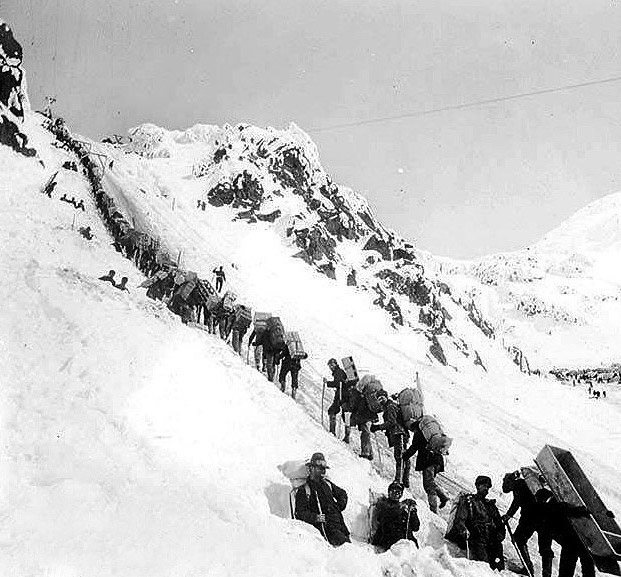
Image context: the lead image uses a real Klondike Gold Rush photograph of prospectors climbing the Chilkoot Pass steps.[6] It is the right visual for this essay because Chaplin's comedy depends on converting actual frontier pressure into form. Snow, ascent, crowding, and bodily strain are the historical ground from which the boot dinner and cliff-edge cabin draw their force.
The boot dinner is funny because etiquette survives after food fails
The meal scene remains one of the great comic transfigurations because it never abandons the fact that the characters are in real trouble.[2][3][5] AFI notes that Chaplin drew the shoe-eating idea from accounts of the Donner Party surviving on moccasins.[3] That origin matters. The gag is not random surrealism. It grows from the oldest fact in the film: food has run out, weather has sealed the men in, and survival has become humiliatingly inventive.
What makes the sequence art rather than anecdote is Chaplin's insistence on ceremony. He does not tear at the shoe like an animal. He serves it. The laces are lifted like spaghetti, the nails are treated like bones, and the plate keeps the fiction of dinner intact long after dinner has ceased to exist.[2][6] Chaplin stages starvation through the grammar of polite eating, which means the scene is not only about appetite. It is about social form refusing to die at the moment material security does. The Tramp is still trying to behave correctly in a world that has withdrawn the ordinary conditions for correct behavior.
That is why the laughter never quite dissolves the pain underneath. The Library of Congress essay puts it well: every bite is comic, but the desperation remains visible behind it.[2] The film refuses two easier options. It could have made the scene purely pitiful, with misery shutting down performance. Or it could have made it purely whimsical, as though hunger were only an excuse for visual invention. Instead, Chaplin keeps both registers active. The boot is a prop and a meal, a joke and a threat. Comedy here does not deny extremity; it organizes extremity so the viewer can bear to look at it.
In the dance hall, desire becomes a problem of distance before it becomes a problem of romance
If the cabin sequences establish bodily need, the town establishes social need.[1][2] The Tramp's longing for Georgia is rarely framed as direct emotional confession. It is framed as a problem of placement: where he can stand, who notices him, whether he belongs inside the room or only at its edge. The National Film Registry essay's observation about the tavern imagery is especially sharp here. Chaplin is often held in the lonely foreground while the background fills with drinkers, dancers, and people who move through pleasure more naturally than he does.[2]
That compositional choice is the emotional key to the film. Georgia matters as a person, but she also stands for access to warmth, recognition, and ordinary sociability. The Tramp does not only want the girl; he wants the room that comes with the girl. He wants to stop being the man who drifts in from the snow already marked as an outsider. Chaplin understands that romantic humiliation is strongest when it is also spatial. A glance, a delayed invitation, an empty place at the table, a New Year's Eve expectation that no one intends to honor: these moments hurt because the film measures belonging in literal feet and inches.
The bread-roll dance only becomes fully legible in that context.[2][5] Treated in isolation, it is pure invention, one of Chaplin's most famous miniatures of grace. Inside the film, it is a hunger dream with an audience attached. The Tramp imagines abundance, but he also imagines himself successfully entertaining the woman whose attention he wants. He turns dinner into theater because theater is the form through which he hopes to bridge social distance. The rolls become feet, the forks become legs, and a nearly empty table briefly behaves like a stage where insufficiency can be converted into charm.
That conversion is fleeting, which is exactly why it lasts in memory. Chaplin does not let performance permanently solve loneliness. He lets it create a temporary pocket where loneliness can be suspended and stylized. The viewer remembers delight, but the scene is also haunted by absence: the imagined audience, the precarious meal, the knowledge that fantasy is doing labor reality has not done.
The cabin on the cliff turns luck into architecture
The cliff-edge cabin sequence is probably the film's clearest example of Chaplin making physical structure carry emotional truth.[2][5] By the time the cabin begins to tilt over the abyss, the movie has already taught us that stability is always conditional. Shelter can fail, food can vanish, friendship can slide into predation, and social hope can turn ridiculous overnight. The cabin merely gives those conditions a brutal geometric form.
This is where The Gold Rush becomes larger than a collection of iconic gags. The set is a machine for converting invisible insecurity into visible balance problems. A few inches of movement, the placement of a body, the angle of a floorboard, the shift of weight from one side to the other: suddenly survival is readable as choreography. Chaplin's genius is that he stages the scene with enough clarity that the audience can grasp both the comic business and the mortal stakes at once. The characters wake, walk, and negotiate breakfast in a room that has already ceased to be a room in any stable sense. It is half domestic interior, half diagram of delayed catastrophe.
The scene also answers the title's promise more honestly than any actual nugget ever could. In most frontier myths, fortune looks like possession. Here it looks like not falling. Luck is not glamorous acquisition but temporary reprieve, the absurd grace of being allowed one more movement before the structure gives way. Chaplin is mercilessly exact about this. The prospector world does not reward strength, virtue, or heroic mastery in any consistent way. It tosses bodies between accident, weather, appetite, and chance, and comedy becomes the form in which human beings keep improvising through that instability.
Why the 1925 ending matters
The version question is not a collector's footnote. It changes the film's final emotional pressure.[1][3] AFI's spotlight notes that Chaplin's 1942 reissue replaced intertitles with narration and altered the ending, trading the original lingering kiss for a more austere walk-away image.[3] This essay follows the 1925 release because its ending feels truer to the film's delirious structure. After so much cold, hunger, exclusion, and near-fall, the reward arrives with the force of a fairy tale someone could only invent after severe deprivation.
That fairy-tale release does not erase the harsher material that came before. It depends on it. The Gold Rush works because it never mistakes relief for normality. Even when fortune arrives, the film still carries the memory of boiled leather, social embarrassment, and wind pushing against wood. Happiness comes with the shimmer of improbability. Chaplin lets the ending feel earned as fantasy rather than earned as realism, and that choice keeps sentiment from going slack.
Why the film still feels inexhaustible
What keeps The Gold Rush alive is not simply that its set pieces are famous. It is that the set pieces all think the same thought in different materials.[2][3][5] The boot dinner says appetite can survive by borrowing etiquette. The dance hall says desire must cross public space before it can call itself romance. The bread-roll dance says performance is a temporary answer to insufficiency. The cliff-edge cabin says luck is a balance problem before it becomes a happy ending.
Put together, those ideas make the film stranger and tougher than its reputation as a beloved classic sometimes suggests. Chaplin is not decorating poverty with whimsy. He is discovering how whimsy behaves when pressed hard by poverty. The comedy sparkles because the pressure never disappears. Gold remains mostly elsewhere, offscreen or deferred, while what we actually watch is a body trying to stay graceful inside hunger, weather, and public awkwardness. That is why the movie still lands. It knows that want changes posture before it changes destiny, and it makes that alteration visible with a precision few comedies ever match.[2][5]
Sources
- BFI, "The Gold Rush (1925)" film page with credits, release information, and running time.
- Library of Congress, Darren R. Reid and Brett Sanders, "The Gold Rush" National Film Registry essay.
- American Film Institute, "THE GOLD RUSH (1925) - AFI Catalog Spotlight" with production history, Donner Party inspiration, and 1942 reissue notes.
- CharlieChaplin.com, David Robinson, "Filming The Gold Rush" (premiere and production context).
- BFI, "10 great films of 1925" entry on The Gold Rush, highlighting the boot feast, bread-roll dance, and cliff-edge cabin.
- Wikimedia Commons, "File:ChilkootPass steps.jpg" photograph file page.