Spoiler note: this essay discusses Morris Townsend's failed elopement, Catherine's transformation after the staircase scene, and the ending.
William Wyler's The Heiress (1949) is usually introduced through a question of motive: does Morris Townsend love Catherine Sloper, or does he want her fortune?[1][2][3] That ambiguity matters, but it is not the deepest wound in the film. The film's real cruelty lives at home. It turns drawing-room etiquette into a delivery system for humiliation, then shows how that humiliation can become a form of inheritance. By the end, Catherine does not simply keep a house. She keeps the house's emotional law.[1][2][4]
That is why the movie lands with such force even when its action seems restrained.[1][2][5] There are no wild chases, no courtroom revelations, no thunderous breakdowns that reorganize the whole plot in one stroke. Instead, Wyler builds pressure through interiors, pauses, and repeated acts of evaluation. Catherine is looked at by her father, measured by visitors, tested by romance, and quietly instructed in how far she falls short of the social confidence expected around her. The violence is conversational first, architectural second, and only then romantic.[2][4][5]
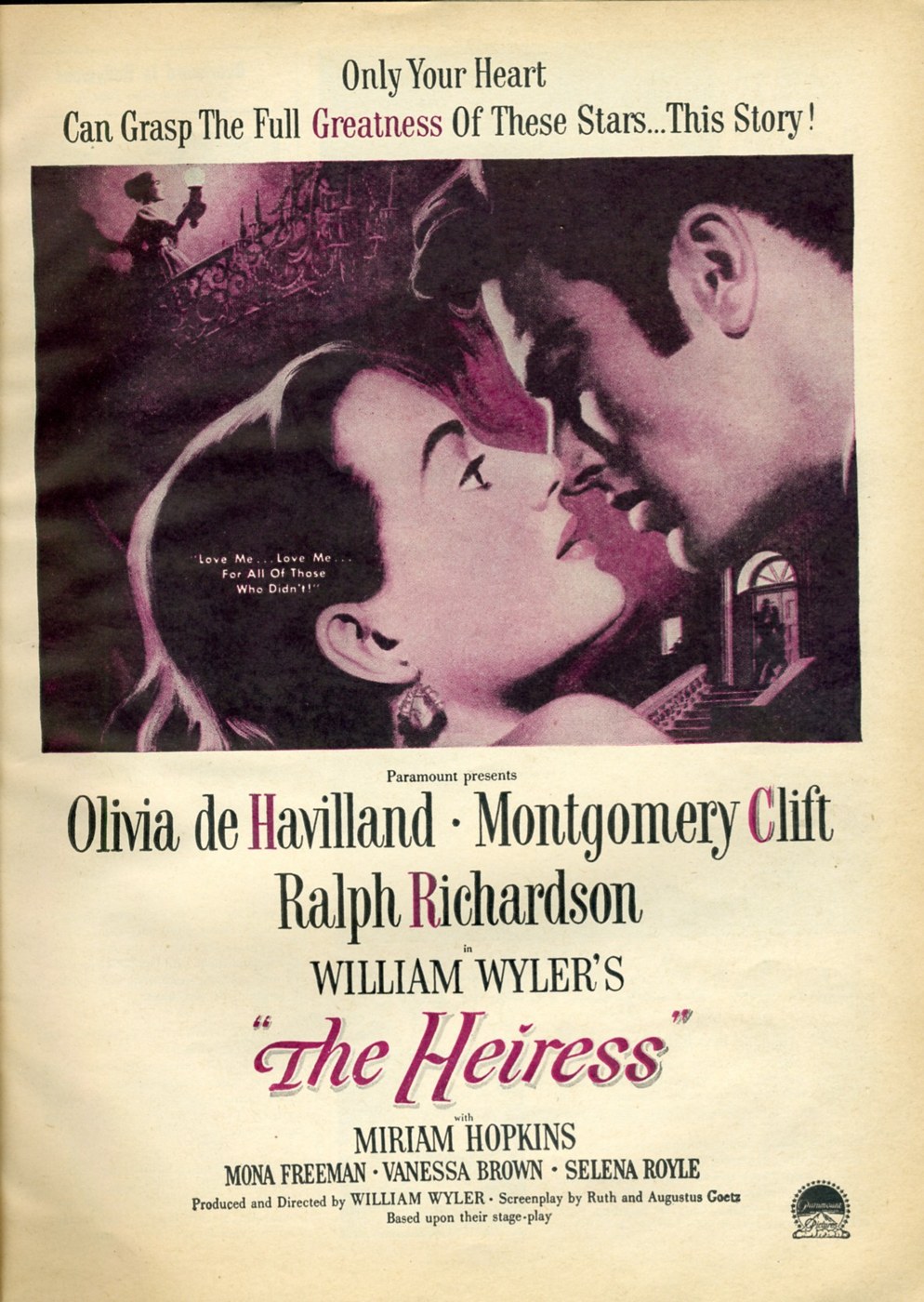
Image context: the cover now uses the 1949 theatrical poster for The Heiress rather than a generic nineteenth-century interior.[6] That choice is more direct: the article’s domestic trap, romance bait, and locked-door cruelty belong to this film’s own visual world, not merely to a plausible New York townhouse.
The parlors teach Catherine that love arrives through appraisal
One of the sharpest observations in Pamela Hutchinson's Criterion essay is that The Heiress traps its characters in rooms framed by doors, windows, fireplaces, mirrors, and deep-focus arrangements that make the domestic world feel theatrical and stifling at once.[2] That description goes to the center of the film. These are not simply handsome period interiors. They are appraisal chambers. People enter them already arranged for comparison: richer or poorer, warmer or colder, graceful or awkward, trustworthy or self-serving. Catherine does not move through neutral family space. She moves through a set of rooms designed to make her feel seen from the wrong angle.[2][3]
This is why the film's early social scenes are so painful.[1][2][5] Catherine is not humiliated by one spectacular insult. She is diminished by atmosphere. The aunt's romantic fussiness, the father's dry wit, the mild bustle of callers and conversations, the careful rituals of receiving company: all of it keeps establishing a world in which Catherine's sincerity looks heavy, slow, and vulnerable. Morris enters that world not as a pure liberator but as another man skilled at reading what the room wants.[4][5]
BFI's Southbank note is useful here because it describes Montgomery Clift's Morris as an archetypal Jamesian fortune hunter while also allowing for an element of self-deception in the performance.[5] That double quality is exactly what makes the film more damaging than a simple villain story. Morris may be opportunistic, but he also speaks the language of charm that the house already rewards. He seems alive where Catherine seems withheld. He looks like movement entering a static room. Catherine mistakes that fluency for rescue because the house has taught her to confuse being chosen with being truly known.[2][4][5]
Dr. Sloper's intelligence is the film's first instrument of cruelty
The father's authority in The Heiress is so devastating because it does not need to raise its voice.[1][2][3] Criterion calls the film a psychologically nuanced character study, and TCM's production history keeps returning to the tension Wyler cultivated between de Havilland, Clift, and Ralph Richardson.[1][4] Richardson's Dr. Sloper is not merely stern. He is professionally exact. He observes, concludes, and speaks with the calm of a man certain that discernment itself is a moral right. His skepticism about Morris may be justified in part, but the film keeps asking what that correctness costs Catherine when it is delivered as contempt.[1][2][4]
That is why the father-daughter scenes feel like psychological duels even when Catherine barely seems armed.[2] Dr. Sloper turns intelligence into a social blade. He does not only doubt that Morris loves her; he lets Catherine feel that the very idea of being loved by such a man is faintly ridiculous. The effect is not protective realism alone. It is domination through superior interpretation. Catherine is required to inhabit her own life as if someone cleverer has already written its verdict.[2][4]
The film's great harshness lies in refusing easy alignment.[1][2][4] Morris is unreliable. Aunt Lavinia is foolishly romantic. Dr. Sloper is often right. Yet being right does not save him from becoming the person who most thoroughly teaches Catherine to experience intimacy as exposure. The house is ruled by a father who mistakes lucidity for permission. By the time Morris fails her, Catherine has already been prepared for betrayal by a more respectable betrayal at home.[2][4]
The staircase converts heartbreak into posture
If the parlors are where Catherine is assessed, the staircase is where she changes form.[2][4] TCM's account of production lingers on the crucial scene after Morris does not arrive for the elopement: Catherine climbs the stairs carrying the suitcase she had packed, and Wyler kept pushing de Havilland until the emotional tone became exact.[4] That anecdote matters because the scene is not just a plot hinge. It is the movie's physical theory of transformation. Catherine does not collapse in public rhetoric. She ascends under weight.[4]
The staircase makes visible what the rest of the film has been building invisibly.[2][4] Her humiliation is no longer a series of drawing-room impressions or paternal judgments. It becomes bodily labor. Every step says the same thing: the romantic future she tried to move toward has turned back into the house she came from. Yet the scene is not only about defeat. It is about compression. Something in Catherine hardens on those stairs. The movement upward looks like retreat, but it also looks like the moment she learns how power in this world is really held: not by innocence, not by longing, but by control of entry, exit, and refusal.[2][4]
That is the genius of de Havilland's performance.[1][2][4] She does not turn Catherine into a suddenly glamorous avenger. She lets injury become composure. The film does not reward her with ease; it gives her a colder kind of legibility. After the staircase, Catherine is still wounded, but she is no longer available to the house in the same way. She has internalized its grammar and will eventually speak it back.[2][4]
The final locked door reveals what kind of inheritance Catherine has accepted
The ending of The Heiress is famous for good reason.[1][2][4] Morris returns too late, sentiment or self-interest once again blurred, and Catherine at last controls the threshold. The image is often remembered as revenge, and it certainly contains revenge. But revenge alone is too simple. The locked door matters because it shows Catherine inheriting not merely money or property, but the emotional temperature of the house itself.[2]
Hutchinson's essay notes that the film is organized around a transfer of guardianship from parent to child.[2] That observation clarifies the ending. Catherine does not escape Dr. Sloper's world and discover some freer self outside it. She becomes the keeper of the world that formed her, and she exercises its authority with terrifying fluency. The final refusal is satisfying because Morris deserves no easy absolution. It is also chilling because Catherine's newfound command arrives in the same language of cold judgment that once wounded her.[2][5]
This is what makes the film tragic rather than merely triumphant.[1][2][3][5] Catherine wins the house, the fortune, and the last word, but the victory has absorbed the methods of her injury. She can now lock a man out with the same certainty her father once used to define her limits from within. In that sense, the title points past property. The heiress is not just the daughter who receives an estate. She is the daughter who receives a style of feeling, a system of ranking, and a capacity for merciless clarity.[2][4]
That is why The Heiress remains so modern.[1][2][4] It understands that family cruelty often survives by presenting itself as discernment, maturity, or realism. It understands that a person can defeat romantic illusion and still emerge spiritually trapped by the house that taught her how to see. The parlors, the staircase, and the final locked door all belong to one structure. Wyler turns domestic elegance into a machine for transmitting shame across generations, then leaves Catherine holding the keys. The ending shocks because it is both justice and contamination at once.[2][4][5]
Sources
- The Criterion Collection, "The Heiress (1949)" film page with synopsis, credits, and restoration details.
- Pamela Hutchinson, "The Heiress: A Cruel Inheritance," The Criterion Collection.
- BFI, "The Heiress (1949)" film page.
- TCM, "The Heiress" - production history and adaptation background.
- BFI Southbank, "The Heiress" screening note.
- Wikimedia Commons, "File:The Heiress (1949) poster.jpg" — theatrical poster used as the cover image.