Alfred Hitchcock’s Rear Window (1954) is often filed under one broad idea: voyeurism. That is accurate, but too flat. What makes the film enduring is more exact. It teaches the viewer a method of looking, rewards that method with discovery, and then lets that same method break down the moment the danger stops being distant.
That is why the film still feels sharper than a lot of later thrillers about surveillance or suspicion. Its suspense is never only about whether Lars Thorwald killed his wife. It is about whether looking from safety can ever stay safe, and whether Jeff’s habit of one-way attention has also become the hidden structure of his love life. The murder thread and the romance thread are not parallel tracks; as John Belton notes in the Library of Congress essay excerpt, the film intertwines them through the theme of voyeurism itself.[2]
That argument is built inside an unusually controlled piece of studio engineering. According to the AFI Catalog, Hitchcock shot the picture on a Paramount courtyard set roughly 98 feet wide, 185 feet long, and 40 feet high, with 31 apartments and eight fully furnished units, while using multiple lenses to reproduce Jeff’s still-camera point of view.[1] In other words, Rear Window does not merely depict a neighborhood. It builds a machine for partial access.
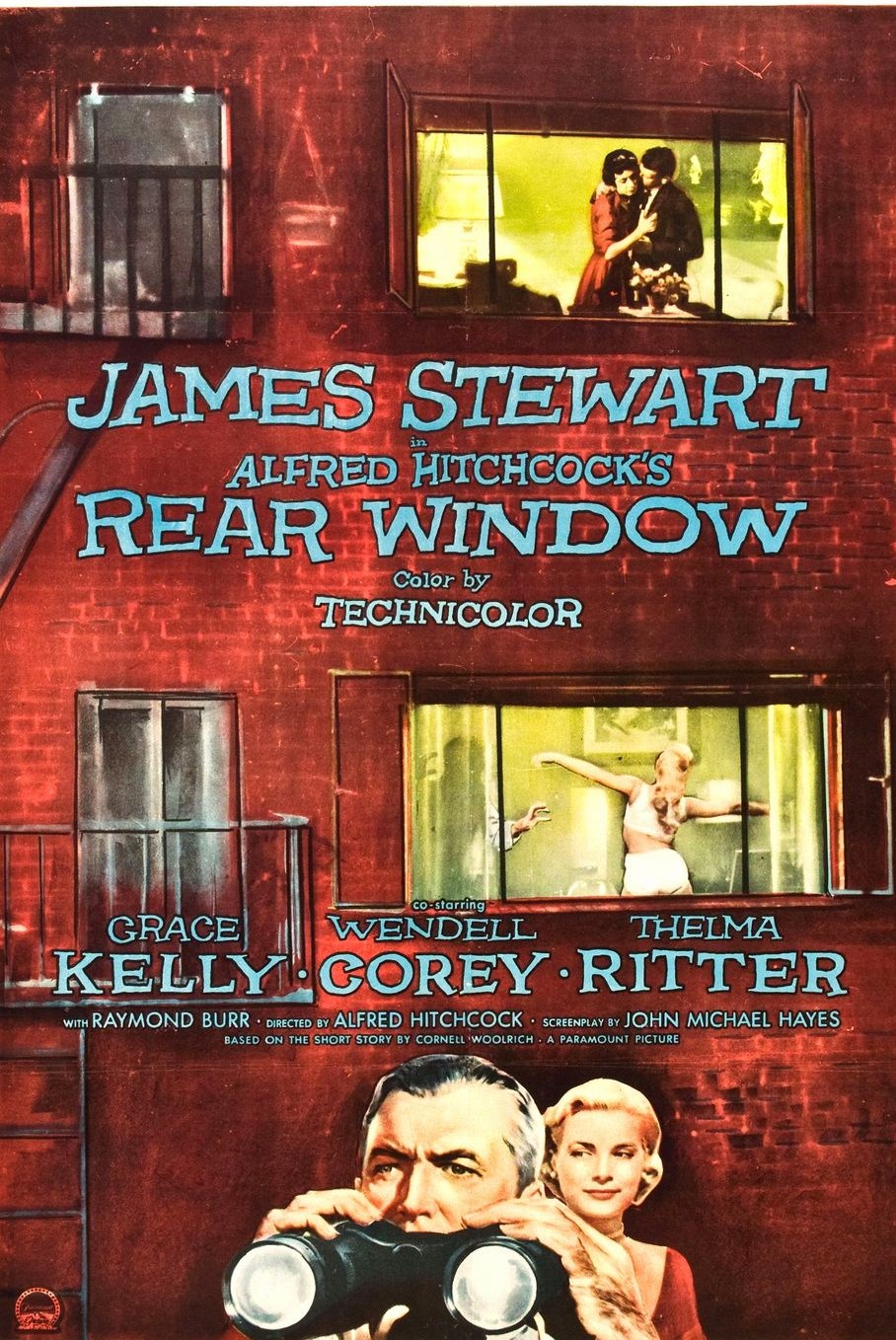
Image context: the hero image uses the 1954 theatrical poster as a release-era recognition cue for the film’s fused promises of glamour, danger, and apartment-window intimacy.[6]
Spoiler warning: this close reading discusses the opening setup, Lisa’s investigative turn, and the final apartment confrontation.
1) The opening courtyard scan: the film teaches us how to browse
The famous opening movement is a masterclass in compressed instruction. Before Jeff fully speaks, Hitchcock has already shown the heat, the open windows, the sleeping bodies, the courtyard routines, Jeff’s broken leg, his smashed camera, and the magazine photograph that explains how he got there. Vincent Canby called it “a model of condensed exposition,” and that is exactly right.[5]
But the scene does more than supply information. It trains attention. The camera pans across fragments of other people’s lives until the viewer begins to read the courtyard as a field of possible stories: Miss Torso dancing, the songwriter at the piano, Miss Lonelyhearts setting a table, the Thorwald apartment holding tension that has not yet declared itself.
This is where the film’s great trick begins. Looking feels casual, almost idle, yet the movie turns idleness into sorting. Because the windows are open, everyday life arrives pre-cut into visible units. Jeff’s immobilized body becomes the excuse for a spectator’s fantasy: all access, no exposure. BFI’s capsule note praises the film’s “brilliant use of image-sizing in the POV shots,” and that matters because scale is what keeps the act of watching pleasurable before it becomes ethically dirty.[3] The neighbors are near enough to be legible, far enough to feel manageable.
2) Lisa’s crossing: the movie stops treating romance as a side plot
A weaker film would keep Lisa Fremont as the elegant interruption to the “real” mystery. Rear Window does the opposite. It makes Lisa the person who exposes the limits of Jeff’s way of seeing.
Jeff’s problem is not that he lacks intelligence. It is that he prefers forms of relation that preserve distance. Belton’s summary gets to the nerve of it: Jeff prefers the freedom of seeing without being seen to the mutual demands of recognition.[2] That pattern governs the film before the murder case fully coheres. He is more comfortable turning neighbors into visual evidence than turning Lisa into a future.
This is why Lisa’s move across the courtyard matters so much. Once she enters Thorwald’s apartment, the geometry of the film changes. Jeff is still the one watching, but now the body at risk belongs to the woman he has kept trying to hold at a conceptual distance. The courtyard is no longer a theater of small human comedies. It becomes a corridor through which feeling has to travel. Hitchcock first sells Lisa as glamour, then makes Jeff watch glamour acquire bodily risk.
Critics in the 1950s often described Rear Window as a technical exercise, while later criticism pushed harder on the gendered nature of its spectatorship. The BFI Southbank programme note is useful here because it shows both histories at once: early reviewers marveled at technique, while later readers recognized that the film’s point of view is not neutral but organized through a distinctly male form of looking.[4] Lisa’s crossing turns that critical insight into drama. She is not just “helping the plot.” She forces the plot to reveal that detached spectatorship depends on somebody else absorbing the danger.
3) The flashbulb finale: looking works, until it has to defend a body
The climax is one of Hitchcock’s cruelest reversals. Jeff has spent the film converting sight into interpretation. By the time Thorwald enters the apartment, however, interpretation is finished. There is no more puzzle left to solve. There is only the fact that the object of Jeff’s gaze has crossed the distance and is now in the room.
The camera flash sequence matters because it is both effective and humiliating. Jeff weaponizes the tools of his profession, but only in a stalling way. Each flash buys a second. Each burst of overexposed light turns Thorwald into a blurred advance rather than a fully controlled image. The very instrument that let Jeff master distance now reveals its limit: a photograph can freeze, but it cannot protect.
Canby highlighted Thorwald’s line — “What do you want of me?” — as one of the film’s keys, because it suddenly throws the spectator’s entitlement back at the watcher.[5] The flashbulbs do something similar visually. They interrupt Jeff’s dominance over the field and replace it with panic, pain, and proximity. Looking does uncover truth in Rear Window. It just cannot keep truth from arriving bodily.
The last joke of the film is worth carrying into that reading. Jeff ends with two broken legs, Lisa appears for a beat to have accepted the domestic script he feared, and then quietly flips back to Harper’s Bazaar once he falls asleep. The gag is gentle, but it does not cancel the lesson. Hitchcock closes on a negotiated intimacy, not a conquered one: Jeff survives, Lisa stays, and the fantasy of risk-free spectatorship does not.
Why the film still feels current
Rear Window remains modern because it understands a durable temptation: distance can feel like innocence. The farther away other lives are, the easier they become to scan, rank, and narrate. Hitchcock builds enormous pleasure out of that condition, then shows the bill coming due.
That is also why the romance is inseparable from the thriller. Jeff’s real education is not simply that Thorwald is dangerous. It is that one-way vision is a poor model for intimacy. A person cannot stay forever in the position of the safe observer, whether in love or in crisis. The film’s last stretch is so satisfying because it does not merely solve a murder mystery. It wrecks the fantasy that spectatorship can remain clean, sovereign, and consequence-free.
Three things to watch on a rewatch
If you revisit Rear Window, three cues make the article’s argument easier to feel shot by shot:
- Watch the opening pan as a menu before you watch it as evidence. Hitchcock first teaches the pleasure of browsing, then turns that pleasure into suspicion.
- Listen to how the courtyard carries sound as well as images. The songwriter, arguments, and little domestic noises make the building feel socially continuous, which is why Jeff’s looking is never as detached as he imagines.
- Watch what happens to risk when Lisa crosses the courtyard. The movie’s moral temperature changes the instant Jeff’s gaze is no longer attached to a safe distance.
- Watch the flashbulbs as delay, not mastery. They still work, but only as borrowed seconds; the sequence is thrilling because the tool of control has already become a sign of helplessness.
Sources
- AFI Catalog, Rear Window (1954)
- Library of Congress, “Rear Window”: National Film Registry 30/30
- BFI, Rear Window (1954)
- BFI Southbank Programme Notes, “Refocusing the Spectator: a comparison of the critical response to ‘Rear Window’ in 1954 and on its re-release in 1983”
- Vincent Canby, “'Rear Window' - Still a Joy,” The New York Times archive (1983)
- Wikimedia Commons file record, Rear Window film poster