Dogme 95 is often reduced to a bag of surface traits: handheld camera, ugly video, no lights, no polish. That description catches the look and misses the wager. What Lars von Trier and Thomas Vinterberg actually did in 1995 was stranger and more ambitious. They tried to turn technical refusal into a moral claim. If cinema had become overproduced, cosmetically managed, and too dependent on machinery, then roughness itself could be recoded as a truth signal.
That is why Dogme mattered beyond Denmark, and why it still reads clearly in 2026. The movement did not simply make films cheaper. It made viewers treat instability, ambient noise, and visual imperfection as evidence that a film was getting closer to something socially raw. In that sense Dogme 95 was less a style than a new realism script.
The manifesto announced in Paris on 13 March 1995 framed itself as a “rescue action,” while the accompanying Vow of Chastity banned studio sets, non-diegetic music, special lighting, optical work, genre plotting, and even director credit.[1] Those rules are quoted so often that they can start to feel like a stunt. But the point was not obedience for its own sake. The rules were meant to break the prestige hierarchy by which expensive control automatically looked like artistic seriousness.
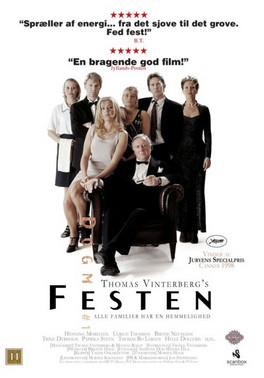
Image context: the hero image uses the Danish theatrical poster for Festen (1998), the first certified Dogme film and the movement’s first major international breakthrough.[4][7]
Dogme’s real invention was not handheld camerawork; it was a credibility contract
The manifesto’s rhetoric is extreme on purpose. It calls cinema “dead,” attacks illusion, and insists that the individual film is decadent unless discipline is imposed from outside the director’s ego.[1] Read literally, some of this sounds absurd. Read historically, it becomes clearer. Dogme arrived at a moment when lighter cameras and emerging digital practices were making production more accessible, while prestige cinema still tended to equate control, finish, and expense with value.
Dogme’s answer was to reverse the charge. Instead of apologizing for roughness, it treated roughness as purification. Instead of presenting limitation as lack, it presented limitation as method. The Vow’s bans on added music, artificial light, and optical manipulation were designed to stop filmmakers from reaching too quickly for emotional insurance. If a scene landed, it had to land through bodies, space, timing, and pressure inside the frame.[1]
That is why the movement traveled so far. Plenty of viewers never memorized the rules, but they learned the more portable lesson: if the image shakes, if the sound is awkward, if the room feels barely controlled, the film may be promising a closer encounter with social truth. Dogme helped teach audiences to read technical abrasion as seriousness.
It also helps to separate Dogme’s truth effect from literal truth. The movement did not magically remove mediation; it built a recognizable package of constraints that made viewers feel closer to unfiltered life. That distinction matters because it explains both sides of Dogme’s legacy: why the style could hit with unusual force, and why it could later be imitated, softened, or parodied once the roughness itself became legible as a code.[1][3]
Festen made the manifesto legible in one blow
Movements survive when they stop being theory and become a work someone can point to. For Dogme 95, that work was Thomas Vinterberg’s Festen (The Celebration), which premiered in competition at Cannes in 1998, won the Jury Prize, and instantly gave the movement a film that looked less like a pamphlet than a viable cinematic event.[4]
The premise is brutally efficient. An extended family gathers at a country-house hotel to celebrate patriarch Helge’s sixtieth birthday; during the dinner, his son Christian publicly accuses him of long-term sexual abuse.[7] On paper, that is strong drama already. What Dogme changes is the delivery system. The handheld image is not just there to feel immediate. It makes the family’s social choreography look unstable even before the moral structure collapses.
BFI’s 2023 guide to Dogme is good on this point because it describes Festen as the manifesto’s most convincing embodiment: the raw authenticity of the Handycam look is tied directly to the film’s commitment to ugly truth-telling rather than to decorative rebellion.[3] The visual roughness matters because the film is about bourgeois ritual failing to contain what the room knows. Toasts keep trying to preserve order; the image keeps suggesting that order is already cracked.
That is Dogme at full voltage. The technical restrictions do not merely create a look. They turn the room into a pressure chamber where manners, hierarchy, and denial can no longer hide behind elegant staging.
The contradiction was the engine: anti-style rules created one of the era’s strongest styles
Dogme 95 publicly rejected authorship as vanity and banned the director credit, yet almost immediately it became one of the easiest looks in world cinema to recognize.[1] This apparent contradiction is the movement’s real historical importance.
By trying to suppress expressive polish, Dogme accidentally created a highly exportable expressive package: handheld instability, available-light intimacy, collision-prone blocking, stripped-down sound, and the feeling that scenes were discovered in the act of happening. The very austerity that was supposed to erase signature became signature.
That is part of why the movement produced such different downstream works. Lars von Trier’s The Idiots pushed Dogme toward provocation and ethical discomfort; Søren Kragh-Jacobsen’s Mifune’s Last Song and Lone Scherfig’s Italian for Beginners showed that the same rough grammar could carry warmth, comedy, and romance instead of pure abrasion.[3] Once the format proved flexible, Dogme ceased to be only a manifesto and became a template for reclassifying low-budget immediacy as festival-grade intention.
The Danish Film Institute’s retrospective on Dogme emphasizes both sides of this story: the manifesto began as a rescue action against complacent film culture, but its traces persisted precisely because it changed what younger filmmakers felt newly permitted to do with less money and lighter tools.[2] That is the key. Dogme did not win by enforcing permanent purity. It won by normalizing a new threshold of acceptable roughness.
Why Denmark mattered, and why Dogme could not stay Danish
Dogme was born out of a very specific Danish moment, but it went global because its proposition was scalable. Peter Schepelern’s Kosmorama essay captures the local part well: from the Cannes premieres of Festen and The Idiots through the following years, Dogme became the word that made contemporary Danish cinema newly legible abroad, whether critics treated it as a serious intervention or a publicity stunt.[5]
That double status actually helped. As an idea, Dogme was easy to summarize. As a production method, it was cheap enough to imitate. As a publicity machine, it was irresistible: numbered certificates, confessions of rule-breaking, an anti-bourgeois tone, and films that looked visibly unlike prestige costume drama or high-gloss Hollywood export. Even people skeptical of its purity could understand its use.
Wikipedia’s overview is broadly right on the larger pattern: what began as a Danish avant-garde provocation expanded into an international network of certified films before formally ending in 2005, while its methods and myths spilled into later low-budget realism cultures.[6] The important point is not the final headcount. It is that Dogme’s central move escaped the movement itself. After the late 1990s, filmmakers no longer had to sign the Vow to borrow its legitimacy effects.
You can feel that afterlife everywhere: in digital chamber dramas that use shakiness as moral proximity, in festival films that foreground room tone and available light as proof of honesty, and even in prestige television that borrows documentary abrasion to suggest social access. Dogme’s rules faded; Dogme’s reading habits stayed.
Why the movement had to die for the method to win
Dogme officially dissolved in 2005.[2][6] In one sense that was inevitable. The stricter the rule set, the more quickly filmmakers either violate it, parody it, or absorb only its useful parts. Even early Dogme history included confessions, exceptions, and strategic slippages.[3] The movement’s own rhetoric about purity was always more theatrical than stable.
But that does not make Dogme a failure. It makes it unusually successful. Once digital image-making became ordinary and lightweight production spread everywhere, the manifesto no longer needed to survive as a governing institution. Its victory condition was cultural, not bureaucratic. Dogme helped recalibrate what realism could look and sound like under digital conditions, and it made a generation of viewers more willing to trust awkwardness.
That is why Festen still matters so much inside the movement’s history. It showed that the Dogme wager could generate not just a concept or a scandal but a fully legible, emotionally punishing film. Without Festen, the Vow might have remained a clever anti-cinema prank. With Festen, it became a route by which technical poverty could be reframed as dramatic force.
Where to enter Dogme 95 now
If you want the cleanest path into the movement, the order is still simple:
- Start with Festen for the strongest proof that Dogme’s restrictions could intensify performance and social violence rather than merely advertise austerity.[3][4]
- Go to The Idiots if you want the manifesto at its most confrontational and ethically unstable.[3]
- Add Mifune’s Last Song or Italian for Beginners to see how the same rough production grammar could soften into melancholy or comic humanism.[3]
Seen in that order, Dogme 95 stops looking like a set of commandments and starts looking like a historical hinge. It taught filmmakers that cheapness could be militant, and it taught audiences that a damaged surface might be part of the argument rather than a defect to be forgiven.
Sources
- P.O.V. / Aarhus University — “DOGMA 95” and “The Vow of Chastity”
- Danish Film Institute — “Dogme Revisited”
- BFI — “Where to begin with Dogme 95”
- Festival de Cannes — Festen (1998)
- Kosmorama — “After the Celebration: The Effect of Dogme on Danish Cinema”
- Wikipedia overview — Dogme 95
- Wikipedia overview — The Celebration / Festen
- Wikipedia file record — The Celebration poster