Lotte Reiniger's The Adventures of Prince Achmed is usually introduced through priority: 1926, Germany, silent, about 67 minutes, and widely described by the BFI as the earliest surviving animated feature film preserved in the BFI National Archive.[1] That label is true and useful, but it can make the film sound like a museum milestone first and a working movie second. The stronger way to approach Prince Achmed is through craft. Reiniger did not merely arrive early. She built a complete animation system out of inexpensive materials and made that system expressive enough to carry a feature-length fantasy.
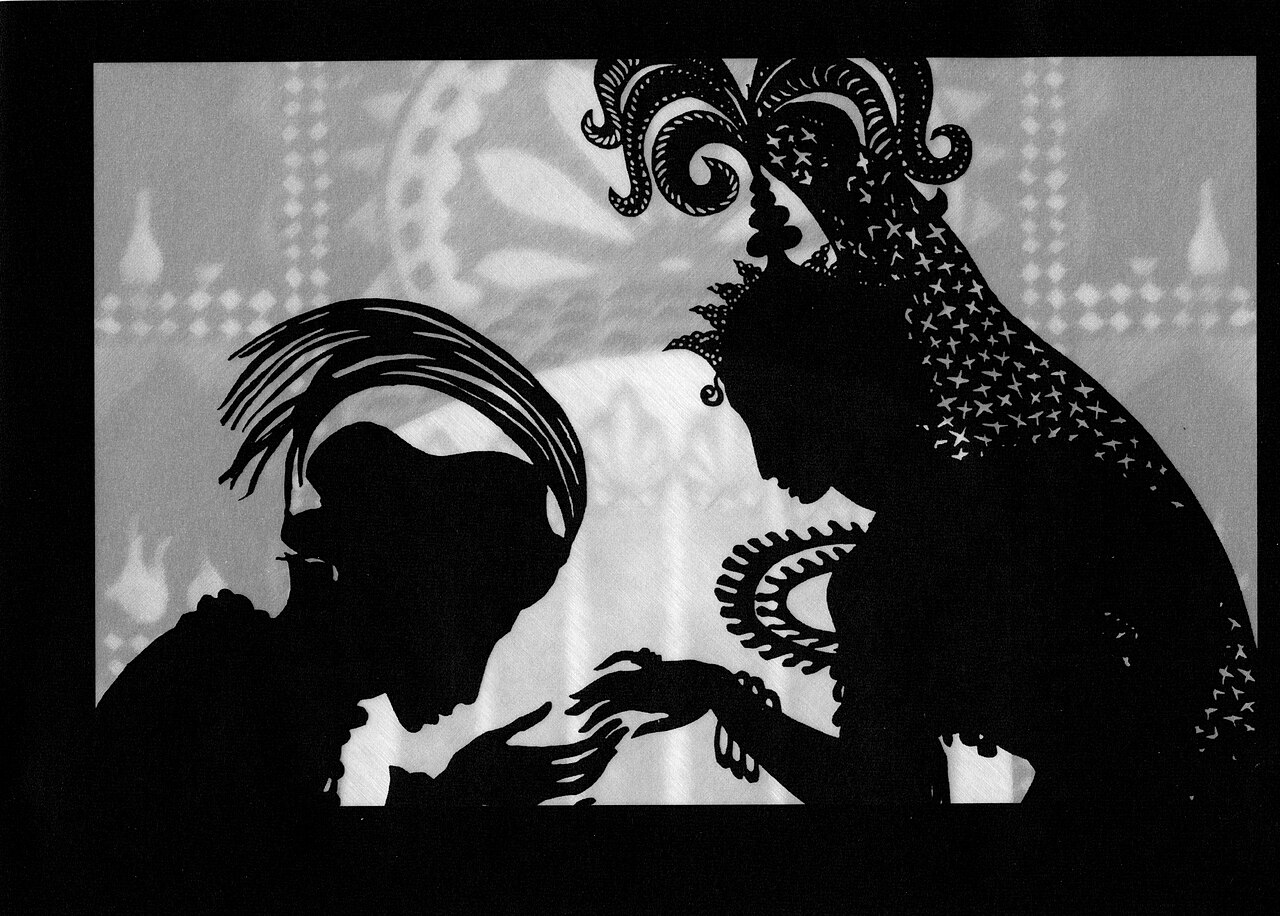
The still used here shows why the technique matters before the plot does.[5] There are no faces to read in the normal close-up sense, no modeled cheeks, no painted eye glints, no illusion that these bodies have escaped their material origin. The figures remain black cutouts. The world around them glows through tint and backlight. Yet the image is not thin. It has depth because the viewer reads relation: hand to branch, body to curve, lacework to empty air, motion implied by an edge held in tension. Reiniger's great technical wager was that cinema could make such relations feel alive.[1][3][5]
The feature begins with a constraint
The film's material facts are remarkably spare. BFI's release notes describe the characters as made in card, cut by hand, and manipulated using sheets of lead joined with wires.[1] BFI Screenonline places the production from 1923 to 1926 and names Carl Koch, Walther Ruttmann, and Berthold Bartosch among the collaborators around Reiniger's best-known work.[2] San Francisco Silent Film Festival's program essay adds the number that makes the labor legible: some 250,000 individual images assembled over three years.[3]
Those facts matter because they describe a technology of patience. A drawn animated feature can change a figure by redrawing it. Reiniger's system had another discipline. A shoulder, wrist, head, hip, or wing was a separate articulated part. Movement came from tiny physical adjustments, one exposure at a time. The animation therefore carries the memory of touch. When a sorcerer's hand rises, when a horse rears, when a dancer bends, the viewer can feel that the gesture was not poured into the frame by software or dissolved into painterly in-betweens. It was negotiated through joints, friction, and light.[1][3]
The constraint also gives the film its visual ethics. Because a silhouette with no facial detail cannot lean on expression in the usual way, the whole body has to speak. A wrist angle replaces an eyebrow. A bowed back replaces a line of dialogue. A sudden diagonal replaces panic. The image becomes readable at the level of posture, spacing, and rhythm. That is why the film's fairy-tale world feels direct even when its cultural borrowings now need historical distance and care. The surface is ornate; the acting grammar is elemental.[3]
Negative space does the acting
Silhouette animation makes absence productive. The figure is black, so detail migrates to the boundary. Everything important happens where body meets light. Reiniger's cutouts have delicate internal lacework in costumes, plants, architecture, and magical forms, but the primary drama remains edge-based: a sleeve curves, a sword points, a horse's neck snaps forward, a pair of arms opens into recognition. The film asks the viewer to read contour as emotion.
That is a different contract from later studio animation, where personality often gathers in eyes, mouth shapes, squash, stretch, and color design. In Prince Achmed, personality gathers in the pressure of a line. A figure can look noble, foolish, predatory, or tender because the contour has been tuned to that state. This makes the movie close to shadow theater, paper cutting, and dance, yet it is still distinctly cinematic. The camera does not merely record a stage. It converts tiny changes in silhouette into duration, sequence, and screen scale.[2][3]
The result is not minimalism in the ordinary sense. The backgrounds and ornamental details can be lavish, and the tinting gives each realm a different weather.[1][5] What is minimal is the acting channel. Reiniger strips human expression down to shape and then proves that shape can hold feeling. That achievement is easy to miss if the film is treated only as a predecessor to later animation history. Its point is not that later feature animation became more technically full. Its point is that a feature can be full by using fewer channels with extreme precision.
The camera table is also a world model
San Francisco Silent Film Festival's essay describes Carl Koch photographing the figures frame by frame from above into a table made from tiered planes of backlit glass.[3] That setup is more than a production anecdote. It explains how the film thinks about space. Figures, backgrounds, atmospheric effects, and ornamental layers can occupy different planes, so movement is built by shifting relations rather than by pretending the flat image has become a realistic three-dimensional world.
This is why Prince Achmed can move from Baghdad to China, from palace to island, from horse flight to demon combat, without losing coherence.[1] The film is not chasing naturalism. It is arranging layers of legibility. A foreground branch can frame the action. A glowing background can create distance. A figure can cross a plane and become either performer or ornament. The fairy-tale geography stays fluid because the technology itself is a layered map.
BFI's later feature on Reiniger's The Star of Bethlehem is useful for reading the working method across her career. It describes silhouette figures and special effects preserved by the BFI, including larger figures made for close shots and handmade materials that reveal how much problem-solving sat inside the craft.[4] Even though that article focuses on a later film, it clarifies the continuity of Reiniger's practice: the magic does not come from hiding the materials. It comes from knowing exactly when a larger puppet, a rougher texture, a flicker of colored material, or a differently scaled element will read on camera.[4]
Music turns craft into timing
Silent animation is never simply silent. BFI's product details list Prince Achmed as silent with music, and SFSFF emphasizes Wolfgang Zeller's original score as part of the production logic rather than an afterthought.[1][3] This matters because cutout animation depends on measured increments. A procession, a flight, a duel, or a transformation must be planned in pulses. Music gives those pulses a public body.
The film's best sequences therefore feel choreographed rather than merely illustrated. A flying horse does not just carry a prince across the frame; it establishes a tempo of lift, pause, and surge. A battle does not become legible through anatomical detail; it becomes legible through entrance, overlap, reversal, and rhythm. When the figures move with musical confidence, the limitation of silhouette becomes an advantage. The viewer is not distracted by skin, fabric, or facial realism. The eye follows timing.
That is also why the film still feels unexpectedly modern. A century of animation has made viewers fluent in transformation, impossible physics, and layered compositing. Prince Achmed reaches those pleasures from the other direction. It begins with paper and wire, then makes the frame elastic through timing. Its magic horse, demons, islands, and shape changes are not impressive because they mimic reality. They are impressive because they obey a crafted screen logic that reality cannot provide.[1][3]
The milestone matters because the system still works
Calling The Adventures of Prince Achmed the earliest surviving animated feature is historically important.[1] It also risks making the film sound protected by age. The film does not need that protection. Its craft remains active. The silhouette system clarifies action at a glance, turns negative space into expression, uses tinting as atmosphere, lets music organize movement, and makes handmade limitation feel like a world.
This is the deeper legacy. Reiniger's film does not stand at the beginning of animation because it predicts every later technique. It stands there because it shows how complete a technique can become when every limitation is converted into a rule of perception. Cardboard becomes body. Wire becomes joint. Glass becomes depth. Backlight becomes atmosphere. Music becomes motion. The feature survives as more than a first because its machine is still visible, still graceful, and still teaching the eye how little a movie needs when its materials know exactly what they are doing.[1][2][3][5]
Sources
- BFI Shop, "The Adventures of Prince Achmed (Dual Format Edition)" - release details, runtime, preservation note, and technical description of Reiniger's cutout method.
- BFI Screenonline, "Reiniger, Lotte (1899-1981)" - biography and production context for Reiniger's animation career and Prince Achmed.
- Jonathan Kiefer, "The Adventures of Prince Achmed," San Francisco Silent Film Festival - program essay on the film's production, camera table, frame count, music, and aesthetic force.
- James White, "Lotte Reiniger and The Star of Bethlehem," BFI - archival note on Reiniger's silhouette materials, special effects, conservation, and working method.
- Wikimedia Commons, "File:Lotte Reiniger Prinz Achmed 002.jpg" - 1926 archival image from Die Abenteuer des Prinzen Achmed used as the article image.