Spoiler warning: this article discusses the film's major emotional turns, including the final sequence.
Mikhail Kalatozov's The Cranes Are Flying is often remembered through one just phrase: the camera is free.[2] That freedom is not decorative. It is the film's way of thinking. In a wartime melodrama, a more conventional camera could have certified sacrifice, framed tears, and held the lovers apart as noble symbols. Kalatozov and cinematographer Sergei Urusevsky do something more volatile. They make grief move. The camera climbs a stairwell, runs through crowds, rides the shock of a bombing, and turns Veronika's private devastation into a changing field of streets, railings, rubble, sound, and human bodies.[1][2]
That is why the film still feels alive inside its 1957 Soviet context. Criterion frames it as a post-Stalin landmark: a story of Veronika and Boris separated by World War II, made with emotional intensity and "gravity-defying" cinematography, and later restored in a 2K edition that foregrounds its visual force.[1] Chris Fujiwara's Criterion essay places it inside the Soviet thaw, when filmmakers could move away from the stiff optimism of late Stalinist cinema toward more personal, wounded forms of wartime memory.[2] The Cranes Are Flying is patriotic, but its patriotism is routed through damage. It does not ask Veronika to become an emblem before she has been allowed to become a person.[2][4]
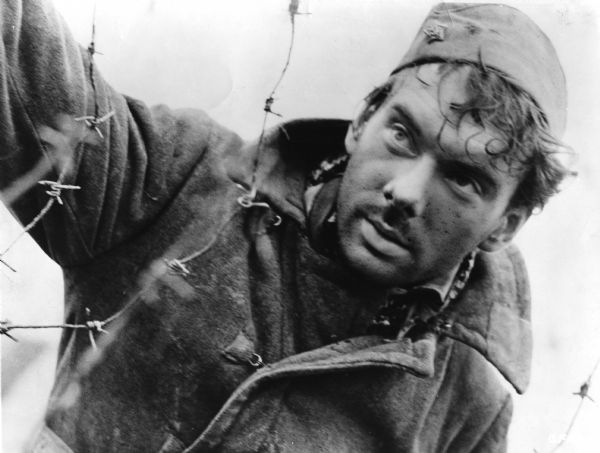
The archival still used here shows Aleksey Batalov as Boris at the front, a soldier pressed into barbed-wire space.[5] It is not the film's most famous image, and that is exactly why it works. Boris becomes an absence around which the movie's moving forms keep reorganizing. The front is real, but for Veronika it is also a gap, a rumor, a delayed letter, a face that memory keeps trying to recover. The still fixes the military fact. The film itself keeps asking what happens to everyone left moving around that fixed fact.[1][2][5]
The opening makes happiness kinetic
The film begins before war has language. Veronika and Boris move through early-morning Moscow as if the city, the sky, and the relationship briefly belong to one rhythm.[2] Fujiwara notes how Kalatozov places the lovers' dawn idyll before the main titles, giving it a self-contained quality, almost outside historical time.[2] The point is not simply that they are young and in love. The point is that the camera grants their happiness spatial permission. High angles, low angles, streets, stairwells, and sky all seem to expand with them.
This matters because the rest of the movie will keep returning to movement under harsher conditions. The famous stairwell movement, where Boris runs upward after Veronika and the camera whips around the open center of the building, is not only a bravura flourish.[2][4] It establishes a grammar: feeling in this film will not sit still. It will climb, pivot, lurch, and expose its own instability. Even before the war arrives, Kalatozov has taught the viewer that love is not a posed image. It is motion under pressure.
The beauty of the opening therefore contains its own wound. If love is defined by movement, then separation will also be felt as broken movement. Boris can be drafted, Veronika can run too late, a crowd can swallow a farewell, and the same mobile camera that once opened the world can begin measuring how inaccessible it has become.[1][2]
Veronika's lateness becomes public space
The departure sequence is one of the great demonstrations of how cinema can make private urgency collide with history. Veronika arrives too late for Boris's farewell, then moves into the crowd trying to reach him. Fujiwara describes the shot's extraordinary elasticity: the camera leaves the bus with her, tracks her through the mass of people, crosses the moving tanks, and rises to look down over the scene.[2] The technique is astonishing, but the emotional logic is even stronger. Veronika's loss is not isolated in a close-up. It is scattered into public space.
That choice changes the meaning of wartime spectacle. The crowd is not a patriotic backdrop arranged behind a heroine. It is a living obstacle, an archive of parallel griefs, and a pressure system that makes one person both singular and nearly invisible.[2][4] Veronika is the film's emotional center, yet the camera refuses to pretend that history has cleared a path for her. Her love has to move through buses, uniforms, tanks, bodies, smoke, and distance.
This is where the film breaks with tidy wartime uplift. Cannes's later Palme d'Or roll call records The Cranes Are Flying as the 1958 winner, a fact that helped make its international reputation durable.[3] What traveled so powerfully was not a simple message of national endurance. It was the film's ability to show endurance as an unstable choreography. Veronika keeps moving because stillness would mean collapse, but movement does not guarantee rescue.[2][3]
The camera gives shame a physical route
The film's most painful passages are built around Veronika after Boris has gone. Her parents die in an air raid. Mark's pressure and cowardice close around her. She marries him, and the world around her becomes harder to inhabit.[1][2] A less daring film might have turned this into moral accounting: betrayal, punishment, redemption. Kalatozov instead treats shame as a route through space.
Fujiwara singles out the sequence in which Veronika, wounded by Fyodor's denunciation of faithless women, rushes into the street and toward the train tracks. The camera runs with her, climbs the pedestrian bridge, and turns the image into jagged graphic force.[2] The movement is not there to glamorize despair. It makes despair legible as acceleration. Veronika's body becomes the place where accusation, grief, exhaustion, and survivor's guilt all try to travel at once.
This is one reason Tatiana Samoilova's performance remains so powerful. Criterion's film page identifies her as Veronika and Batalov as Boris, but the movie's real achievement is not casting alone.[1] Samoilova gives the camera a face that can be luminous, awkward, panicked, closed, and open in quick succession. The camera does not simply admire that face. It follows the body that carries it: across streets, through interiors, into crowds, toward danger, away from judgment.[2]
War appears as altered architecture
One of the film's sharpest visual ideas is that war changes space before everyone has found words for it. After the departure for the front, Veronika exits a phone booth and the camera reveals that Moscow has filled with X-shaped anti-tank obstacles.[2] Later, after an air raid, the camera's movement discovers the ruined apartment at the same time Veronika does.[2] The effect is devastating because the film does not treat destruction as a report. It makes destruction arrive as a changed room.
That method keeps the movie from becoming abstract. The war is vast, but Kalatozov makes it readable through thresholds: a staircase no longer means reunion, a doorway opens onto rubble, a phone booth releases Veronika into a militarized street, a crowd turns a farewell into a maze.[2] The moving camera is therefore not a sign of formal exuberance alone. It is a sensing device. It discovers how history has altered the surfaces through which daily life used to pass.
The Wisconsin archival record for the lead image is useful here because it names the still as a 1957 photographic print of Batalov as Boris, a soldier at the front.[5] The image reminds us that Boris's part of the story is materially military: uniform, wire, battlefield risk. Yet the film's deepest originality lies in showing that the home front is also a battlefield of altered architecture, moral pressure, and broken routes.[1][2][5]
The ending turns return into redistribution
The final sequence, with Veronika holding flowers in the crowd and discovering that Boris will not return, could have become pure private bereavement. Kalatozov makes it stranger and larger. Veronika's flowers do not remain a sealed offering for one dead man. They move outward. The gesture of giving becomes a way of surviving the fact that the beloved has been absorbed into a collective loss.
This does not erase Boris. It changes the form of fidelity. The cranes of the title return as a visual and emotional pattern, linking the lovers' lost dawn to a public scene after victory.[2] The film's closing force depends on that double register. Veronika remains marked by one absence, but she is no longer trapped inside a private corridor of grief. The crowd that once blocked her farewell now becomes the space through which mourning can be redistributed.
That is why The Cranes Are Flying deserves to be read as more than a showcase for camera movement. Its camera is free because the film needs a form equal to unstable feeling.[1][2][4] It refuses to turn war into a sequence of fixed monuments. It runs through the spaces where people learn news too late, choose badly under pressure, lose homes, misread one another, and still keep moving. The camera does not save Veronika. It gives her grief a world large enough to move through.[2][3]
Sources
- The Criterion Collection, "The Cranes Are Flying (1957)" film page - credits, restoration notes, cast, synopsis, and production context.
- Chris Fujiwara, "The Cranes Are Flying: A Free Camera," The Criterion Collection - essay on the film's Soviet thaw context, camera movement, sound, and key sequences.
- Festival de Cannes, "Palme d'or: the 1950s" - official Cannes page listing The Cranes Are Flying as the 1958 Palme d'Or winner.
- Chicago Film Society, "The Cranes Are Flying" screening note - contextual note on Kalatozov, Urusevsky, Soviet thaw filmmaking, and the film's camera choreography.
- Wisconsin Historical Society, "Aleksey Batalov in Letyat zhuravli (The Cranes are Flying)" - 1957 photographic publicity still used as the article image.