Preston Sturges is often introduced as the first great Hollywood screenwriter who forced his way into the director's chair.[1][4] That is true, and it matters. But it does not quite explain why his best films still feel so electrically unstable. Plenty of writer-directors control tone, dialogue, and structure. Sturges controls velocity. In his comedies, money changes the emotional weather in seconds, class rank is a costume that can tear mid-scene, desire arrives as both seduction and tactical improvisation, and a room full of secondary players can turn a private problem into a public stampede before the protagonist has caught up.[2][3][5][6]
That is why his cinema still feels sharper than the polite label "screwball" sometimes suggests.[2][6] The jokes are wonderful, of course, and the dialogue can sound as if it were written to outrun ordinary breathing. But Sturges's deeper subject is American self-invention under stress. His characters are always improvising a social self: heiress, genius, reformer, respectable husband, war hero, sophisticated lady, practical businessman.[1][2][6] The comedy comes from how quickly those identities start slipping once money, appetite, vanity, or plain bad timing enters the frame.
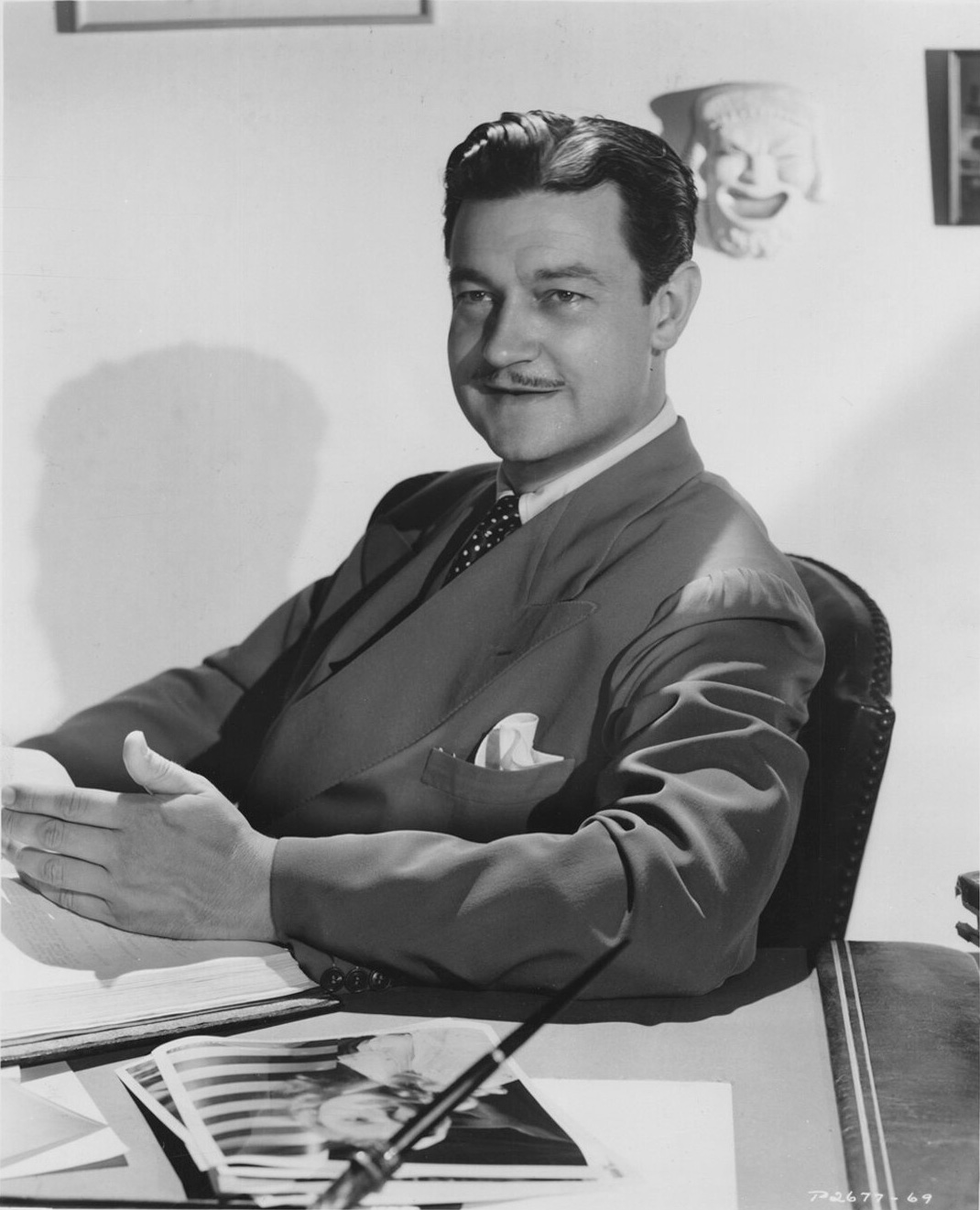
Image context: the lead image uses a real 1941 Paramount portrait preserved on Wikimedia Commons.[7] It fits this piece better than a single film still because the article is about a directorial method spread across a furious cluster of pictures, all made while Sturges was converting screenwriting intelligence into one of the fastest comic machines Hollywood ever built.
Sturges made authorship feel like a traffic problem
Britannica and Criterion both stress the historical headline: Sturges became the first prominent American screenwriter to break through decisively as a director, and his 1940-1944 Paramount run remains astonishing for its speed and concentration.[1][4] Yet the more interesting fact is how that authorship behaves onscreen. It does not announce itself through solemn control. It announces itself through managed overload. Sturges writes like a playwright who loves collision, then directs as if every collision ought to produce three more before the audience has fully processed the first one.[2][4]
That is why his films are so densely peopled with useful eccentrics.[2][5][6] Side characters in Sturges do not merely decorate the margins. They increase pressure. A valet, a millionaire, a platoon of veterans, a band of drunks, a father with money, or a roomful of executives can push the protagonist into a new moral posture in a handful of lines. The result is a world where personality is never private for long. Society in Sturges is loud, interventionist, and perpetually ready to turn temperament into spectacle.
Senses of Cinema is especially good on the darker undercurrent in all this.[2] Beneath the comic speed lies a recurring suspicion that American life rewards appearance faster than substance. That suspicion does not make Sturges sour. It makes him exact. He knows charm can be a hustle, authority can be theatrical, and public honor can be manufactured by a crowd that wants a flattering story more than a true one. His films laugh hard because they do not trust prestige very much.
In The Lady Eve, class is a bodily accident waiting to happen
No Sturges film makes that principle more graceful than The Lady Eve.[3][8] Barbara Stanwyck's Jean Harrington is at once con artist, strategist, romantic lead, and social inventor. Henry Fonda's Charles Pike arrives with money, innocence, and scientific prestige, but Sturges immediately treats those qualities as comic vulnerabilities rather than as stable possessions.[3][8] The whole film runs on a delicious premise: class confidence is fragile because the body is fragile. One fall, one glance, one badly timed entrance, and dignity can collapse into furniture.
Criterion's The Lady Eve essay is valuable here because it frames the movie as a high-risk act that somehow turns pratfalls, erotic charge, and emotional tenderness into one seamless comic system.[3] BFI's note on the film is equally helpful in naming the class dimension directly: Jean's masquerade as "Lady Eve" works because American wealth is already eager to believe in imported glamour, especially when glamour gives desire a better costume.[8] Sturges does not treat social rank as a deep essence. He treats it as a performance that can be gamed by anyone quick enough to read the room.
That quickness is the point. Jean wins scenes not because she is symbolically "liberated" in some abstract way, but because she can think faster than the social codes supposedly containing her.[3][8] Sturges's great comic intuition is that humiliation is democratic. The rich fall. The expert falls. The seducer falls. Love itself enters through imbalance.
Sullivan's Travels turns seriousness into another kind of performance test
If The Lady Eve is the erotic version of Sturges's method, Sullivan's Travels is the self-portrait.[4][6] Criterion's essay notes how unusually direct the identification is: John L. Sullivan is the rare Sturges protagonist who shares the filmmaker's profession, and the film keeps circling the problem of what a comedy director owes the world beyond amusement.[4] That question could have become a pious defense of social realism. Sturges chooses a much more volatile route. He makes seriousness itself look like a social costume that can harden into vanity.
Sullivan wants to suffer in order to earn significance.[4][6] The satire bites because Sturges can see both sides of the impulse. He understands the lure of making important art, and he understands how quickly that ambition can become a form of self-dramatization once privilege decides to go slumming for insight.[4][6] The film therefore keeps shifting registers: Hollywood satire, road comedy, prison nightmare, folk parable. Instead of smoothing those modes into one respectable tone, Sturges lets them scrape against one another.
What emerges is not an anti-intellectual defense of lightweight entertainment. It is a defense of comic form as a public good.[4][6] Laughter in Sturges is not escapism because it solves injustice. It matters because it briefly creates common feeling in a world stratified by money, status, and pretense. That is a subtler and harder claim.
In The Palm Beach Story, money does not corrupt romance; it accelerates it
The Palm Beach Story may be Sturges's cleanest demonstration that economic pressure can be comic without becoming trivial.[5][6] The marriage at its center is affectionate, sexy, and financially impossible. That mismatch gives the film its whirling momentum. Gerry and Tom are not just deciding whether they love each other. They are trying to discover what love can look like when cash, pride, gifts, class fantasy, and absurdly generous millionaires keep changing the terms of the relationship.[5]
Criterion's essay on the film makes the key point beautifully: Sturges substitutes candor for romantic piety, and the movie becomes more moving for it.[5] Money is everywhere, but it is never reduced to a sermon. Wealth can be humiliating, liberating, vulgar, useful, and weirdly benevolent within the same reel.[5][6] That tonal flexibility is pure Sturges. He does not simplify capitalism into a villain. He treats it as a manic delivery system that keeps sending people into moral and emotional contortions.
This is one reason the films still feel modern. Sturges knows that material life does not sit outside romance as a secondary issue. It is inside the tempo of every argument, every flirtation, every self-deception.[5][6] His lovers tumble because budgets, fantasies, and bodies keep colliding.
Public myth is the last machine he takes apart
To stop at romance would make Sturges seem lighter than he is. Britannica and Senses of Cinema both point toward Hail the Conquering Hero as proof that his comic engine could also dismantle American hero manufacture.[1][2] The discharged Marine mistaken for a war celebrity becomes the perfect Sturges protagonist because he is personally decent and publicly false at the same time. The town wants a legend, and legend arrives faster than verification.
That pattern reaches toward the core of Sturges's worldview.[1][2][6] Crowds are funny in his films, but they are also dangerous because they love a usable story. Prestige sticks to surfaces. Institutions reward performance. The line between civic warmth and civic delusion can disappear overnight if enough people decide to clap. Sturges does not answer that instability with bitterness. He answers it with velocity, exposing the fraud before it can settle into decorum.
That is why his best work lasts. The films move quickly because the society they describe moves quickly. Everybody is improvising status; everybody is trying to stay upright; everybody is one accident away from revelation. Sturges turned that condition into style. He made American comedy run like a jammed luxury machine throwing off sparks, pratfalls, and moments of grace all at once.[2][3][4][5][6]
Sources
- Encyclopaedia Britannica, "Preston Sturges" biography page.
- Jonas Varsted Kirkegaard, "Sturges, Preston," Senses of Cinema.
- Imogen Sara Smith, "Chef du Cinema: The Lady Eve," The Criterion Collection.
- Todd McCarthy, "Sullivan's Travels," The Criterion Collection.
- Stephanie Zacharek, "The Palm Beach Story: Love in a Warm Climate," The Criterion Collection.
- Matthew Thrift, "Preston Sturges: 10 essential films," BFI.
- Wikimedia Commons, "File:Preston Sturges.jpg" archival portrait page.
- BFI, "The Lady Eve (1941)" film page.