Spoiler note: this essay discusses major scenes from My Darling Clementine, including James Earp's death, the church dance, and the O.K. Corral gunfight.
John Ford's My Darling Clementine is often introduced through legend: Wyatt Earp, Doc Holliday, Tombstone, and the shootout at the O.K. Corral.[1][2][4][5] Those names matter, but they can misdirect a first reading of the film. Ford is not mainly trying to give the western a cleaner historical record or a louder action climax. He is using frontier myth to ask a different genre question: what does a western look like when it pauses long enough to show a town trying to become a town? The answer arrives through posture and public ritual. Porches, barber chairs, saloon floors, church beams, and a dance under unfinished rafters matter as much as gun belts.
That is why the film feels both classical and unexpectedly gentle.[1][2][3] The violence is real, but it is not staged as the whole point of western life. Criterion's film page calls the movie a story of the triumph of civilization over the Wild West, and that phrase is useful so long as "civilization" is read concretely.[1] In Ford's hands, it means small acts of form: washing up, shaving, standing watch, showing up to dance, deciding where a church will stand, and learning whether law can look relaxed without dissolving into drift. The western here is not only a genre of chase and showdown. It is a genre of provisional public order.
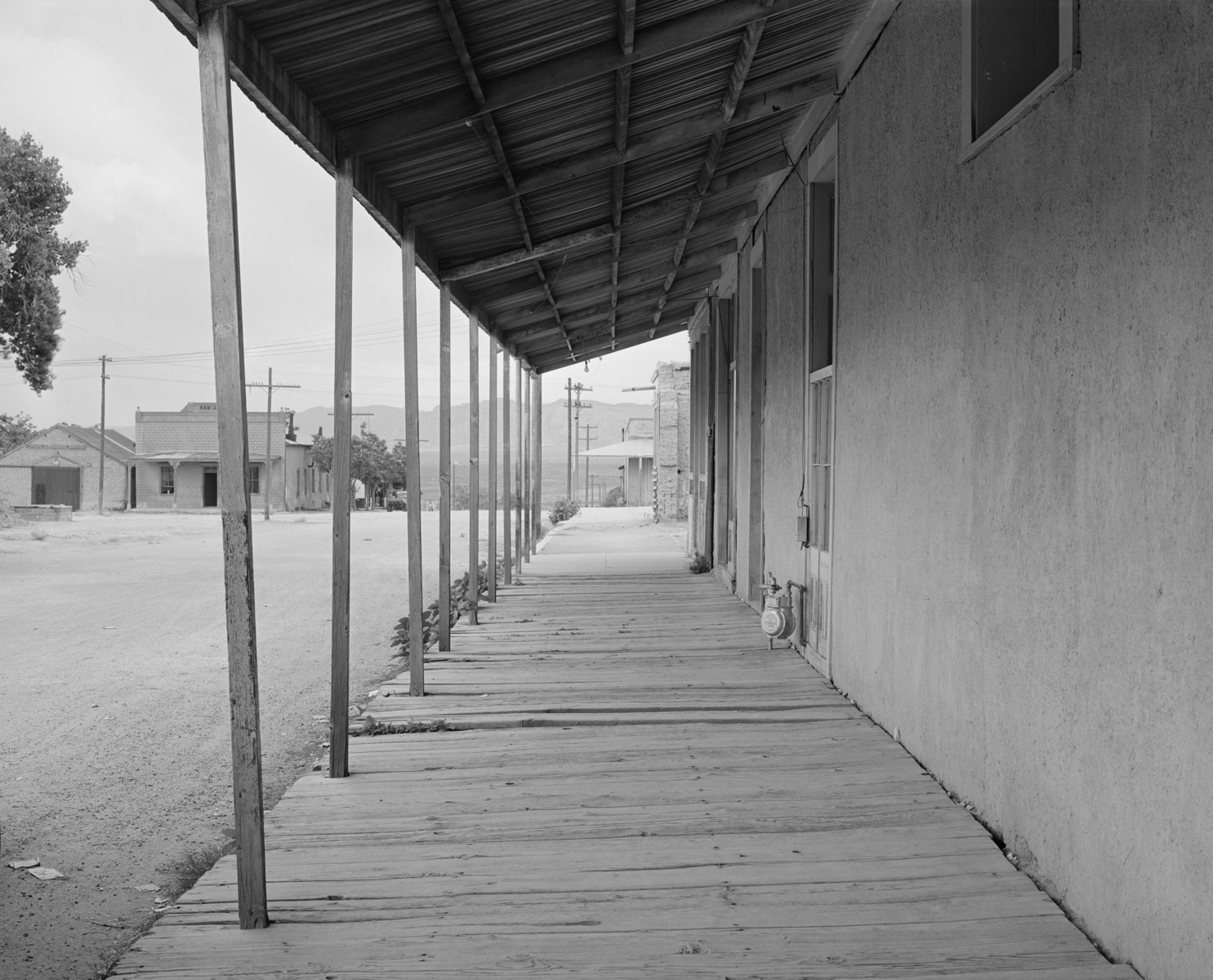
Image context: the lead image uses a real 1940 photograph of a covered board sidewalk in Tombstone, Arizona, preserved on Wikimedia Commons.[6] It is the right image for this essay because it avoids title cards and analytical graphics while grounding the film's civic argument in the material grammar of the western town: porch, street, storefront, shade, and public passage.
Tombstone is introduced as a place without settled form
The plot begins with motion and loss. Wyatt Earp and his brothers arrive with cattle, drift toward Tombstone, and are quickly pulled into a local disorder that becomes personal after James is killed.[1][2] Yet even in this opening movement, Ford resists the western as pure velocity. David Jenkins's Criterion essay is especially sharp on the town's condition: Tombstone is wide open, unfinished, and morally unsettled, a place where structure has not yet fully been imposed.[2] That does not mean the movie lacks action. It means action serves a slower transformation.
The Library of Congress National Film Registry note helps define the split between history and genre. It says Ford had heard Wyatt Earp's own tall-tale version of the O.K. Corral story when he was young and later bent history freely in My Darling Clementine.[4] The film is therefore operating in a distinctly western key. It takes names and incidents from frontier lore, but its deeper work lies in arranging them into a public fable about how rough space becomes civic space. Clementine herself is summarized by the Library of Congress as representing the new civilized Tombstone, and that is exactly how Ford uses her.[4] She is less a psychologically complex heroine than a force of social shape.
This is why Tombstone's buildings matter so much. They are not yet a secure townscape. They feel temporary, exposed, and permeable.[2][3] People drift through the street, gather in the saloon, lean on wood railings, improvise authority, and try on roles that may not hold. In many westerns, architecture becomes a backdrop for conflict. Here it is the conflict's subject. The town is trying to decide whether it will remain a "wide-open" stopover or harden into a place where law, worship, schooling, and courtship can take recognizable form.[2]
Wyatt Earp turns stillness into authority
One of Ford's strangest achievements is making Wyatt Earp's calm more memorable than his gunfire.[1][2] Henry Fonda's Wyatt does not swagger constantly or explain himself at length. He leans, waits, watches, and lets time gather around him. Jenkins calls attention to the famous chair-balancing and porch-sitting rhythms, and they matter because they turn western authority into posture rather than theatrical domination.[2] Wyatt looks like a man who has already learned that order is made as much from patience as from force.
That choice is crucial for genre context. The classical western often depends on the arrival of a competent figure who can stabilize a frontier environment. My Darling Clementine keeps that structure, but Ford drains it of brag. Wyatt becomes marshal partly to settle a private score, yet his authority keeps being tested in public, low-temperature scenes: at the barber, in the street, near the hotel, on the porch, in conversation with Doc.[1][2] The point is not that he can outshoot everybody, though he can. The point is that he can occupy the town's in-between spaces without panicking or overperforming.
That stillness changes the whole tempo of the film. It is one reason the movie can feel, as Jenkins says, almost like an "antiwestern" in mood even while remaining fully committed to western material.[2] Ford slows the genre until ordinary civic gestures begin to glow. The western hero does not just clear space through violence. He models how to inhabit a space that might become civil.
The church dance shows the genre trying on ceremony
The film's most revealing scene may be the social dance at the unfinished church.[1][2][4] Westerns are full of saloons, shootouts, and trail movement; Ford stops for a public gathering under beams that are still visibly skeletal. The building is not complete. That incompletion is the whole point. Ceremony arrives before the town is finished, almost as a wager that the town can become worthy of the ritual it is already staging.
This is where Clementine becomes more than a love interest.[1][4] She enters Tombstone carrying eastern poise, schoolmarm possibility, and a steadier relation to manners than the town yet possesses. When Wyatt dances with her, Ford is not merely inserting romance into frontier narrative. He is letting the western rehearse one of its foundational dreams: that rough male movement can be slowed, partnered, and brought into measured public form.
The scene also clarifies why Ford's western imagination is never only about conquest. American flags, church framing, community gathering, and music all signal institution-building, but the movie does not pretend the work is done.[2][4] The floor is still temporary. The town's violence still runs underneath. Doc Holliday and Chihuahua remain near the edges of the civic picture, reminders that illness, jealousy, class resentment, and fatigue do not disappear just because a dance has begun. The genre's ideal of civilization is therefore shown as fragile, not automatic.
Doc Holliday keeps the western from becoming a simple progress myth
If Clementine points toward civic order, Doc Holliday keeps exposing its cost and incompleteness.[1][2][4] Victor Mature's performance gives the film its other center of gravity. The Library of Congress note emphasizes how memorable Ford's treatment of Holliday is, and Jenkins goes further, describing the way his face and rooms are often sunk in shadow and regret.[2][4] Doc is educated, ruined, theatrical, and already half outside the future that Tombstone is trying to build.
That matters for genre because the western often stages transition by splitting figures between past and future. In My Darling Clementine, Wyatt can enter the town's emergent civic role; Doc cannot do so cleanly. He carries illness, failed vocation, and exhausted charisma with him. His medical diplomas on the wall are among the film's most poignant props because they turn a room into an afterimage of another life.[2] The western's movement toward public order therefore produces residue. Someone is always left out, or left behind, by the new form.
The film becomes richer precisely because Ford refuses a neat opposition between good marshal and bad outlaw. Wyatt needs Doc. Their alliance at the O.K. Corral is what lets Tombstone's crisis be settled at all.[1][2] Civic form is born through damaged intermediaries, not spotless founders.
The O.K. Corral gunfight clears space more than it provides spectacle
The most famous incident in the film arrives almost late and almost quietly.[1][2][5] By the time Ford stages the O.K. Corral confrontation, he has already taught the viewer to watch streets, porches, interiors, and gathering places as seriously as combat zones. Jenkins notes the startling restraint of the sequence: sparse dialogue, little musical support, and even a stagecoach cutting across the action, as if to remind us that town life continues on another track while myth is being made.[2]
That restraint is the real genre lesson. In many later westerns, the gunfight becomes the whole symbolic center, the place where identity reaches terminal clarity. My Darling Clementine handles violence differently. The showdown matters because it removes an obstacle to town form. It clears space. It does not replace the church dance, the porch, the barber chair, or the schoolmarm future; it exists so those quieter civic possibilities might continue.
This is also where the actual history becomes useful as contrast. The National Park Service page on Virgil Earp stresses that the real O.K. Corral gunfight was brief, contested, and heavily mythologized afterward.[5] Ford knows this world belongs to legend already. He leans into that fact, but instead of inflating the gunfight into pure thunder, he folds it back into the western's larger problem of social shape. The shootout is one episode in the making of a town, not the town's sole meaning.
That is why My Darling Clementine remains so central to the genre.[1][2][3][4] It does not treat the West as a permanent carnival of lawlessness, and it does not romanticize civic progress as clean uplift either. It shows a public world being improvised out of grief, posture, ritual, violence, and desire. Ford slows the western down until its deepest subject becomes visible: not just frontier action, but the fragile moment when open ground starts learning the habits of a town.
Sources
- The Criterion Collection, "My Darling Clementine" film page.
- David Jenkins, "My Darling Clementine: The Great Beyond," The Criterion Collection.
- BFI, "My Darling Clementine (1946)" film page.
- Library of Congress, "My Darling Clementine (1946)," National Film Registry: Brief Descriptions and Expanded Essays of National Film Registry Titles.
- U.S. National Park Service, "Virgil Earp," Homestead National Historical Park.
- Wikimedia Commons, "File:Covered board sidewalk in Tombstone, Arizona - May 1940 (cropped).jpg" real Tombstone street photograph used for the cover image.