John Cassavetes's Opening Night is often introduced as the story of an actress in crisis, and that is true as far as it goes.[1][3][4][5] Myrtle Gordon drinks too much, fears aging, sees a teenage fan die after a performance, and starts coming apart during out-of-town tryouts for a Broadway play.[1][4][5] But that description can make the film sound more clinical than it is, as if Cassavetes were simply charting a breakdown. What he actually does is stranger and more frightening. He turns performance itself into a hostile environment. In Opening Night, a dressing room mirror can feel like a second audience, a backstage hallway can stretch into a moral tunnel, and the stage can stop being the place where a character is hidden and become the place where hiding fails.[1][2][4]
That is why the movie hits so hard.[2][5] Myrtle is not only afraid of becoming older or less desirable. She is afraid that the role offered to her in The Second Woman is already a verdict on her life.[2][4] Dennis Lim's Criterion essay catches the decisive pressure: Myrtle is flatly refusing the prescribed roles being handed to her, onstage and off.[2] Cassavetes builds the entire film around that refusal. The plot does not move toward a neat cure, a clean collapse, or a triumphant act of professionalism. It keeps asking what happens when a performer can no longer tell where the script ends and where the self begins.
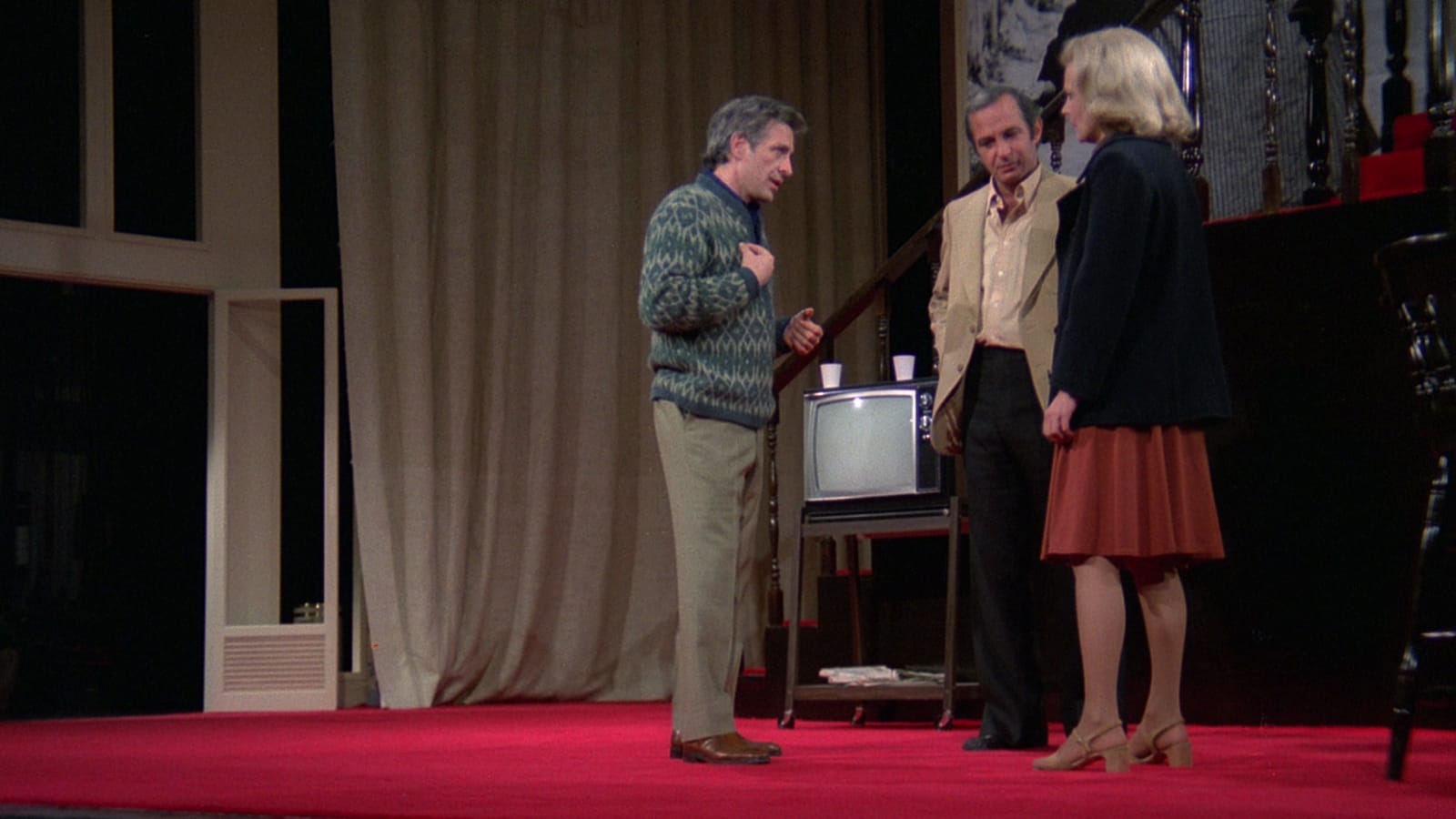
Image context: the cover uses a Criterion still from the stage-play material inside Opening Night, showing Myrtle with Manny and Maurice on a bare set.[6] It is the right recognition image because the article's argument is not that Myrtle suffers somewhere private and then performs somewhere public. Cassavetes keeps forcing both conditions into the same exposed theatrical space.
Mirrors make age feel like a public event
One of the film's most punishing ideas is that age is not presented to Myrtle as private knowledge.[1][2][4] It is staged back at her. The mirror is never just a reflective surface. It behaves like a device that turns self-scrutiny into performance. MoMA's capsule is blunt on the point, noting that Myrtle drinks against the wrinkles she sees each morning as well as against the shock of the dead fan's possible claim on her conscience.[4] Cassavetes does not treat those wrinkles as vanity alone. He treats them as a role arriving too early, before Myrtle has agreed to play it.
This is where the play within the film matters. Sarah Goode has written The Second Woman as a script about female aging, compromise, and emotional management, which means Myrtle is being asked to embody a settled version of womanhood she experiences as deadening.[2] Lim notes her insistence that she wants to find a way of playing the part in which age "doesn't make any difference."[2] That line is desperate, but it is also formally exact. Cassavetes is making a movie about what happens when an actor rejects the explanatory frame that everyone else around her has already accepted. The crisis is not only psychological. It is interpretive. Other people think they know what Myrtle means now.
The force of Gena Rowlands's performance comes from how badly Myrtle wants to escape that advance interpretation.[1][2][5] She lashes out, drifts, seduces, pleads, and sabotages because each gesture is really a fight over authorship. If she delivers the part as written, she fears she will be consenting to someone else's story about her future. The mirror therefore becomes less an object than a rehearsal partner she cannot dismiss.
Backstage corridors turn every conversation into rehearsal under pressure
Cassavetes sets much of the film in liminal theatrical space for a reason.[2][4] Corridors, dressing rooms, wings, hotel rooms, lobbies, and stairwells dominate the rhythm. These are zones where people are always about to go on, have just come off, or are trying to renegotiate what happened in front of witnesses. Lim calls them haunted corridors, and the phrase fits because the movie is full of scenes that feel only half complete, as if each conversation were being overheard by the role, the production, or the dead girl Nancy.[2]
The result is that ordinary reassurance becomes impossible. Maurice tells Myrtle she is no longer a woman to him but a professional, and Manny keeps trying to flatter or steady her by repeating versions of the same logic.[2] They mean to calm her, but the words land as accusations. Professionalism in this movie often sounds like a demand to keep the machinery moving, no matter what kind of personal falsification that requires. Myrtle hears the demand clearly. That is why the corridors feel so long: they are built out of delay, rerouting, and emotional traffic control.
Cassavetes then sharpens the pressure by letting the script scene involving a slap reverberate across rehearsal and life.[2] Again and again, touch inside the play ruptures whatever thin line Myrtle is trying to preserve between role and self. Lim is especially good on this recurring slap because he shows how it repeatedly knocks Myrtle out of the illusion of the play instead of deeper into it.[2] Each return to the scene produces a new refusal. She falls, screams, laughs, stalls, derails the timing. Performance does not stabilize identity. It exposes how unstable identity already is.
That is why the movie can feel so physically exhausting.[1][2][5] Nothing stays contained in the scene where it began. A fan's death leaks into rehearsal. A sexual rejection leaks into stage blocking. A drunken collapse leaks into artistic argument. The theater is not a sealed world in Opening Night; it is a circulation system for unfinished feeling.
Nancy is less a ghost than a demand Myrtle cannot edit away
Many descriptions of the film emphasize Nancy as a ghostly figure, which is fair but incomplete.[2][4] Nancy matters less as supernatural ornament than as a form of unruly address. She keeps returning because Myrtle cannot reduce the dead girl to a fan encounter that is already over. In Lim's reading, Nancy becomes Myrtle's own muse as well as an embodied challenge from the younger woman she is expected to leave behind.[2] That doubleness is crucial. Nancy is at once accusation, temptation, memory, and an impossible alternative self.
Seen this way, Opening Night is not content to ask whether Myrtle is hallucinating.[2][4] The better question is what Nancy does to the film's structure. She destroys the hope that rehearsal can remain technical. Every attempt to "fix" Myrtle's performance now passes through a body that keeps being reminded of youth, spectatorship, and death. The dead fan becomes a permanent note in the movie's tonal register.
This is where Roger Ebert's review is useful even when it pushes the alcoholism angle hardest.[5] He is right that the film knows a great deal about enablers, about the ways talented people are cushioned by collaborators who need the show to continue.[5] But the deeper reason that enabling becomes so pervasive is that everyone around Myrtle wants the crisis translated into a manageable problem. If it is "just" drink, "just" nerves, or "just" fear of age, then the production can still imagine itself intact. Nancy keeps wrecking that simplification. She is the sign that something more radical has entered the room: Myrtle no longer believes the role system around her deserves obedience.
The Broadway premiere reaches truth only by destroying professional smoothness
The film's ending is famous because it looks, at first glance, like catastrophe miraculously rebranded as success.[2][4][5] Myrtle arrives disastrously drunk. She has to be dressed, made up, and pushed toward the stage.[4] Ebert stresses the extremity of this condition, and MoMA says it just as plainly.[4][5] Yet once the performance begins, Cassavetes refuses the standard backstage-drama payoff where discipline finally snaps back into place and the star conquers herself through technique.
Instead, technique breaks open.[2] Lim describes the finale as an improvised rampage in which Myrtle and Maurice abandon the safety net of professionalism and discover a goofy, volatile shared language before the audience.[2] That description gets to the heart of the scene. Myrtle does not save the night by finally behaving correctly. She saves it by making correctness unusable. The script becomes porous; timing becomes alive; panic turns collaborative. The premiere works because the performance stops pretending it can remain sealed off from the mess that produced it.
This is the most Cassavetes move in the film.[1][2] Truth arrives not as polished mastery but as risky contact. What looked like total derailment becomes, for a few minutes, the condition of real exchange. Even then, the movie refuses to guarantee that this breakthrough solves anything.[5] Ebert's question hangs over the applause: is this actually triumph, and what exactly are people cheering?[5] Cassavetes leaves the ending open enough that the applause can register as relief, exhilaration, denial, or some unstable mix of all three.
That instability is precisely why Opening Night lasts.[1][2][3][4] It does not reduce acting to fraud, nor does it romanticize breakdown as a magical path to authenticity. It shows something harder. A self can become unlivable when every available role starts feeling secondhand, and art can still matter when it becomes the place where that secondhand quality is publicly fought. Mirrors, corridors, slap scenes, dead fans, and a drunken premiere all belong to one design. Cassavetes turns them into a single argument: the script begins to tell the truth only after someone risks ruining the play.
Sources
- The Criterion Collection, "Opening Night" film page, with synopsis, credits, and restoration details.
- Dennis Lim, "Opening Night: The Play's the Thing," The Criterion Collection.
- BFI, "Opening Night (1977)" film page.
- MoMA, "Opening Night. 1977. Written and directed by John Cassavetes."
- Roger Ebert, "Opening Night" review (1991).
- Criterion still image used for the cover, from Opening Night.