Michael Powell and Emeric Pressburger remain one of cinema's great partnerships because their films do not treat borders as lines to be crossed and forgotten.[1][5] They turn borders into climates. Heaven and earth, stage and street, convent and cliff, romance and duty, England and elsewhere: in film after film, a threshold becomes the place where feeling changes pressure.[1][3][4] That is why their work still feels so modern. It is sumptuous without being placid. The colors glow, the matte paintings deepen, the sets breathe with unreal conviction, and all that beauty keeps carrying a question underneath: what happens to a person when imagination stops being ornament and begins to reorder the terms of ordinary life?[1][2][6]
That question belongs to both men, not just one house style lazily split into "Powell the visualist" and "Pressburger the writer."[1][5] BFI's recent Powell and Pressburger season describes them as a partnership of bold, subversive, iconoclastic ambition that stretched across twenty-four films.[1] The range matters. They could make a wartime fantasia, a mountain fever dream, a backstage ballet tragedy, or a romance argued in the key of folklore, and yet the films keep returning to the same deeper problem: how to make inward states visible without flattening them into psychology alone.[1][3][4] Pressburger's own life in exile sharpened that problem.[5] An outsider who helped remake British cinema from within, he brought displacement, adaptation, and doubleness into the bloodstream of the Archers' work, while Powell gave those tensions tactile form in camera movement, décor, sound, and weather.[1][5]
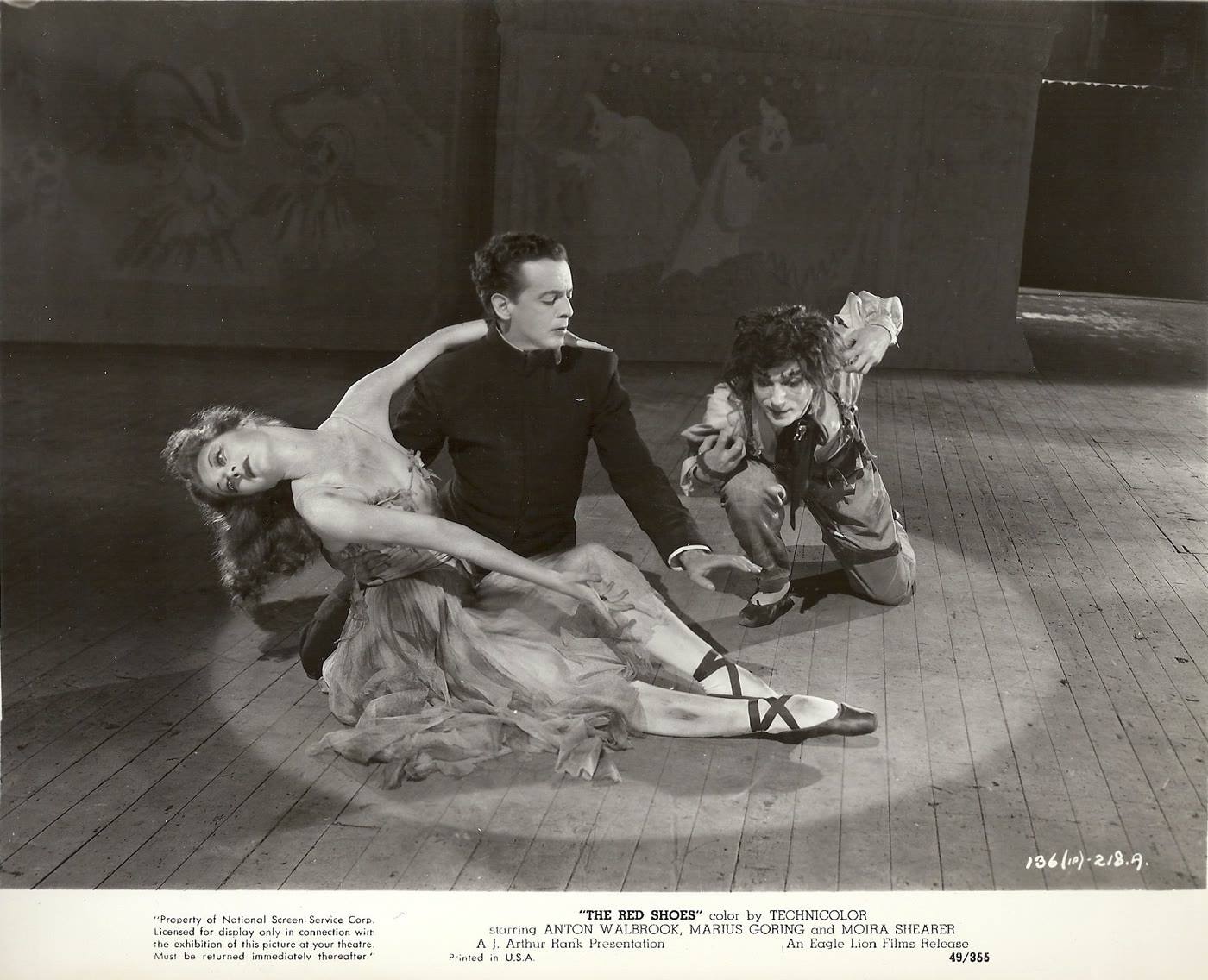
Image context: the lead image uses an archival publicity still from The Red Shoes, showing Moira Shearer, Marius Goring, and Anton Walbrook arranged on a bare stage floor.[2][7] It is the right recognition image for this profile because Powell and Pressburger's cinema keeps staging life as a performance space under pressure. A floorboard, a spotlight, a costume, or the angle of a body is never only decorative in their films; it is where emotional law becomes visible.
Thresholds are their real special effect
What Powell and Pressburger grasped better than most of their contemporaries is that fantasy becomes stronger when it is attached to procedure.[1][4] Their miracles, hallucinations, and heightened worlds are rarely vague. They arrive with rules, routes, and textures. That is why even the most extravagant Archers films feel strangely concrete. They do not ask viewers to leave reality behind. They ask viewers to notice how reality is already organized by crossings: from one room to another, one altitude to another, one duty to another, one language or national outlook to another.[1][3][5]
This is also why "imagination" in their films should not be mistaken for escape.[1][2][4] The BFI page on A Matter of Life and Death emphasizes the film's audacity in setting Technicolor England against a monochrome heaven.[4] That contrast is not just a visual trick. It turns metaphysical uncertainty into architecture. A man survives the jump from a burning bomber, falls in love, and is then summoned to answer for a clerical mistake in the afterlife.[4] The premise sounds whimsical until Powell and Pressburger make it procedural: there are heavenly officials, stairways, hearings, points of view, and a world still reorganizing itself after war.[4] Fantasy becomes persuasive because it is given civic texture.
A Matter of Life and Death makes the border between worlds feel bureaucratic and tender
The film remains one of the clearest demonstrations of the duo's method.[4] Its most striking effect is not simply that heaven looks different from earth, but that the passage between them feels administered. A border exists. It has agents, delays, arguments, and mistakes.[4] This procedural quality matters because it keeps the film from dissolving into misty transcendence. Powell and Pressburger turn the afterlife into a place that can be appealed to, argued with, and visually negotiated. The result is both romantic and sharply historical. BFI notes that the film also plays as a sly satire on Anglo-American relations at the end of World War II.[4] That is exactly the kind of double register the Archers excelled at: private feeling passing through an institution, and institution revealing its deepest absurdity through love.
Once that pattern is visible, the duo's cinema starts to cohere. They do not simply contrast reality and dream. They build passages between states and then make those passages do dramatic work.[1][4] The stairway in A Matter of Life and Death is memorable for its image, but more important for its function. It literalizes a negotiation between mortal attachment and abstract order.[4] The heaven-and-earth split is therefore never merely decorative. It is a machine for pressure.
Black Narcissus turns place into a weather system of desire
If A Matter of Life and Death is a film of explicit passage, Black Narcissus shows how Powell and Pressburger can make a place itself become the threshold.[3] BFI's anniversary essay on the film is especially good on this point, describing a range of fantastical worlds in the Archers' cinema and then focusing on how Black Narcissus converts landscape, erotic repression, and cultural fantasy into one fevered whole.[3] The Himalayan convent is studio-made, but that artificiality is the source of the film's force rather than a limitation.[3] The topography is heightened until it becomes a pressure chamber. Bell tower, precipice, painted sky, corridors, wind: every element seems to push the nuns back into the parts of themselves they hoped religious order had settled.[3]
This is one of the duo's deepest strengths.[1][3] They knew that interior crisis often becomes clearest when it is routed through surface. Black Narcissus does not explain desire away in dialogue. It lets color, altitude, and architecture tighten around the characters until repression becomes spatial.[3] The gorge is both landscape and psychic drop; the convent is both mission outpost and unstable theater.[3] Powell and Pressburger are often praised for lushness, but lushness in their films is rarely soft. It is active. It corners people.
The Red Shoes makes art itself into a border one cannot cross safely twice
If one film gathers the partnership's major instincts into a single emblem, it may still be The Red Shoes.[2][6] The Criterion essay calls it a turning point after which dance, design, and music fused into a new dreamlike cinematic medium.[6] BFI's account stresses something equally crucial: Powell and Pressburger pushed against postwar realism and made a film in which artistic expression carries agony as well as ecstasy.[2] That combination is central to the Archers. They were never interested in beauty that merely reassures. Their greatest images are beautiful because they are perilous.
In The Red Shoes, stage performance is not a diversion from life. It is the form through which life becomes unbearable to simplify.[2][6] Vicky Page is asked a question that runs through the entire Powell-Pressburger project: what kind of existence does art demand?[2] The film answers not with a thesis but with a space. Rehearsal room, wings, stage floor, costume, spotlight, applause, exhaustion: each zone changes what love, labor, and ambition mean.[2][6] The long ballet sequence is therefore not an ornamental centerpiece bolted onto a backstage melodrama. It is the film's governing argument. Art creates its own terrain, and once a person enters that terrain, ordinary balances do not return intact.[2][6]
That helps explain why Powell's later recollection that the film asked people to die for art still lands with such force.[2][6] The line sounds extravagant, but the movie has already built a world where extravagance feels like the truthful register. The Archers' genius lay in making that register believable without reducing it to camp or self-importance. They understood that total devotion can be intoxicating, generative, destructive, and lonely at once.[2][6]
Why Powell and Pressburger still feel alive
What survives in Powell and Pressburger is not just cinephile admiration for "great visuals."[1][2] It is the sense that cinema can make atmosphere think. They give weather, thresholds, painted spaces, and stylized systems an argumentative role. Their films do not merely contain ideas; they distribute ideas across floors, skies, staircases, fabrics, and routes of movement.[1][3][4] That is why they continue to matter to later directors. They show that artifice can intensify moral and emotional reality rather than dilute it.
Pressburger's exile perspective is part of that durability.[5] The films repeatedly look at Britain from slightly off-center, as though national myth, religious certainty, and social order are all visible but never fully settled.[4][5] Powell, for his part, knew how to give that off-centeredness sensual conviction.[1] Together they made movies in which enchantment is never passive. It is a test. A lover may need to argue with heaven, a nun may discover that landscape has entered her bloodstream, a dancer may find that the stage has become more binding than ordinary affection.[2][3][4]
That is the pressure of the border in the Archers' cinema.[1][2][3][4][5][6] Their worlds are not divided into fantasy on one side and reality on the other. They are organized around thresholds where the two contaminate each other. The weather changes, the light changes, the rules change, and suddenly a room, a staircase, or a stage floor becomes the place where a whole life is forced to declare what it serves. Few filmmakers have made imagination feel so luxurious and so costly at the same time.
Sources
- BFI, "Cinema Unbound: The Creative Worlds of Powell + Pressburger."
- Pamela Hutchinson, "5 things to know about The Red Shoes, Michael Powell and Emeric Pressburger's ravishing film about a dancer," BFI.
- Adam Scovell, "Black Narcissus at 75: exoticism and eroticism in Powell and Pressburger's masterpiece," BFI.
- BFI, "A Matter of Life and Death (1946)" film page.
- Kevin Gough-Yates, "Emeric Pressburger: England and exile," Sight and Sound / BFI.
- Ian Christie, "The Red Shoes," The Criterion Collection.
- Wikimedia Commons, "File:Original publicity still for the film 'The Red Shoes.' From The Red Shoes (1948) Collection at Ailina Dance Archives.jpg."