Mikio Naruse is often introduced as the quiet one among the great postwar Japanese directors, but quiet is the wrong word if it suggests calm.[1][2] His films are full of movement. People climb stairs, cross streets, take trains, leave rooms, return to rooms, enter bars, carry trays, board buses, or walk through rain that seems to record every mistake they have already made.[2][3] What makes Naruse singular is that movement in his cinema rarely feels like release. It feels like contact with a limit. A person tries to shift position by one degree, and the surrounding world immediately reveals the cost.
That is why a director profile suits him so well.[1][2][3] Naruse's signature is not one flamboyant camera move or one instantly recognizable image pattern. It is a pressure system that keeps reappearing across different stories: ordinary life organized by money, obligation, embarrassment, and timing. The contemporary North American retrospectives framed him as one of the major Japanese masters precisely because this method stayed so consistent across decades, especially in the postwar films that center women negotiating work, intimacy, and social dependence.[1][3] He does not need melodramatic speeches to show that a life has narrowed. A station platform, a cramped dining room, a staircase to a bar, or a rain-soaked goodbye will do the work.
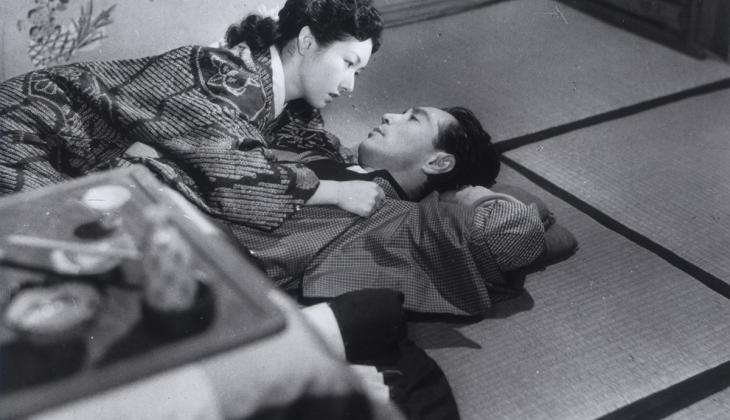
Image context: the lead image uses a real archival still from Floating Clouds on BAMPFA's film page. It fits this profile because Naruse's cinema keeps making intimacy look unstable. Even when two people occupy the same room and the same frame, the scene is already carrying debt, memory, and bad futures inside it.[5]
1. Naruse turns ordinary motion into an index of social pressure
The easiest way to misread Naruse is to look for grand external conflict first.[1][2] The stronger route is to watch how he organizes small actions. A person goes upstairs to work. A wife takes a train to visit family. A lover arrives too late. A widow considers remarriage because the arithmetic of independence is hostile. None of this sounds monumental in synopsis form, which is exactly the point. Naruse is one of the great filmmakers of how daily procedure becomes destiny.[1][2][3]
The Harvard Film Archive's retrospective framing is helpful here because it emphasizes how strongly Naruse's postwar breakthrough lives in dramas of ordinary people rather than heroic exception.[3] Senses of Cinema reaches a similar conclusion from another direction, stressing how his mature films keep finding enormous emotional force in people of limited means trying to manage compromise, shame, and endurance without illusion.[2] Naruse does not romanticize hardship, but he also does not convert it into abstract sociology. He shows what pressure feels like when it is distributed through errands, interiors, wages, and fragile personal bargains.
2. In Repast, marriage erodes through habit rather than catastrophe
That method sharpens in Repast (1951), which both BAMPFA and the Harvard Film Archive treat as a key turning point: Naruse's first adaptation of Fumiko Hayashi and one of the films that begins his extraordinary late run.[3][4] The title itself is almost anti-spectacular. A meal sounds like maintenance, repetition, one more unit of daily life. Naruse uses that scale to his advantage. The film studies a marriage not as a single crisis but as a set of habits that have lost conviction while still continuing to function.[4]
BAMPFA's description of Repast as a sly critique of love, estrangement, and middle-class marriage is exact because Naruse never films domestic routine as neutral background.[4] Shared rooms, table talk, departures, and returns all become measurements of what the couple can no longer honestly repair. His camera is not trying to inflate the situation into prestige tragedy. It is observing how disappointment hardens when people keep doing the same things under slightly altered emotional weather. That emotional weather is one of Naruse's deepest tools. He understands that a life can break not only through event, but through repetition after belief has thinned out.
3. In Floating Clouds, postwar desire becomes climate
If Repast shows Naruse's control over domestic attrition, Floating Clouds (1955) shows what happens when he lets desire travel through a larger historical wound.[1][5] BAMPFA calls it a haunting elegy to memory, love, and the impossibility of reconciliation amid the rubble of postwar Tokyo.[5] That description matters because Naruse never treats postwar damage as mere background information. Ruin enters the emotional texture of the film. Love in Floating Clouds is not simply doomed by personal weakness; it is repeatedly deformed by a world in which continuity has already been broken.
This is where Naruse's relation to weather, travel, and drift becomes unforgettable.[2][5] Lovers separate, reunite, move, wait, or fail to arrive in time, but the movement never accumulates into freedom. It accumulates into exhaustion. The physical world seems to absorb indecision and return it in harsher form. Rooms feel temporary. Journeys feel circular. Rain and dampness do not decorate sadness; they thicken it. The result is one of the clearest examples of Naruse's gift for making feeling inseparable from material circumstance. Passion is not staged against society from the outside. It is already shaped by scarcity, aftermath, and compromised shelter from the start.[1][5]
4. When a Woman Ascends the Stairs condenses the whole Naruse method into one recurring climb
For many viewers, the cleanest way into Naruse is When a Woman Ascends the Stairs (1960), and it is easy to see why.[2][6] BAMPFA's note on the film captures the essential situation with unusual precision: Keiko, a widowed bar hostess in Tokyo's Ginza district, is high-minded and determined, yet badly placed in a world that keeps pricing her dignity against money and male appetite.[6] The famous title image does not function as metaphor alone. It is work. It is repetition. It is social exposure. Every time Keiko climbs, she reenters an economy that she dislikes but cannot simply step outside.
Naruse's brilliance is that he makes the staircase structural rather than symbolic decoration.[6] The climb gathers the entire film's logic into one action. Independence requires capital. Marriage threatens dependence in another form. Work demands performance. Respectability is costly. Time is moving. Keiko is not trapped because the film denies her intelligence. She is trapped because every available route is already burdened with compromise. Naruse films this without cruelty and without consolation. He lets the bars, back rooms, street-level detail, and nighttime Ginza atmosphere register fully, but he never mistakes atmosphere for escape.[6]
This is also where his cinema's relation to women becomes clearest.[1][2][6] He does not turn female suffering into sainthood, and he does not pretend the social field will reward moral clarity. What he offers instead is attention: to posture, work rhythm, hesitation, endurance, and the exact pressure exerted by bad options. That attentiveness is why the films feel so lucid. Naruse is not telling us that life is tragic in the abstract. He is showing how a person remains legible while moving through arrangements designed to reduce legibility to function.
5. Why Naruse still feels modern
Naruse lasts because he understood a modern problem that has not gone away.[1][2][3] People keep imagining that one more move, one more room, one more train ride, one more marriage proposal, one more job arrangement, or one more emotional return will finally produce a clean exit from the present tense. Naruse keeps showing the harsher truth. Structures travel with the person. Money travels with the person. Reputation travels with the person. The world changes, but not fast enough to make escape simple.
That worldview could have produced heavy, didactic cinema. Instead it produced films of remarkable tact and control.[2][4][5][6] Naruse does not flatten life into thesis. He makes it granular: meals, staircases, drinks, wet streets, boarding rooms, reconciliations that fail to hold, departures that carry too much hope, and interiors that look ordinary until they begin to feel impossible to breathe in. Seen together, these elements form a director's signature as distinct as any in twentieth-century film. He is a master of pressure without noise, motion without liberation, and feeling without sentimental rescue. Once you recognize that pattern, Naruse stops looking quiet. He starts looking exact.
Sources
- Reischauer Institute of Japanese Studies, "Floating Clouds… The Cinema of Naruse Mikio" - overview of the North American Naruse retrospective and his career.
- Adrian Martin, "Four Studies by Mikio Naruse," Senses of Cinema.
- Harvard Film Archive, "Floating Clouds… The Cinema of Naruse Mikio" program page - retrospective framing for Naruse's postwar run, including Repast.
- BAMPFA, "Repast" event page - note on Naruse's adaptation of Fumiko Hayashi and its portrait of a fading marriage.
- BAMPFA, "Floating Clouds" event page - note on postwar Tokyo, memory, and impossible reconciliation; source page for the lead still.
- BAMPFA, "When a Woman Ascends the Stairs" event page - note on Keiko, Ginza bar life, and the recurring stair climb.