Spoiler note: this article discusses the film's ending.
More than a century after its Berlin premiere on February 26, 1920, The Cabinet of Dr. Caligari still feels less like a story one watches than a trap one enters.[1][2][3] Plenty of silent classics remain impressive at the level of film history; Robert Wiene's 81-minute feature remains actively unnerving.[1] Its fear is not built mainly from shock, gore, or even suspense in the modern sense. It comes from the way the film keeps asking who gets to define reality for everyone else. A fairground showman, a sleepwalker, a murder investigation, an asylum director, and a narrator who may or may not be trusted all end up orbiting the same problem: authority here never arrives as calm truth. It arrives as staging, command, and a set of images so forceful that they begin to feel more solid than the world around them.[2][3][4]
That is why the movie's Expressionist design matters so much.[2][4] BFI's centenary essay stresses that the film's distorted, studio-bound world broke with realism and fused set design, acting, and mood into one system.[2] The Deutsche Kinemathek's Caligari exhibition notes the same thing from another angle: crooked perspectives, grotesque costumes, long shadows, and the open asylum subplot gave later horror, psychological thriller, and film noir traditions a grammar they kept reusing.[4] In Caligari, style is not decorative. Style is the mechanism by which power gets felt.
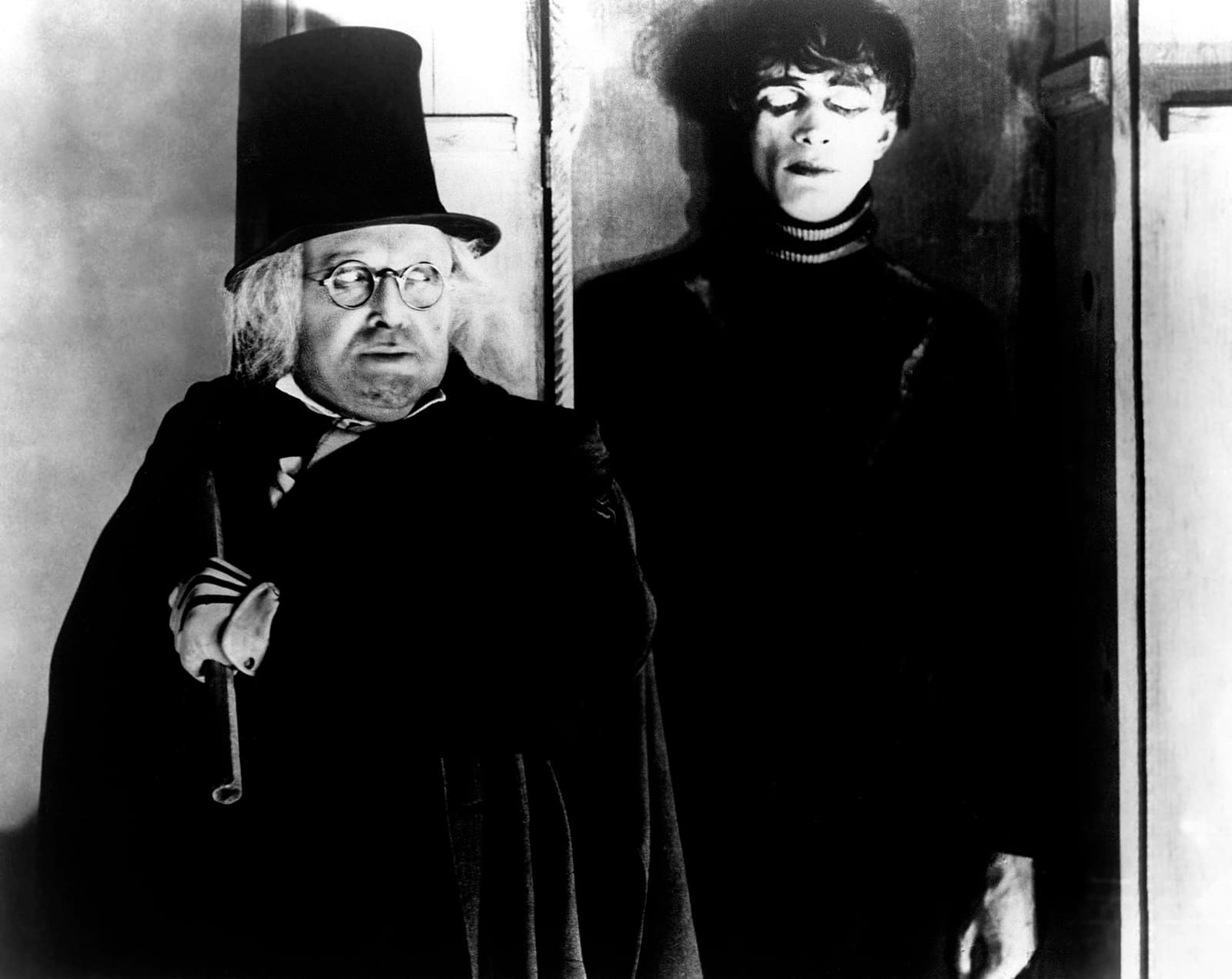
Image context: the lead image uses a 1920 publicity still from Wikimedia Commons showing Cesare carrying Jane through the film's jagged town. It fits this essay because the frame condenses the movie's whole pressure system: the sleepwalker looks both human and instrument-like, while the painted rooftops and broken diagonals make the town itself seem complicit in the abduction.[5]
The fairground cabinet makes command look like entertainment
The title gives away the film's first great idea. Caligari does not begin with an institution in the formal sense. It begins with a cabinet, a booth, a piece of fairground showmanship.[2][3] WeimarCinema's dossier is especially useful here because it describes Dr. Caligari's cabinet as both a fairground attraction and a quasi-movie theater.[3] That double identity matters. Inside the booth, the townspeople pay to watch a body awaken on command. They buy a ticket to witness obedience turned into spectacle.
That booth changes the moral weather of the story before the murders fully register.[2][3] Caligari is not merely a villain who happens to control Cesare. He is a manager of attention. He stands beside the cabinet, frames the miracle, narrates what the audience should find wondrous, and converts passive watching into complicity. The sleepwalker becomes an exhibit, a demonstration that someone else's will can be made visible and sold. The fair is therefore not a neutral setting for Gothic business. It is the film's first lesson in how domination hides inside entertainment, novelty, and public curiosity.
This is one reason the film's recurring concern with authority never feels abstract.[2][4] The command structure is tiny and theatrical before it becomes medical or bureaucratic. We see it as performance first. The later asylum material does not replace this logic; it enlarges it. Caligari begins as a showman because the film wants us to understand that control often enters public life already wrapped in display. Theatricality is not a distraction from power. It is one of power's most efficient delivery systems.
Painted shadows turn fear into architecture
What the film's sets do, and still do, is remove any safe distinction between environment and emotion.[2][4] BFI describes the movie's world as a chiaroscuro field of contorted angles and sharp jagged edges, while the Kinemathek emphasizes the anti-realist force of its distorted perspectives.[2][4] Streets tilt. Windows narrow into threats. Rooflines stab the sky. Shadows are not cast by light; many of them are painted directly onto walls and pavement, as if anxiety had soaked so deeply into the town that it no longer needed a physical source.
Because of that, Holstenwall never behaves like an ordinary setting.[3][4] It behaves like a town already arranged to make private fear public. A chase through this place does not simply happen in space; it happens inside a designed argument about how unstable space has become. Every diagonal seems to push bodies off balance. Every corner looks like a command issued by architecture. The city does not witness paranoia. It performs paranoia.
The actors' movement deepens that effect.[2] BFI notes that Werner Krauß and Conrad Veidt had both worked under Max Reinhardt, and the film repeatedly makes bodies merge with set design into geometric patterns.[2] That fusion is one of Caligari's strangest and most enduring achievements. People do not merely stand in rooms. They seem conscripted by the rooms, shaped by them, absorbed into their angles. Authority is therefore not just a matter of orders given from one person to another. It becomes atmospheric. The entire built world starts behaving like an extension of command.
Cesare is frightening because he makes delegated violence look graceful
Conrad Veidt's Cesare remains one of cinema's great nightmare figures because he is less a monster than a body lent out to someone else's will.[1][2][4] The Kinemathek page is sharp on how style-defining that figure became: black clothing, disheveled hair, darkened eyes, and the rigid elegance of the sleepwalker silhouette kept echoing through later performance culture.[4] Yet the film's power does not come simply from the look. It comes from the contradiction the look contains. Cesare appears weightless, fragile, almost tender in repose, but once awakened he becomes the instrument through which Caligari's commands move into the world.
That contradiction is clearest in the scenes where the film lets Veidt's body glide rather than lunge.[2][5] The publicity still used as the lead image captures exactly this problem.[5] Cesare carries Jane across the expressionist town with a strange mixture of abduction, trance, and exhausted delicacy. The scene is frightening not because the film turns him into a wild beast. It does the opposite. It makes him seem eerily disciplined, as if murder and kidnapping were only the extension of a previously programmed line.
BFI's centenary essay notes that later critics saw Cesare as a figure through which postwar Germany could read its own damaged youth: a young man sent to kill under another authority's direction.[2] Whether one takes that allegory literally or more cautiously, it helps explain why Cesare feels sad as well as terrifying. He is the film's human remainder, the body that proves power does not only coerce from above; it travels through exhausted intermediaries. The horror of Caligari lies partly in the fact that the most visible perpetrator is also visibly unfree.
The asylum frame does not restore order. It widens the nightmare.
The final twist remains famous because it seems, at first glance, to explain everything away.[2][3][4] Franzis, who has narrated the central murder story, appears to be an asylum inmate; the apparently sinister doctor is revealed as the institution's director; the world can be refiled as delusion. But the film's ending does not actually behave like a clean explanation. BFI's essay is persuasive on this point: the so-called objective world of the frame story looks just as expressionistic as Franzis's narrated world, which makes the division between truth and madness unstable from the start.[2]
The WeimarCinema dossier reaches a similar conclusion in plainer narrative terms. It notes that the film finally leaves open what is true and who is insane: Caligari or Franzis.[3] That uncertainty is not a final flourish pasted onto an otherwise stable plot. It is the culmination of the movie's central method. The institution that seems to promise order inherits the same visual sickness as the nightmare it claims to diagnose. Authority returns in a benevolent guise, but the guise itself is poisoned.
This is where the film becomes more than a historical landmark of Expressionism.[2][4] The Kinemathek argues that the open asylum subplot established conventions of the psychological thriller, and that seems right, but the ending also does something meaner than generic twist logic.[4] It suggests that official reason and pathological fantasy may share the same stagecraft. Caligari's final claim that he knows how to cure Franzis does not settle the film. It chills it. After all the jagged streets, painted shadows, and theatrical commands, the most sinister possibility is not that madness has been isolated. It is that madness has learned to speak in the voice of diagnosis.
That is why The Cabinet of Dr. Caligari still feels modern.[2][3][4] It understands that domination rarely appears first as naked force. It appears as narrative framing, aesthetic seduction, expert language, and institutions that insist they alone can say what counts as reality. The fairground booth, the sleepwalker, the painted town, and the asylum do not belong to separate layers of the film. They are one machine. Each asks the same question in a different register: when power tells you what you are seeing, how much of your own sight is left?
Sources
- BFI, "Das Cabinet des Dr. Caligari (1919)" film page with credits, cast, running time, and release metadata.
- Alex Barrett, "100 years of The Cabinet of Dr. Caligari: why we're still living in its shadows," BFI.
- WeimarCinema / Murnau Foundation, "The Cabinet of Dr. Caligari dossier preliminaries and production/restoration notes" PDF.
- Deutsche Kinemathek, "Be Caligari! – The Virtual Cabinet."
- Wikimedia Commons, "File: Publicity still for The Cabinet of Dr. Caligari (1920) 04.jpg."