Peter Weir's Picnic at Hanging Rock lasts because it understands that mystery is not the same thing as information withheld.[1][2][3] Plenty of films hide an answer. This one builds an atmosphere in which answer-seeking itself starts to feel like the wrong instrument. Criterion's film page calls it less a mystery than a journey into the mystic and an inquiry into class and sexual repression in Australian society, while Megan Abbott's essay argues that the frustration of not knowing is not a defect to be repaired but one of the movie's central powers.[1][2] The film does not merely refuse to solve its disappearance. It teaches the viewer to feel how explanation shrinks the thing that matters.
That is why the movie keeps slipping away from detective grammar and into sensual arrangement.[1][2][3] Vincent Canby describes it as horror made not from gore but from warm daylight, girlhood, and hints of unexplored sexuality so intense they become transporting.[3] The BFI's 50th-anniversary release page is brief, but its phrasing is exact: the film returns in restoration having lost none of its mystique or mesmerising power.[4] Mystique is not an accidental residue here. It is the method. Weir's great trick is to make uncertainty feel less like a blank space in the plot than like a property of air, stone, cloth, and ritual.
Image context: the lead still shows the girls in white before the ascent, not the rock alone and not a retrospective publicity image.[4] That choice fits the argument because the movie's disturbance starts in surfaces and posture first. Before disappearance becomes narrative fact, whiteness, heat, and arrangement have already made ordinary school decorum look unstable.
The film's real event is the conversion of school discipline into sensuous drift
The opening movement at Appleyard College matters because it establishes repression not as a rulebook but as a texture.[2][3] Abbott notes that only at Hanging Rock do hats and gloves come off, stockings unroll, and the body begin to slip loose from the finishing-school regime that has been fastening it into place.[2] Canby is equally alert to how the film dramatizes innocence so intensely that desire starts appearing everywhere: among the girls, between students and teachers, and in the Valentine's rituals that make the day feel ceremonially overcharged before anyone leaves campus.[3]
This is the first reason the movie remains so unnerving. It never treats repression as something abstractly Victorian and therefore safely historical.[1][2][3] It makes repression tactile. White muslin clings. Corsets bite. Gloves, ribbons, and posed deportment create a style of social surface that looks delicate until it starts to resemble suffocation. When the girls move toward the rock, the film does not stage a simple break from order into freedom. It stages a transfer from one kind of control to another: from institutional discipline to a landscape pressure that is less legible and therefore more seductive.[2][3]
Miranda becomes the film's clearest carrier of that seduction.[2][3] Abbott writes that she comes to feel like a figure who knows more than others do, while Canby emphasizes how anticipation, heat, and the strange charge of the outing make the girls seem almost called upward.[2][3] The film uses her beauty in a peculiar way. Miranda is not individualized into psychological depth so much as diffused across looks, glances, echoes, and remembered lines. She becomes an image others cannot stop organizing themselves around. That is one reason the disappearance hurts the whole school even before its factual implications are sorted out. An image has been removed, and the social field loses shape.
Hanging Rock is powerful because Weir films it as a change of scale, not a clue
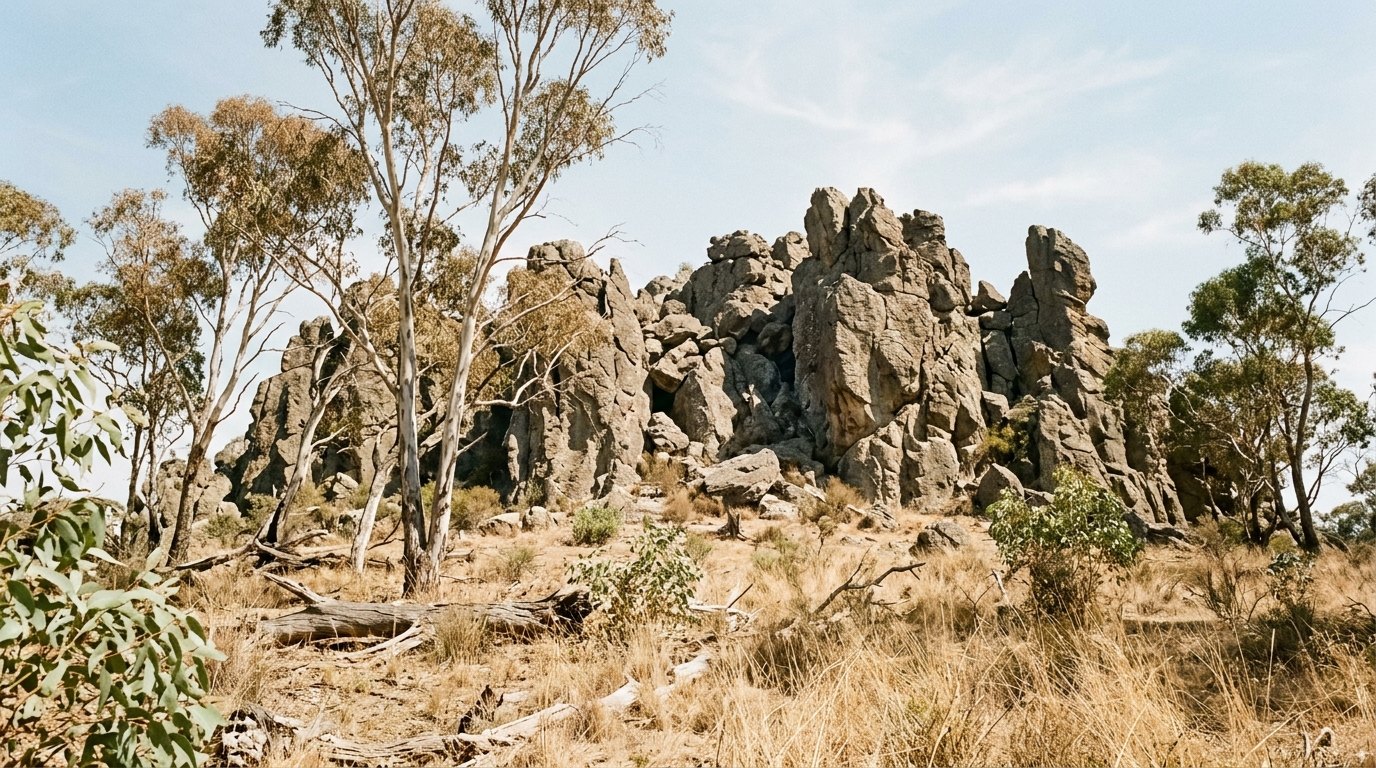
Many films with a landmark setting want the place to function as symbol, secret box, or final reveal. Hanging Rock resists all three.[1][2][3][4] The BFI page identifies it plainly as an unusual volcanic formation, and that geological fact matters because the rock always feels older than the categories the school party brings to it.[4] Criterion's description is sharper still: the film is a work of poetic horror whose secrets haunt viewers to this day.[1] Secrets, in other words, are not buried pieces of plot waiting to be excavated. They are the haunting effect produced when human order enters a space that does not recognize it.
Canby says Weir makes the landscape feel alive, and Abbott goes further by suggesting a godlike gaze from above, as though the rock itself were watching.[2][3] Those observations clarify the film's uncanny balance. The rock is never anthropomorphized into a monster, yet it is not neutral scenery either. It alters the movie's scale. Once the girls begin climbing, human motives cease to look proportionate to the experience. Language thins out. The body becomes slower, dreamier, harder to account for. The famous lack of solution works because the movie has already shifted the viewer into an environment where solution would belong to a smaller and duller order than the one the film has entered.[1][2][3]
The line Abbott quotes from Weir, about not knowing what happens in our own minds, is the right key.[2] The rock externalizes that inner opacity. It gives it heat, shadows, fissures, and altitude. Rather than explaining desire through backstory or confession, Weir lets the landscape carry it. Desire becomes topographical. That is what makes the film feel both erotic and impersonal at once. No single person fully owns the force moving through the afternoon.
The aftermath is devastating because society can record facts but cannot restore atmosphere
Once the disappearances occur, Picnic at Hanging Rock becomes a study in administrative failure.[1][2][3] Abbott points out that Edith returns screaming and that Irma, when later found alive, remembers nothing; from that point on, everyone is left to project, interpret, and deteriorate inside the vacuum.[2] Criterion's film page frames the aftermath as part of a broader inquiry into class and repression, which is exactly right.[1] The adults know how to file reports, protect reputations, police behavior, and assign blame. They do not know how to absorb an event that seems to have dissolved the explanatory scale on which their authority rests.
That is why the film's social critique lands so hard without ever turning programmatic.[1][2][3] Appleyard College looks organized enough to survive scandal, yet it has no language for the atmosphere that produced the catastrophe. It can only retreat into harder surfaces: etiquette, punishment, gossip, concealment. Canby remarks that Weir and screenwriter Cliff Green deal in moods rather than exposition, and the aftermath proves why.[3] Mood is not decorative here. Mood is the evidence the institutions cannot process.
Abbott makes the most incisive point of all when she argues that the unsolved mystery sends viewers back toward their own projections.[2] The film's refusal does not simply frustrate curiosity. It implicates it. Any explanation we rush to provide starts revealing more about our own appetite for order, punishment, sexuality, transcendence, or doom than about the vanished girls themselves. The movie becomes a machine for returning interpretation to the interpreter. That is a rarer and more enduring effect than suspense.
Picnic at Hanging Rock therefore remains one of cinema's great studies in the point where plot gives way to environment.[1][2][3][4] Noon light, white dresses, loosened clothing, volcanic stone, and the murmuring failure of adult order create a world in which desire cannot be cleanly assigned and knowledge cannot be cleanly recovered. Weir does not ask us to solve the disappearance. He asks us to sit inside the humiliating fact that some events alter the whole pressure system around them and leave explanation behind. The film's mystery stays alive because the rock does not keep a secret for us. It teaches us what it feels like to live near one.
Sources
- The Criterion Collection, "Picnic at Hanging Rock (1975)" film page.
- Megan Abbott, "Picnic at Hanging Rock: What We See and What We Seem," The Criterion Collection.
- Vincent Canby, "Picnic at Hanging Rock," The Criterion Collection.
- BFI, "Picnic at Hanging Rock (4K)" release page.