Spoiler note: this essay discusses major plot turns in Grand Illusion, including de Boeldieu's sacrifice and the ending.
Jean Renoir's Grand Illusion is usually introduced as one of cinema's great antiwar films, which it is, and as one of the first great prison-escape movies, which it is as well.[1][2][3] Those labels tell the truth and still leave out the movie's strangest pressure point. Renoir is not mainly interested in military strategy, patriotic uplift, or suspense mechanics. He is interested in what war accidentally reveals about who can still speak to whom. Inside the prison camps, nationality remains official fact, yet class, education, manners, appetite, and fatigue keep cutting across it.[2][4] The movie's deepest sadness lies there. It shows human solidarity appearing in flashes, but it also shows one older language of solidarity already dying while the characters are still forced to use it.
That is why the title keeps widening as the film goes on.[2][3][4] The "grand illusion" is not just the hope that World War I would be the last war, though BFI's historical framing makes clear that this meaning mattered sharply in 1937.[4] It is also the belief that nations, classes, and institutions are stable enough to tell people exactly where they belong. Renoir keeps disproving that belief in small, material ways: a lunch invitation after a shootdown, a shared food parcel, a tunnel dug by many hands, a theatrical performance in camp, a flower tended in a fortress room, a German widow feeding French fugitives, a border crossed on foot through snow.[2][3][4] The film turns these acts into a running argument that the world's lines are both real and insufficient.
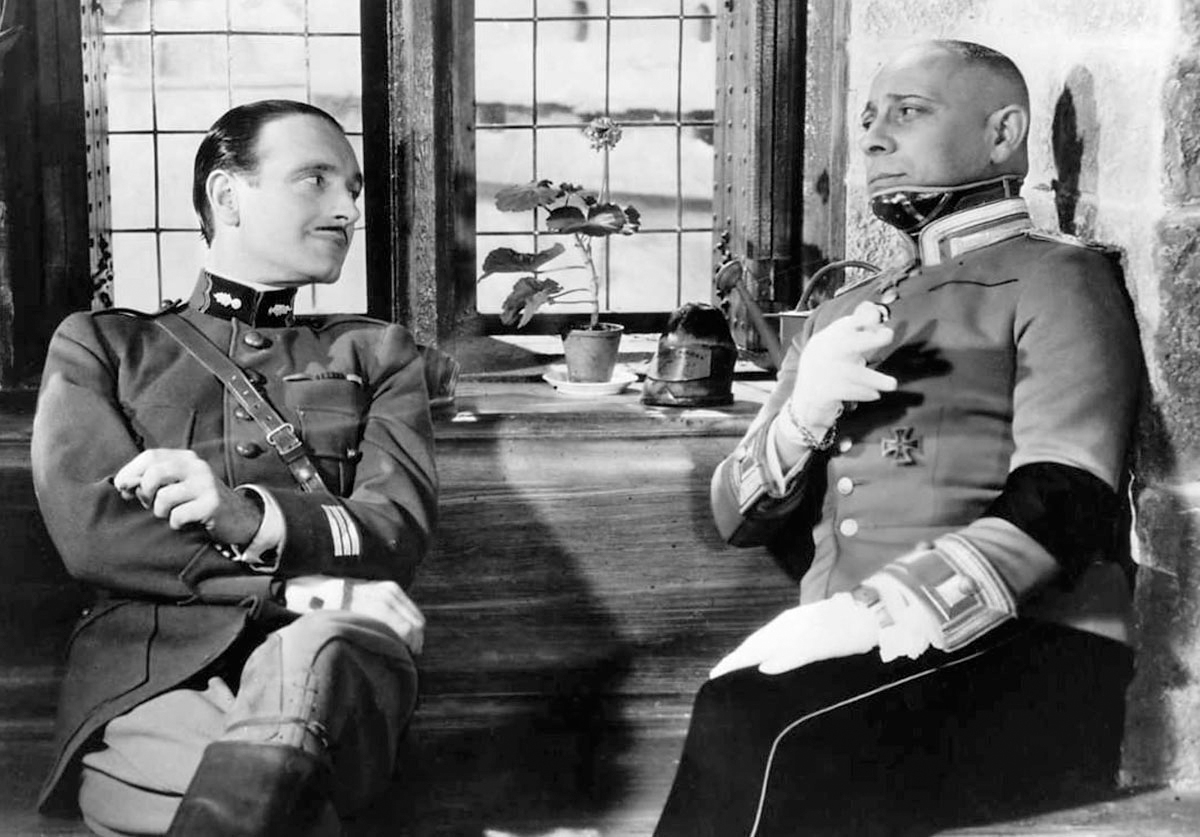
Image context: the cover uses an archival 1938 promotional still published in National Board of Review Magazine. It is the right recognition image for this essay because Renoir's war film keeps returning to one unusual fact: the sharpest conversations do not always happen between compatriots, and the most painful recognition may pass between social equals on opposite sides of a war.[5]
The mess hall matters because Renoir keeps testing who can share a table
The first prison-camp lunch establishes the film's whole method.[2][3] Rauffenstein, the German officer who has just shot down the French aviators, invites them to dine with him. On paper this could read like military courtesy or aristocratic theater. In the scene, it becomes something more revealing. The camp is already sorting people by uniform and nation, yet conversation begins sorting them again by accent, schooling, wit, and habit.[2][4] Maréchal is blunt, practical, and impatient with ornament. De Boeldieu moves with aristocratic ease. Rosenthal, wealthy and Jewish, enters carrying the marks of a class position that makes him vulnerable to stereotype and then steadily undoes those stereotypes through wit and generosity.[2][4]
Renoir keeps coming back to food for that reason.[2][4] Rosenthal's parcels matter not because they are charming props, but because they reorganize the room. He feeds men who had been prepared to read him through prejudice. A meal does what ideology cannot quite stop: it forces bodies into proximity, makes dependence visible, and temporarily replaces abstract nationality with the ordinary social question of who gives, who takes, and who knows how to share.[2][4] Grand Illusion does not say class disappears in war. It says class becomes newly legible in war, sometimes cruelly, sometimes tenderly, because the institutions around it have become unstable.
This is one reason the film never feels like a simple statement of universal brotherhood.[2][3][4] Difference remains everywhere. Rosenthal is still needled. Maréchal is still suspicious. De Boeldieu is still protected by codes the others do not fully possess. Renoir's humanism has weight because it does not pretend sameness is the condition for decency. The men do not become interchangeable. They become temporarily capable of recognizing one another despite the categories they carry in with them.
The tunnel is less an escape machine than a brief social commons
Many prison films treat tunnel-digging as the clean geometry of hope. Renoir gives it a different temperature.[1][2] The tunnel matters, but not as a triumphal engineering plot. It matters because it lets the prisoners form a provisional world under the official one. They dig by night, joke, share news, argue, and sustain themselves by believing coordinated labor can still produce a future.[2] The tunnel is an illusion, but not a foolish one. It is the kind of illusion people need in order to remain social while institutions are trying to make them passive.
The same is true of the camp performance, where men dress for theater and look briefly beyond discipline toward fantasy and memory.[2][3] Renoir does not mock these rituals. He understands them as emotional infrastructure. The men need stage play, song, tunnel dirt, and rumor from the front because captivity threatens not only freedom of movement but the feeling that time is still moving toward anything at all.
Then Renoir cuts the whole construction off with transfer.[2][4] The tunnel is not discovered through a heroic last-minute chase. The prisoners are simply moved. That narrative decision is crucial. It tells us that the film does not worship effort for its own sake. The tunnel is valuable because of what it created among the men while it lasted, not because it was destined to succeed. A community can be real even if the plan built inside it fails.
De Boeldieu and Rauffenstein speak a language history is already withdrawing
The film's most haunting relationship is not the one between fellow French prisoners. It is the one between de Boeldieu and Rauffenstein.[2][3][4] They recognize one another almost immediately as men of the same old world. They know the same restaurants, the same manners, the same assumptions about breeding, composure, and sacrifice. The war has made them enemies, but class makes them legible to one another in a way their own nations no longer quite do.[2][4] Renoir does not stage this as a noble reconciliation that transcends politics. He stages it as historical twilight.
That is why Rauffenstein is so moving and so brittle.[2][3] MoMA is right to call the film personal to Renoir, because Rauffenstein feels like part reminiscence, part farewell.[3] Wounded, corseted into stiffness, tending his geranium in a fortress that looks more museum than barracks, he is the curator of a social order that can still identify itself but can no longer reproduce itself.[2][3][4] De Boeldieu understands this before anyone says it aloud. His sacrifice does not merely help Maréchal and Rosenthal escape. It acknowledges that the aristocratic code linking him to Rauffenstein has reached the point where its last meaningful act may be to clear the way for men who belong to the future more than they do.
BFI's account puts the point sharply: this is a film about class solidarity as much as national conflict.[4] But Renoir's genius is that he refuses to flatter that solidarity. De Boeldieu and Rauffenstein's mutual understanding is humane, cultivated, even beautiful. It is also socially exhausted. It cannot prevent war. It cannot build peace. It can only recognize its own obsolescence with style. Renoir mourns that without pretending it deserved to survive intact.
Elsa's farmhouse gives the film its clearest picture of life after military theater
Once Maréchal and Rosenthal reach Elsa's farm, Grand Illusion changes key without abandoning its argument.[2][4] The officers' codes recede. The film enters a household marked by grief, labor, weather, and routine. Elsa has lost her husband at Verdun and her brothers in the war, yet she shelters two French fugitives and feeds them at her table.[2][4] Here Renoir finds a more durable solidarity than the aristocratic one: not elegance under pressure, but ordinary coexistence built out of work, childcare, hunger, and mourning.
That interlude matters because it keeps the antiwar argument from staying abstract.[2][3][4] War is not only a system of uniforms and camps. It enters kitchens, bedrooms, and winter fields. Elsa's house is the place where national hatred has the strongest reason to harden and instead begins to soften. Maréchal's affection for Elsa does not erase the dead, and Renoir is too serious to pretend it does. What it shows is that the border between enemy and host can become human again much faster than the border between classes inside official Europe ever did.
The snowy ending completes that thought.[2][4] Maréchal and Rosenthal crossing into Switzerland should feel like a great victory, but Renoir stages it quietly, almost as disappearance. The border exists. The soldiers below cannot pursue them past it. Yet the line itself looks thin against the landscape, important mainly because institutions agree that it is important.[4] The human fact is elsewhere: two men alive because many temporary forms of solidarity held long enough to move them there.
That is why Grand Illusion still feels larger than either a war movie or a prison movie.[1][2][3][4] Renoir uses captivity to study social arrangement, then uses escape to ask what, if anything, survives those arrangements. Nations keep fighting. Classes keep decaying. The old aristocratic language remains graceful and insufficient. The newer common life glimpsed at Elsa's farm remains fragile and unfinished. The film never gives us a final political answer. It gives us something harder: a world in which people keep discovering that the categories ordering them are real, but never real enough to exhaust what they owe one another.
Sources
- The Criterion Collection, "Grand Illusion (1937)" film page.
- Peter Cowie, "Grand Illusion," The Criterion Collection.
- MoMA, "La Grande Illusion. 1937. Directed by Jean Renoir."
- Ginette Vincendeau, "The great escape: what makes La Grande Illusion great," Sight and Sound / BFI.
- Wikimedia Commons, "File:Grand-Illusion-1937.jpg" archival promotional still used for the cover image.