A dirty plate brings Shosho into Piccadilly. A nightclub customer complains, the floor show stops, and manager Valentine Wilmot goes downstairs to find out why the washing-up has stalled. In the scullery, he discovers the workers gathered around a kitchen hand dancing on a table. Shosho is still in her work clothes. She has no stage, no billing, and no permission. Yet the room has already reorganized itself around her.[1][5]
That entrance contains the whole argument of E.A. Dupont's 1929 film. Piccadilly repeatedly lets Anna May Wong seize the eye before anyone in authority has decided what she is worth. It then asks a harsher question: what does being seen actually buy her? Shosho rises from the kitchen to become the club's star attraction, but she never owns the club, the appetite surrounding her, or the story that will finally explain her away. Visibility resembles power because it can interrupt work, revive a business, and redirect desire. It is not power because the people doing the looking still control the wage, the costume, the acceptable relationship, and the verdict.[1][3][4]
The distinction is what keeps Piccadilly from settling into either a simple star-is-born fantasy or a simple account of victimhood. Wong's performance is too commanding for the first, and too deliberate for the second. Shosho understands display as work. She negotiates how she will appear, whom she will bring with her, and how close other people may come. The film gives her unusual room to shape her image, then reveals how quickly an entertainment system can convert that image from sensation to evidence.
Spoiler note: this essay discusses the film's final act and ending.
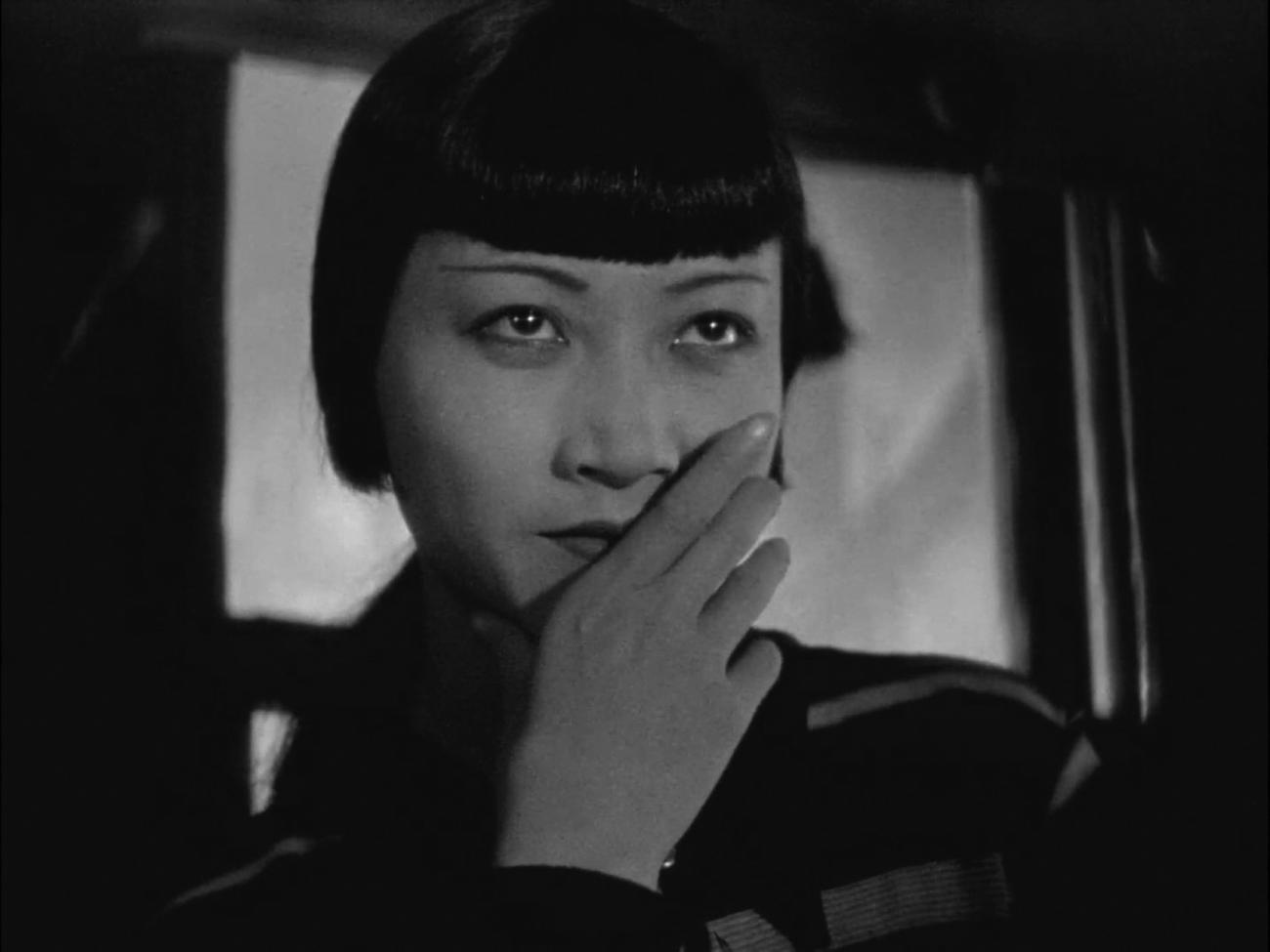
Image context: the lead image is a real archival still of Anna May Wong in Piccadilly, published by the BFI.[3] It belongs here because Wong's held pose and direct visual command make the essay's central tension visible: Shosho can dominate a frame without gaining secure control over the world beyond it.
The kitchen sees a performer; management sees an asset
The opening discovery is built on two kinds of labor. Upstairs, the Piccadilly Club sells polish: synchronized entertainment, dressed tables, bright surfaces, and the promise that nothing messy exists behind the room. Downstairs, dishes accumulate and exhausted workers keep that promise intact. Shosho's first dance does not erase this division. It exposes it. Her audience is made up of co-workers who have stopped scrubbing long enough to look.[5]
Valentine arrives because their attention has become an operational problem. His first encounter with Shosho is therefore also an inspection. The club's manager sees what everyone else sees—her ability to hold a room—but translates it into a solution for a failing show. The promotion that follows is genuine upward movement, and the film does not pretend otherwise. A kitchen worker gains pay, clothes, status, and public recognition. But her discovery begins with management converting an unauthorized pleasure among workers into a saleable attraction.
That conversion gives the dirty plate more than plot function. It travels from dining room to scullery as proof that glamour rests on work the audience is not supposed to notice. Shosho crosses the boundary in the opposite direction. She moves from hidden labor to visible labor, from washing the objects on which pleasure is served to becoming part of the service herself. Her body replaces the plate as the thing on which the club's promise is presented.
The production context sharpens the irony. Piccadilly was a well-resourced British International Pictures production made at the end of the silent era, with Arnold Bennett credited for the screenplay, Werner Brandes for cinematography, and Alfred Junge for production design.[2] The BFI's restored version preserves the film's amber and blue tinting and the contrast between West End luxury and Limehouse night.[1] This is not a rough little picture accidentally discovering a star. It is an elaborate image-making machine whose richest visual resource turns out to be the performer initially placed behind its scenes.
Shosho does not merely accept the costume
Once Valentine offers her the stage, Shosho refuses to behave like raw material. She takes him to Limehouse and insists on the costume she wants for her debut. She also makes employment for Jim, the musician who belongs to her life before the Piccadilly Club. These demands matter because they complicate the familiar idea that the nightclub simply dresses an Asian woman in an exotic fantasy and sends her out for white spectators.[4][5]
The fantasy is certainly there. Shosho's metallic, spiked costume bears little relationship to ordinary Chinese dress. The club sells her as an imagined elsewhere: distant enough to excite its clientele, legible enough to package as a number. Scholarship on Wong has described this terrain as more unstable than a one-way act of exoticization. Appropriation, masquerade, sexual display, and racial difference can become materials a performer handles even while they remain structures that constrain her.[4]
That instability is alive in Wong's dance. Shosho begins as a sculptural figure, then makes the rigid costume move through controlled gestures. Light catches the armor while her hands set the rhythm. She is presented for looking, but she also regulates the look. The costume does not become authentic because she chose it, and choice does not dissolve the racial fantasy sold by the club. What her insistence changes is the direction of the transaction. Shosho is not passively costumed by Valentine; she names a price for the image he wants to profit from.[5]
Wong's own career makes this negotiation larger than one scene. She arrived in London in July 1928 after working in Hollywood and Germany, and Piccadilly became her first British film. The BFI traces six British productions through 1934 and argues that this run established a durable, transnational kind of stardom for an Asian American actor.[3] Contemporary attention could celebrate Wong and reduce her to an exotic object in the same breath. The publicity machine saw novelty; Wong supplied technique, taste, and a screen presence strong enough to survive the language used to contain it.[3]
The city welcomes a spectacle and polices a relationship
The film's racial politics become clearest away from the Piccadilly stage. In a Limehouse bar, a white woman dances with a Black man until the landlord stops them and forces them out. Shosho and Valentine are nearby. The scene does not function as background color; it states the social rule surrounding their attraction. Mixed company may be consumed as metropolitan excitement, but interracial intimacy can still trigger public discipline.[6]
British censors supplied an off-screen version of the same rule by preventing a kiss between Wong and Jameson Thomas.[1][6] The result is not an absence of erotic force. Dupont and the actors route that force through looks, stairs, pauses, framing, and distance. But the missing kiss defines the perimeter of what the production could turn into an image. Shosho may be the club's sensation; her desirability is marketable so long as contact remains controlled.
This is why the film's looking never feels innocent. Spectatorship and surveillance occupy the same rooms. Workers watch Shosho in the kitchen; customers watch her onstage; a club employee notices her private exchange with Valentine; the bar crowd monitors who may dance together; the final inquiry reorganizes intimate gestures as testimony.[5][6] Attention can make Shosho valuable, but it also makes her punishable. The more visible she becomes, the more observers are available to tell her story for her.
Piccadilly both criticizes and participates in this arrangement. It gives the racist boundary unusually direct dramatic form, yet it still builds fascination around an Orientalized Limehouse and makes its Chinese heroine's ascent end in violence. A strong reading should preserve both facts. Calling the film progressive would sand away its containment of Shosho; calling Wong merely contained would ignore the authority with which she handles the frame.
The trial turns a performer into a case
After Shosho is killed, the movie changes texture. The nightclub's movement and the apartment's charged stillness give way to an inquest, repeated evidence, and male officials reconstructing what happened. A woman who had controlled entrances, costumes, and poses becomes an object of procedure. The transformation is brutally efficient: sensation becomes case file.
The ending completes that conversion in public. Newspaper headlines carry Shosho's death into the street. A reader glances at the story, moves on to other items, and discards the paper. Nearby, advertising boards announce another show. “Life Goes On” is not consolation here. It is the entertainment economy's threat: the room that appeared to belong to Shosho can replace her as soon as her image no longer generates the right kind of attention.[5]
Yet the ending cannot make Wong disposable to the viewer. The administrative scenes feel depleted precisely because her visual intelligence is gone. The film can kill Shosho and circulate the news, but it cannot transfer her command to the men explaining her death. Narrative authority returns to managers, police, and headlines; cinematic authority remains stubbornly attached to Wong.
That residue is the film's most enduring contradiction. Later accounts of Wong's career describe glamour as a space in which racialized looking could be inhabited, manipulated, and resisted without ever becoming free of its stereotypes.[7] Piccadilly makes the contradiction concrete. Shosho's image is a commodity, but it is not an inert one. She looks back, sets terms, and makes every supposedly stable hierarchy—kitchen and stage, worker and star, watcher and watched—briefly visible as an arrangement rather than a fact.
Visibility, then, is neither liberation nor illusion. It is a contested workplace. Shosho gains room inside it and demonstrates exactly why the room wants her. What she cannot gain is protection from the owners, censors, spectators, and institutions that decide how far her power may travel. Piccadilly still stings because Wong makes that limit feel imposed, not natural. The film tries to close the room around her; her performance leaves the door visibly open.
Sources
- BFI Player, “Piccadilly” — film synopsis, production context, censorship note, and BFI National Archive restoration information.
- filmportal.de, “Piccadilly” — institutional record for credits, format, production company, and release history.
- Marc David Jacobs, “How Anna May Wong changed stardom in Britain.” BFI, 2025 — British-career context, contemporary reception, and source of the archival lead still.
- Yumin Li, “Shape shifters: Racialized and gendered crossings in Piccadilly (1929) and Shanghai Express (1932).” Sexualities 23, nos. 1–2, 2020.
- Rebecca Liu, “Erotics at a Distance — Piccadilly (1929).” Bright Wall/Dark Room, 2021 — close analysis of the kitchen dance, stage performance, surveillance, inquest, and ending.
- Mixed Museum, “Removal of interracial kiss from the film ‘Piccadilly’” — censorship context and documentation of the interracial dance scene.
- Iris Moon, “Glamour as Resistance.” The Metropolitan Museum of Art, 2025 — Wong's fashion, labor, racialized visibility, and glamour as a constrained form of agency.