Film history likes a single name. A movement enters the canon, and collective labor quietly resolves into a row of directors: John Akomfrah, Isaac Julien, Maureen Blackwood, Martina Attille. That shorthand is especially misleading for the Black British Film Workshop Movement of the 1980s. Its radical unit was not simply the individual filmmaker or even the finished film. It was the workshop: people, wages, equipment, argument, training, exhibition, and an audience treated as parts of the same cultural practice.
The distinction changes what “representation” means. Putting Black lives on British screens mattered, but the workshops asked a harder set of questions. Who had paid time to decide how those lives would be framed? Who could handle the camera, cut the material, design the soundtrack, own the finished work, and bring it back to the communities from which it came? A new face inside an old production hierarchy was not the same achievement as a new means of making images.
This is why the movement cannot be reduced to a house style. Black Audio Film Collective, Sankofa Film and Video Collective, and Ceddo Film and Video Workshop did not agree on one correct form. What they shared was an effort to build conditions in which disagreement—about documentary truth, Black identity, feminism, sexuality, history, and political strategy—could become cinema.[3][4][7]
The declaration treated a film as more than a product
The opening was institutional. In 1982, after years of pressure from independent filmmakers, the ACTT trade union, the British Film Institute, regional arts bodies, and the approaching Channel 4 agreed on the Workshop Declaration. Selected nonprofit workshops could receive continuing support rather than chase one short commission after another. In return, they practiced what the agreement called “integrated” work: production joined to distribution, education, access to equipment, and audience development. The structure also made regular full-time employment possible for people whom the mainstream industry had kept outside.[1]
That sounds administrative until one imagines the alternative. A precarious filmmaker might borrow a camera for a weekend, finish a tape between paid jobs, and have no secure way to show it. A funded workshop could keep skills and machines in circulation. Members could move among roles, receive equal pay rather than reproduce a rigid hierarchy, and retain copyright even when Channel 4 declined to transmit a work.[2] Time became a formal resource. A film could be researched, argued over, revised, screened, and discussed without having to imitate the quickest recognizable television package.
The declaration did not create collective filmmaking from nothing, and it was not designed solely for Black artists. It formalized practices already developed by radical, feminist, regional, labor, Black, and Asian groups. Its importance to the Black Film Workshop Movement lies in the protected opening it created. Black Audio, Sankofa, and Ceddo could use public-service money and union recognition to pursue work that challenged the assumptions of the public sphere providing that support.[1][7]
Collective authorship was a method, not a modesty ritual
Black Audio Film Collective began among students from different disciplines at Portsmouth Polytechnic before establishing itself in London. In a 1989 interview, producer Lina Gopaul rejected the idea of forming an ordinary independent company: the group wanted to investigate collective practice and combine different abilities. Akomfrah described a field wider than feature production—mixed media, installations, Super 8, video, programming, and discussion all belonged to the project.[3]
This was not an attempt to pretend that every decision had seven identical authors. It was a way to stop the director's credit from explaining more than it could. Handsworth Songs depends on montage, archival research, writing, production, and Trevor Mathison's unsettling sound work as much as it depends on direction. Calling it “an Akomfrah film” is useful for finding it and inadequate for understanding how it thinks. The collective form gathered different kinds of knowledge before the film assembled different kinds of image and sound.
Sankofa made the point differently. Founded in 1983 by Martina Attille, Maureen Blackwood, Robert Crusz, Isaac Julien, and Nadine Marsh-Edwards, the group sought room for multiple Black experiences rather than a corrective, unified portrait. Blackwood and Julien co-directed The Passion of Remembrance, joining a family story to an abstract arena where political positions confront one another. Black feminist history, generational conflict, and Black gay cultural life do not settle into a single authorized voice; the film gives disagreement a space and a structure.[4]
The movement's collective claim therefore had aesthetic consequences. Shared authorship did not guarantee harmony. It made contradiction harder to edit out.
There was no workshop look
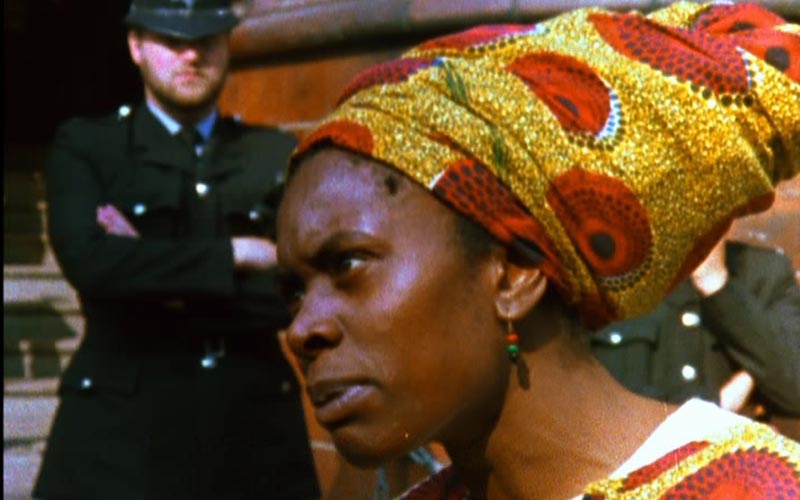
The image above comes from Handsworth Songs, Black Audio's response to the 1985 uprisings in Birmingham and London. A conventional current-affairs documentary might organize such events around a reporter, a timeline, and a search for one immediate cause. The film instead moves through contemporary footage, postwar archives, testimony, music, industrial noise, and meditative narration. It treats the uprising not as an isolated spectacle but as a present haunted by colonial memory, migration, housing, policing, and repeatedly deferred belonging.[3][5][9]
That refusal of a single explanation is not vagueness. It is the film's argument about evidence. News images can show a burning street and still conceal the history that made the street combustible. By interrupting the authority of reportage, Handsworth Songs asks the viewer to read gaps, echoes, and repetitions—to notice that the frame of a news report is itself a political decision.
Sankofa's work could be equally experimental without looking remotely the same. The Passion of Remembrance uses fiction, direct political address, performance, domestic space, and an almost theatrical argumentative plane. Attille's Dreaming Rivers turns migration and family memory inward, toward the unspoken life surrounding a Caribbean-born mother's deathbed. Ceddo's The People's Account stays close to Broadwater Farm after the television crews have moved on, allowing residents' analysis of policing and resistance to contest the label of “riot.”[4][7][8]
These works share neither genre nor visual grammar. Birmingham City University's workshop history makes the larger contrast explicit: the workshop field held campaigning films, labor traditions, community documentary, Black Audio's deconstructive politics, and Sankofa's attention to sexuality and masculinity. Workshops also assisted one another across cities; the Birmingham Film and Video Workshop contributed to the making of Handsworth Songs.[6] The movement was a network of capacities, not a palette.
The audience belonged inside the production model
“Integrated practice” also overturned the idea that a film was complete when the master left the editing room. Black Audio's early Expeditions project used tape and projected slides, then traveled through screenings and discussions. The collective programmed work at venues including the Rio in Dalston and the New Cinema in Nottingham. Gopaul described exhibition and education not as promotional extras but as necessary steps in creating a media-conscious Black audience.[3]
That ambition is easy to misread as outreach: the institution makes a film, then delivers culture to a public waiting outside. The workshop model was more reciprocal. Discussion could alter the makers' understanding of their material; community exhibition could test whether a film opened thought or merely repeated an expert vocabulary. An audience was not a market segment discovered at the end. It was part of the conditions under which a Black cinema could exist.
The 2020 Second Sight tour demonstrates how much this part of the work still matters. By circulating restored workshop films such as The People's Account, Omega Rising Women of Rastafari, and Dreaming Rivers alongside new commissions, the Independent Cinema Office and LUX did more than commemorate a finished period. They rebuilt, temporarily, the connection among archive, screen, contemporary artist, and public conversation.[8] Preservation here means preserving a route of encounter, not only a file.
Public support did not eliminate the gatekeeper
The workshop era should not be romanticized into perfect autonomy. Public money supplied time and protection, but broadcasters still controlled access to national schedules. Ceddo's The People's Account was pulled after the Independent Broadcasting Authority demanded changes to its language about police and the Broadwater Farm uprising; the collective refused. The conflict exposed the limit inside the agreement: a workshop might own its film and still be denied the audience promised by television.[7]
There was also a strategic dispute within Black British media culture. The 1989 Black Audio interview records the criticism that workshops could become a “ghetto within a ghetto,” while other organizers argued for entry into mainstream film and television. Black Audio's answer was not that independence was pure. It was that a Black cinema required more than placing a few individuals inside existing institutions; it required the power to experiment with form, cultivate audiences, and define the terms of address.[3]
Later career histories reveal the pressure of individualization. Julien and Akomfrah became internationally legible as singular artists, while the production ecologies around early work became less visible. Their achievements are real. The distortion begins only when recognition flows backward and turns a collective's films into apprenticeships for famous auteurs.
Representation includes the machinery around the frame
The Black Film Workshop Movement's durable lesson is not that every film should be made by committee. It is that an image carries the structure that made it, even when that structure remains outside the shot. A salary changes who can persist. Shared equipment changes who can practice. Control of editing changes whose uncertainty survives. Distribution changes whether a community can answer the image. Education changes who gets to make the next one.
That is why Handsworth Songs, The Passion of Remembrance, Dreaming Rivers, and The People's Account cannot be grouped by appearance. Their common form sits around the films: collective labor, institutional negotiation, political debate, and a refusal to separate making from showing. The workshops did more than improve the picture of Black Britain. They made the production of that picture available for argument.
Sources
- LUXONLINE, “1982: The ACTT Workshop Declaration” — the declaration's institutional origins, continuing funding, integrated-practice requirements, full-time work, and participating workshops.
- Colin Beckett, “A Workshop for All: The Miners' Campaign Tapes,” International Documentary Association, March 25, 2025 — workshop role flexibility, equal pay, union protection, copyright, and the declaration's wider collective-film context.
- Julian Petley, “Memory is the only raw material we can turn to: the Black Audio Film Collective on creating a Black cinema,” Monthly Film Bulletin interview from September 1989, republished by BFI — primary testimony on collective practice, integrated exhibition, formal experiment, and Handsworth Songs.
- Xavier Alexandre Pillai, “The Passion of Remembrance: the Sankofa collective's remarkable tapestry of Black British experience,” BFI, April 28, 2023 — Sankofa's founders, co-direction, Black feminist and gay cultural contexts, dual narrative form, and image context.
- Museo Reina Sofía, “Sounds in Diaspora: The Cinema of the Black Audio Film Collective” (2014) — institutional program history, collective credits, Handsworth Songs production specifications, archival method, and political context.
- Roger Shannon, “Background to Birmingham Film and Video Workshop,” Birmingham City University — Channel 4-era funding, regional cooperation, assistance on Handsworth Songs, and the workshop movement's formal diversity.
- Independent Cinema Office, “The People's Account” — Ceddo Film and Video Workshop's membership and support structure, the documentary's 1985 production context, and the editorial dispute that kept it off Channel 4.
- Independent Cinema Office, “Second Sight” (2020) — curatorial history of the UK Black Film Workshop Movement and the touring program connecting archive films with contemporary commissions.
- University College London, “City in the Essay Film: Handsworth Songs” (2019) — institutional screening page and source of the article's film still, credited to Black Audio Film Collective and LUX, London.