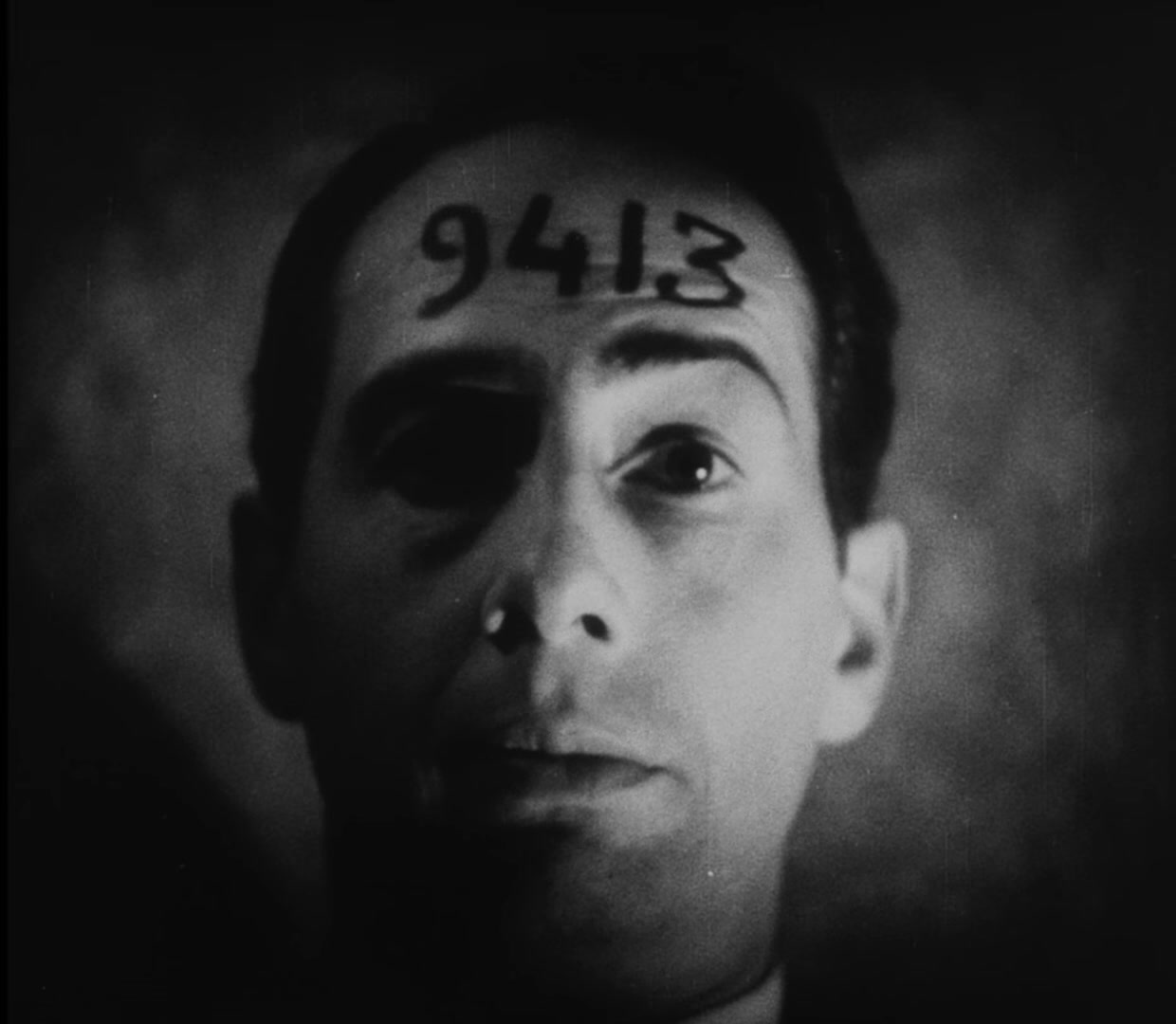
The most imposing Hollywood in silent cinema may also be one of the cheapest. In The Life and Death of 9413: a Hollywood Extra, towers lean over the frame, studio signs flare like commands, and a staircase rises toward the word “SUCCESS.” Yet this city was assembled from paper cubes, cigar boxes, tin cans, toys, and whatever else Robert Florey and Slavko Vorkapich could persuade light to enlarge.[1] Its star is not a star at all. He is a hopeful actor whose name is replaced by 9413, written directly across his forehead.
Made in late 1927 and released in 1928, the short cost a reported $97 and runs roughly thirteen minutes in surviving presentations.[1][3] Those figures are irresistible, but treating them as a charming shoestring anecdote misses the craft. Poverty did not merely constrain the film’s look. It gave the filmmakers a material language for their subject: a movie industry that can manufacture monumental dreams from cheap components, then treat the people inside those dreams as cheaper components still.
The budget became a design method
Florey’s first act of economy happened before the camera rolled. After hearing George Gershwin’s Rhapsody in Blue, he planned the short as a “musical” continuity without synchronized sound, specifying it shot by shot so he would know how much film stock each passage required.[1] The finished work was cut to one reel—about 1,200 feet—with unusual attention to tempo.[1] Here thrift means premeditation. Every repeat, angle, and burst of motion has to earn its length.
Vorkapich’s miniature city applies the same discipline to space. According to the Library of Congress essay, its buildings were made from paper forms, cigar boxes, cans, and children’s toys.[1] A University of California Press history of California modernism describes the resulting world as an expressionist combination of models, live action, moving light, and trick effects.[2] The constructions do not imitate full-size studio architecture in convincing detail. They reduce architecture to the things power needs: height, hard edges, gates, ramps, signs, and a route upward that can always be denied.
That abstraction is why the sets feel larger than a careful scale model might. A realistic miniature invites the eye to admire resemblance. These black slabs and trembling planes invite the eye to feel pressure. Because windows, masonry, and street detail have been stripped away, the city reads instantly as hierarchy. There is a bottom, a top, a door, and somebody else’s hand deciding who may pass.
Three image worlds keep colliding
The film organizes its imagery into three rough registers: miniature environments, close-ups of live actors, and newsreel-like views of actual Hollywood streets and studios.[1] It does not smooth those registers into one seamless illusion. It cuts among them until their mismatch becomes the point.
Real marquees and studio exteriors establish that Hollywood exists as a physical place. The miniature city then converts that place into a mental and economic machine. Finally, the close-ups show what the machine does to a face. Jules Raucourt’s 9413 rarely owns a stable middle distance in which he can simply stand as a whole person. He looms in a tight portrait, shrinks beneath signage, or becomes one layer within an exposure. Scale changes with his position in the industry, not with ordinary geography.[1][2][6]
This is especially sharp in the casting scenes. Authority appears as pieces: a cigar-filled mouth, a telephone, a finger that points and refuses. The applicant, meanwhile, must present a face as a product. One successful rival cycles through paper masks; 9413 offers his own mask and receives no recognition.[1][6] The film does not need a realistic office or a fully characterized executive. By fragmenting the boss and numbering the worker, it makes the relation legible before psychology can soften it.
One light source turns cardboard into weather
Accounts differ on the lamp’s wattage. The National Film Registry essay reports a single 400-watt bulb; the Viennale archive preserves Vorkapich’s recollection that the crew began with two 500-watt lamps, one burned out, and filming continued with the survivor.[1][3] The discrepancy is worth keeping because both accounts describe the same practical truth: this supposedly vast Hollywood depended on one movable source.
That source does several jobs at once. Raked across the models, it makes flat or flimsy material disclose an edge, throw a long shadow, and briefly acquire mass. Moved during a shot or combined through superimposition, it makes the city seem unstable—less like a place than a nervous illumination system.[1][2] On the actors, the same scarcity becomes selective visibility. Half a face can disappear while the number on the forehead remains readable. The institution sees the label more reliably than the person.
The small camera package also had a boundary. Most footage was made by Florey and Vorkapich, with help from Paul Ivano, but the young Gregg Toland had access to a Mitchell camera for close-ups and effects the DeVry could not manage. Florey described passages involving four or five exposures on one plate.[1] Multiple exposure is not ornamental haze here. It lets signs, machinery, faces, and lights occupy the same patch of film, as if Hollywood’s promises and its apparatus have physically crowded out ordinary space.
Montage turns rejection into a production line
The movie’s rhythm is built from returns. The extra climbs toward success and gets nowhere. “NO CASTING TODAY” comes back. The pointing hand comes back. Masks come off and go on. The UC Press account compares the repeated staircase to the looped labor in Ballet mécanique, emphasizing how repetition converts one action into a system.[2]
This is the crucial difference between melodrama and montage. In a conventional story, one rejection might reveal a cruel employer and another might deepen the hero’s misfortune. In 9413, repetition drains the encounters of individual exception. The signs and gestures behave like standardized parts. Rejection does not happen because the wrong person happened to answer the telephone that morning; it is what the image factory is organized to keep producing.
Even the film’s most lyrical devices preserve that mechanical edge. Spotlights cross the sky, reels turn, celluloid dangles, and tilted street views rush by in short collisions.[1] The editing grants Hollywood genuine kinetic excitement—this is not a scold made by people indifferent to movies—but refuses to separate excitement from attrition. The same velocity that can make a career also makes a worker vanish between two cuts.
The ending pushes that logic into bitter comedy. After 9413 dies, the film sends him upward, removes the number, and gives him an angelic release. The Library of Congress essay reads the passage both as melodramatic closure and as a satire of Hollywood’s compulsory happy ending.[1] Heaven can recognize the person only after the studio has finished using the body. Even transcendence arrives as one last special effect.
The calling card carried an accusation
The short’s industrial afterlife completes its paradox. Light Cone’s distribution catalogue places it at the meeting point of German Expressionism, French avant-garde practice, and early American experimental filmmaking, while USC’s Vorkapich-Hoffman archive connects its co-director to a later career in montage, optical effects, studio filmmaking, and film education.[4][5] Florey, Vorkapich, and Toland did not remain outside the system they caricatured.[4]
Nor did the film remain a kitchen experiment. Charlie Chaplin helped introduce it to an industry audience, and FBO eventually distributed it to more than 700 American theaters, according to the National Film Registry essay.[1] A movie about an extra whom Hollywood cannot see became a highly visible demonstration of what its makers could do. The machine absorbed the criticism partly because the criticism was so technically useful.
That does not make the film’s independence fraudulent. It makes the achievement sharper. The Life and Death of 9413 understands that cinema’s glamour and its waste are made by many of the same operations: cutting, masking, numbering, lighting, enlarging, and discarding. With almost no money, it found physical equivalents for all of them. Cardboard becomes a city; one bulb becomes an atmosphere; a few frames become a recurring refusal. Only the man with the number is never permitted to become more than the material assigned to him.
Sources
- Brian Taves, “The Life and Death of 9413: A Hollywood Extra.” Library of Congress National Film Registry essay — production planning, visual design, lighting, cameras, editing, narrative, and distribution.
- William Moritz, “Visual Music and Film-As-An-Art Before 1950,” in On the Edge of America: California Modernist Art, 1900–1950. University of California Press — models, trick effects, moving light, rhythmic repetition, viewpoints, and avant-garde context.
- Viennale, “The Life and Death of 9413 – A Hollywood Extra” — film record, production materials, budget, performers, lamp recollection, and career context.
- Light Cone, “The Life and Death of 9413, A Hollywood Extra” — distribution catalogue note on the film’s Expressionist, French avant-garde, and early American experimental context.
- USC HMH Foundation Moving Image Archive, “Vorkapich–Hoffman Collection” — Vorkapich’s montage, optical-effects, studio, teaching, and preservation record.
- Wikimedia Commons, “The Life and Death of 9413 a Hollywood Extra (1928) HD” — high-definition film copy used to verify scenes and extract the featured archival frame.