Spoiler warning: this article discusses the film's ending and several major scene turns throughout.
Robert Bresson's Pickpocket looks small if it is described only as a crime film: a young Parisian thief steals, stops, returns to stealing, and finally lands in prison.[1][4] On screen, the movie is much stranger. Its suspense does not come from whether Michel will be caught in the usual thriller sense. It comes from whether a hand, a face, a door, a step, or a silence can remain unread for one more second. Bresson turns theft into a test of perception.[1][2][3]
That is why Pickpocket still feels so modern inside its 1959 Paris. BFI calls it intentionally not a thriller, while still full of suspense, and that distinction is the right entry point.[1] Bresson strips away most of the genre's ordinary stimulants: chase psychology, underworld glamour, procedural explanation, confessional acting. What remains is a film of surfaces and transfers. A wallet slides. A newspaper covers a movement. A train door opens and closes. Michel's face offers almost nothing, so the viewer begins looking at everything else.[1][3]
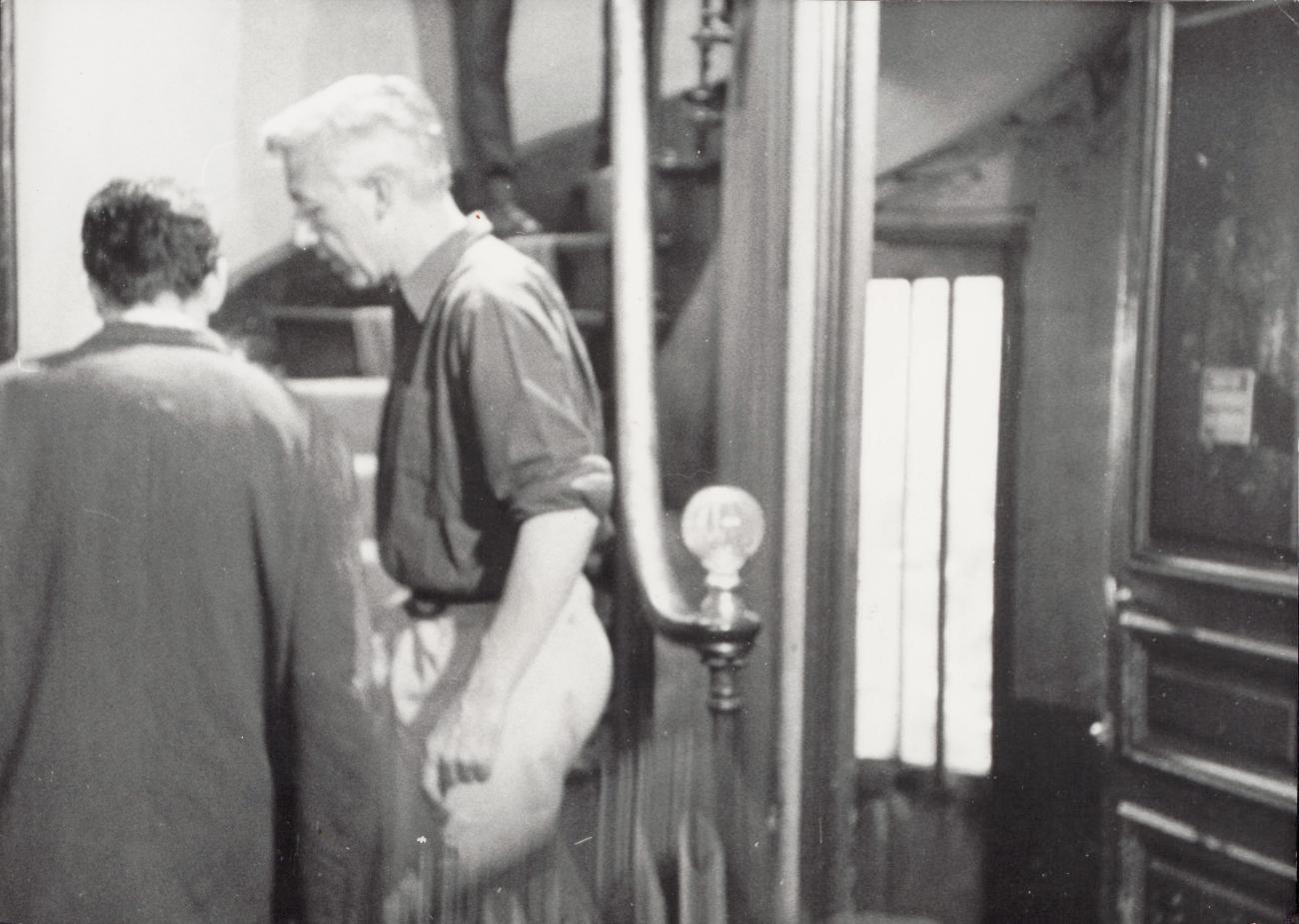
The cover photograph, from BFI's Sight and Sound feature on cinematographer Leonce-Henry Burel, shows Bresson talking with Martin LaSalle on a staircase during production.[2] It is the right image for this essay because Pickpocket is less a film of emotional display than of instructed bodies in real spaces. Bresson does not ask Paris to become picturesque. He asks staircases, cafes, streets, stations, and metro cars to become instruments for timing.[2][3]
The hands carry the plot before Michel does
The first craft fact to absorb is that Pickpocket is not organized around Michel's psychology as much as around his manual training.[1][3] Michel says ideas about exceptional men and the law, but the film treats those ideas as thin compared with the evidence of his hands. His theory is abstract; the thefts are exact. Bresson's camera keeps returning to fingers entering handbags, withdrawing wallets, passing objects between accomplices, and disappearing beneath coats. The real drama is tactile before it is verbal.
Senses of Cinema is especially useful on this point because it describes the movie's central Gare de Lyon passage as a sustained sleight-of-hand ballet: three pickpockets work the station and train with fluid precision, while the soundtrack emphasizes heels, train doors, and motion.[3] The phrase matters because the scene really does behave like choreography. Each thief's body only makes sense in relation to another body. One hand distracts, another extracts, a third receives. The stolen object travels through a chain faster than moral judgment can settle on any single person.
Bresson makes the sequence thrilling by denying the viewer the usual emotional handles. There is no swelling music to tell us what to feel and no nervous acting to externalize Michel's risk. Instead, the scene creates suspense through spatial grammar: shoulder, hand, pocket, newspaper, door, platform, compartment. The viewer watches technique become rhythm. Theft turns into a form of editing performed inside the frame.
That does not make the sequence morally neutral. It makes the moral problem harder to locate. The hands are beautiful because they are precise. They are disturbing for the same reason. Bresson lets the viewer feel the elegance of the operation while keeping the human cost nearby: ordinary passengers become surfaces to be read, touched, and emptied. The beauty of the gesture never cancels the violation inside it.[1][3]
Location stealth makes Paris feel half-caught
Burel's production account explains why the exterior scenes feel so alive.[2] Bresson wanted to film in the streets with as little public awareness as possible, and Burel describes hidden lights, a hand camera, fast film stock, heavy rehearsal, and final takes executed before bystanders could fully register the filming.[2] The result is not documentary randomness. It is planned stealth.
That difference is crucial. Pickpocket does not simply record Paris as found life. It uses real Paris as a resistance surface. The Madeleine, the Opera, Place Pigalle, Boulevard Saint-Michel, Gare de Lyon: these locations are not tourist markers in the film. They are places where Michel's isolation can be tested against public circulation.[2][3] He moves through crowds, yet the crowds rarely become community. They are pressure, cover, temptation, and evidence.
This is one reason the film's austerity never feels empty. The world around Michel has density, but Bresson refuses to turn it into atmosphere for its own sake. Harvard Film Archive notes that the film was Bresson's first entirely original script and places it near Crime and Punishment through its lonely thief and moral reflection.[4] The Dostoevskian inheritance is there, but Bresson shifts the burden from speech to public movement. Instead of long confession, he gives Michel transit.
The city therefore becomes an ethical machine. Michel can hide in it, but he cannot belong to it. Every public space offers him an opportunity to touch another person's life without entering it. That is the source of the film's bleak precision: theft promises contact while preserving isolation.[1][3][4]
The performances are sparse so the objects can speak
The acting in Pickpocket is often described through Bresson's famous distrust of performance, and the point is visible in every scene.[1] Michel's face is not expressive in the conventional sense. Jeanne does not become a melodramatic savior. The inspector does not swell into a theatrical adversary. This restraint can look cold on first contact, but it changes the viewer's labor. We stop waiting for characters to explain themselves through emotional emphasis and begin watching the small external facts around them.
That redistribution of attention is the film's craft. A door closing matters. A notebook matters. Money matters. A bed in a spare room matters. A visit to Michel's mother matters less because Michel emotes than because he cannot convert obligation into care. Bresson's sparse performance style makes objects and gestures carry emotional pressure that conventional acting would have absorbed.[1][3]
Senses of Cinema complicates the received idea of Bresson as merely ascetic by stressing the film's sensual contradictions: Paris is modern and old, Michel is stiff and charged, the thefts are criminal and graceful, and Lully's Baroque music cuts into postwar street space.[3] That is exactly what the performances allow. Because the actors are flattened, the world becomes more textured. Because Michel withholds, the viewer notices rhythm, fabric, footsteps, metal, and paper.
The film's final prison scene depends on this discipline. If Michel had been rendered as a fully legible psychological subject all along, the ending would risk becoming a neat redemption beat. Instead, the famous movement toward Jeanne arrives after a long training in withheld feeling.[4] The bars between them matter because Bresson has spent the whole film making barriers physical. The emotional release is small, but the film has taught us to read small movements as decisive.
Sound turns suspense into a pressure system
The sound design is as important as the hands. In the Gare de Lyon sequence, footsteps, door slides, cloth, and station movement do the work that ordinary suspense scoring would do elsewhere.[3] These sounds are not background realism. They are timing devices. They tell the viewer when the city is open, when the exchange is possible, when a body has crossed a threshold, when a risk has become irreversible.
The sparing use of music sharpens that system. Lully's Baroque music enters like an interruption from another order of experience, formal and elevated, while the thefts themselves depend on street-level contact and mechanical transit.[1][3] The contrast could have felt decorative. Instead, it gives the movie its strange double register. Michel's acts are shabby, compulsive, and predatory; the film's construction around them is severe, lucid, and almost ceremonial.
BFI's film page describes Michel as isolated and ambivalent, drawn into theft for reasons unclear even to himself.[1] Bresson's soundscape reinforces that ambiguity by refusing to turn him into either a charismatic outlaw or a case study. We hear the world he cannot join. Trains, crowds, doors, and footsteps continue with or without him. Suspense comes from his attempt to insert himself into that flow by stealing from it.
The trick is that capture becomes the only readable ending
The film's ending is often discussed in terms of grace, salvation, or spiritual breakthrough.[4] Those readings are legitimate, but the craft route to the ending is more concrete. Bresson spends the film showing Michel trying to evade social readability. He steals without confession, speaks in theories, dodges work, misses ordinary obligations, and treats other people as occasions for his private compulsion.[1][4] Prison finally gives him a frame he cannot slip through.
That is why the ending does not feel like conventional punishment. It feels like composition tightening around a man who has avoided composition. The bars, Jeanne's face, Michel's hand, the spoken recognition between them: all of these elements are simple because the film has already removed excess. The emotion lands through placement.
In that sense, Pickpocket is one of cinema's cleanest demonstrations of how craft can replace plot mechanics. Bresson does not need a complicated criminal scheme. He needs hands, doors, train compartments, stairs, withheld faces, and a city filmed close enough to seem half unaware of the camera.[2][3] The movie's greatness lies in that conversion. It takes the smallest physical acts and makes them bear the full weight of suspense, sin, desire, and possible release.[1][3][4]
Sources
- BFI, "Pickpocket (1959)" film page - credits, running time, poll placement, and BFI synopsis of the film's suspense and moral ambiguity.
- Tom Milne, "Notes from the cinematographer: Leonce-Henry Burel on working with Robert Bresson," BFI Sight and Sound - production account and source of the BFI staircase photograph used as this article's image.
- Alexandra Heller-Nicholas, "Pickpocket (Robert Bresson, 1959)," Senses of Cinema - close reading of the film's location work, sleight-of-hand choreography, sound, and formal contradictions.
- Harvard Film Archive, "Pickpocket" screening note - Bresson's original script, 35mm print details, Dostoevskian context, and reception summary.