Spoiler note: this article discusses the prologue, Alma's beach confession, the letter scene, and the merged-face passages near the end.
Ingmar Bergman's Persona has the kind of reputation that can make viewers approach it like a puzzle box.[1][2][3] The film is famous for breakdowns of identity, for silence, for modernist self-consciousness, for the question of whether Alma and Elisabet become one another or merely imagine it.[1][2] All of that matters, but the most useful way into the film is more concrete. Persona keeps asking what a face is once cinema gets hold of it. Is a face a window into a soul, a mask hiding one, a surface that invites projection, or a screen that reflects the viewer's own need back at them? Bergman never settles on one answer. He makes the uncertainty itself into the film's formal motor.[1][3][4]
That is why the movie still feels so alive. Criterion's capsule description stresses the mute actress Elisabet Vogler, the talkative nurse Alma, and the emotional transference that develops between them in an isolated cottage.[1] BFI sharpens the same point by calling attention to the fractured opening montage, the blurring of realism and fantasy, and the film's abiding interest in masks, mirrors, and self-reflexive cinema.[2] Put those together and a pattern emerges. Bergman is not simply telling a psychodrama about two women who exchange traits. He is studying what happens when one woman's speech, one woman's silence, and the camera's appetite all converge on the unstable surface of the face.
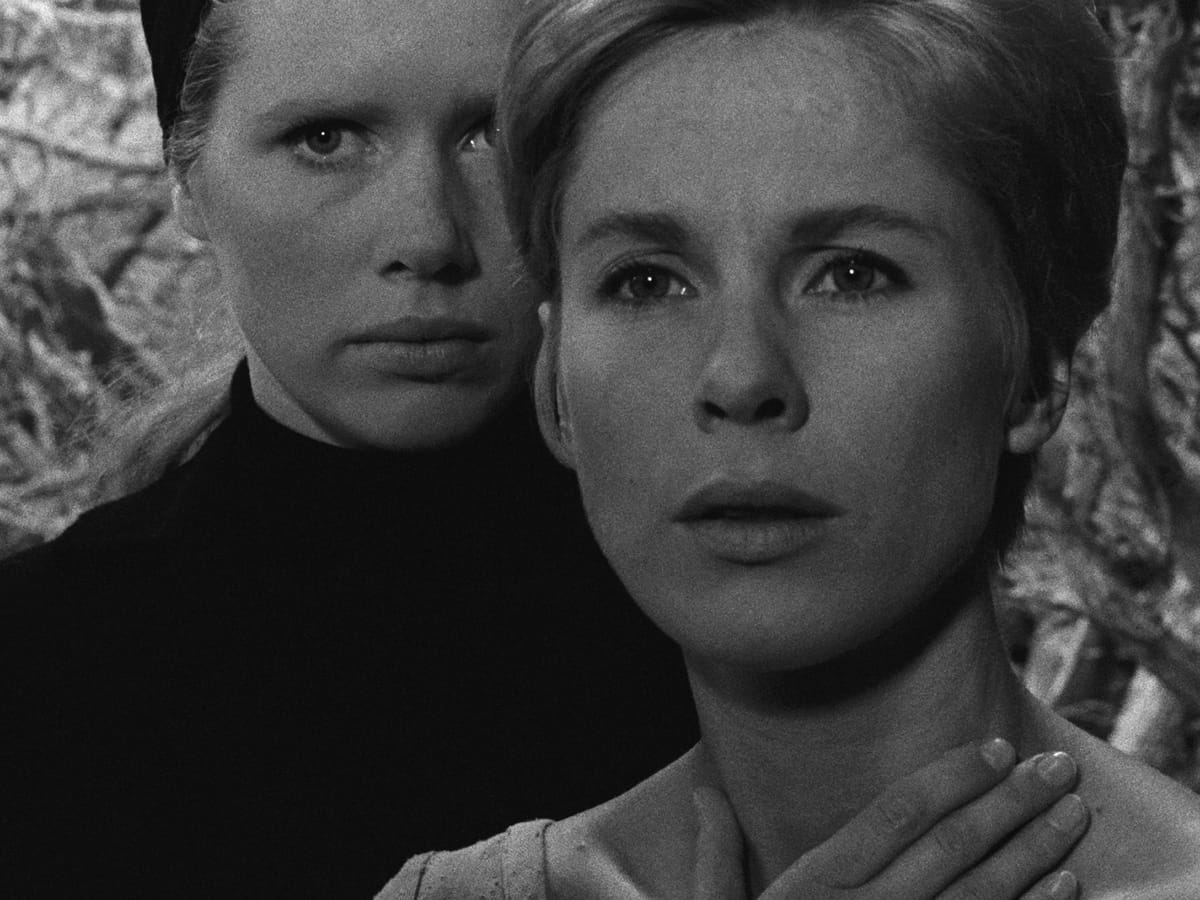
Image context: the lead image uses a Criterion still showing Liv Ullmann and Bibi Andersson in almost unnerving proximity. It is the right image for this essay because Persona does not treat resemblance as a plot twist to be solved. It treats resemblance as a visual condition that keeps threatening to turn one face into the other's screen.[6]
The prologue tells you immediately that faces in this film will be touched through apparatus
The prologue remains one of the clearest statements any film has made about its own medium.[2][3] Before the central story even settles, Bergman gives us projector light, filmstrips, bursts of violence and death, a boy on what looks like a hospital bed, and then the extraordinary shot Elsaesser isolates: the boy reaching out toward the large face that appears before him on a translucent surface.[3] The moment is simple enough to describe and impossible to reduce. Cinema becomes, all at once, touch and non-touch. The face looks close enough to graze, yet it remains trapped in light and separation.
That shot matters because it programs the whole film.[3] A weaker reading of Persona says that Bergman later "reveals" the two women to be fragments of one identity. The prologue suggests something stranger. It says that cinema itself already works through divided presence. A face on screen is intimate and unreachable, warm with human detail and cold with technological distance. The boy's gesture turns spectatorship into a bodily act that cannot complete itself. He can approach the image, but he cannot inhabit it. That tension, desire for contact and the certainty of mediation, becomes the basic emotional weather of everything that follows.
BFI is especially good on the way Bergman lets the celluloid itself become visible as cinema, not as a transparent container for story.[2] The film does not hide the projector gate, the strip, or the possibility of rupture. Even before Alma and Elisabet begin testing the limits of each other's identities, Bergman has already shown that the image can burn, tear, or fail. The face is therefore never only psychological in Persona. It is material. It arrives through emulsion, light, framing, and interruption.
Alma's beach monologue turns Elisabet's silence into a screen for speech
Once the film moves to the hospital and then to the island cottage, the central method becomes clearer.[1][2][4] Elisabet's silence is not passive. It reorganizes the room. Alma keeps talking because someone has to keep language moving, and soon the words begin to expose her more than they explain anything to Elisabet. The beach monologue is the decisive instance. As Abbey Lustgarten notes, Bibi Andersson had to fight to keep the scene in the film, rewriting parts of the dialogue and later dubbing the entire monologue in postproduction.[5] Bergman knew what he had: a scene in which confession becomes almost too vivid to bear.
What makes the moment so powerful is not only the content of Alma's story about a sexual encounter on the beach with her friend and two boys and the troubled aftermath that followed.[5] The power comes from the listening arrangement. Elisabet's face scarcely gives Alma the ordinary social feedback that most speech depends on. There is no easy reassurance, no reciprocal confession, no verbal correction. Alma therefore hears herself at the same time that she tells the story. The monologue feels less like information passed between two people than like a projection thrown onto the blankest possible receiving surface.
This is why Persona makes speech feel tactile.[1][3][5] Alma's language has rhythm, breath, embarrassment, excitation, recoil. It seems to strike Elisabet's face and rebound. Elsaesser argues that the film is concerned not only with what lies behind a mask but with what must pass through the mask.[3] The beach monologue is the sharpest example. Alma is not unmasked into some final stable truth. She is transformed by the act of sending desire, shame, memory, and fantasy across a face that receives everything and returns almost nothing. Silence here is not emptiness. It is an intensifier.
The letter and the merged close-up show that projection is inseparable from aggression
The relationship turns harsher once Alma discovers that Elisabet has written to the doctor about her, describing her almost as a fascinating case.[2][5] This is one of the film's cruelest moves because it reveals that listening, which had seemed intimate, may also have been extractive. Alma thought she was being received; instead she may have been observed. Lustgarten's production note about the broken-glass episode belongs here too.[5] Alma's anger is not abstract. It becomes spatial and physical, a way of laying a trap in Elisabet's path. The film's psychological struggle keeps turning into problems of surfaces and contact.
From there Bergman pushes toward the image that has become the movie's most famous emblem: the two faces joined into one composite.[3][5] The shot is often described as a symbol of shared identity, but that is too calm. It is more disturbing than that. The merged face does not reveal a harmonious synthesis waiting underneath the plot. It shows how cinema can manufacture unity out of separate fragments and still leave the result uncanny. Bergman found the idea in the editing room, and neither Andersson nor Ullmann fully recognized herself in the combined image.[5] That detail is not trivial production lore. It gets at the film's deepest proposition. The face becomes most unstable precisely when the image looks most complete.
Seen next to the prologue, the composite face clarifies the whole arc.[2][3] Early on, the boy reaches toward a projected face he cannot touch. Late in the film, Bergman gives us a face that seems touchingly whole but is actually an edit, a splice, a manufactured proximity. In between sits the entire drama of confession, silence, resemblance, resentment, and desire. The movie never says that identity is unreal in a vague philosophical sense. It says something harder: identity in cinema is always being made and unmade by framing, performance, memory, and the viewer's own need to stabilize what is seen.
That is why Persona still feels modern rather than merely canonical.[1][2][3][4] It understands that intimacy can become invasive, that spectatorship can become predatory, and that the face is where those risks become visible first. Bergman does not use the close-up to guarantee access to the self. He uses it to show how badly we want access, and how quickly that wanting turns other people into surfaces for our own fear, pity, lust, and interpretation. The film's mystery remains productive because it is anchored in a concrete cinematic problem: how do you look at a face without trying to possess it?
In Persona, no one solves that problem.[1][2][3] Bergman only sharpens it. The projector in the prologue, Alma's beach confession, the letter's betrayal, the broken-glass anger, and the merged close-up all belong to one severe line of thought. A face is never just a face once the camera begins working on it. It becomes a window, mirror, mask, wound, and screen at the same time. That is the film's real disturbance, and also its lasting clarity.
Sources
- The Criterion Collection, "Persona (1966)" film page.
- BFI, "Persona (1966)".
- Thomas Elsaesser, "The Persistence of Persona." The Criterion Collection.
- MoMA, "Persona. 1966. Written and directed by Ingmar Bergman."
- Abbey Lustgarten, "10 Things I Learned: Persona." The Criterion Collection.
- Criterion Collection carousel still used for the article image, Persona (1966).