Spoiler note: this article discusses the second half of the film and the way Emmi and Ali's relationship changes under public pressure.
Many melodramas tell us that society disapproves. Rainer Werner Fassbinder's Ali: Fear Eats the Soul does something sharper: it shows disapproval becoming architecture.[1][2][3][4] A doorway narrows into a trap, a stair landing becomes a tribunal, an outdoor café turns into an exhibition platform, and a restaurant table acquires the chill of a stage. The film's great cruelty is that Emmi and Ali are rarely permitted a truly private feeling. Even when they sit alone, the shot keeps asking who is looking, who is withholding, who has decided that this couple must explain itself.
That is why the film still feels so current more than fifty years after its 1974 release.[1][3] Fassbinder is not mainly interested in bigots as colorful villains. He is interested in the smaller and more durable machinery of social sorting: the stare that lingers a second too long, the neighbor who suddenly claims the hallway as moral property, the coworker group that requires a victim before it can become cheerful again.[2][4] Instead of treating prejudice as an exceptional breakdown of civic life, he films it as a pattern built into everyday rooms and routines.
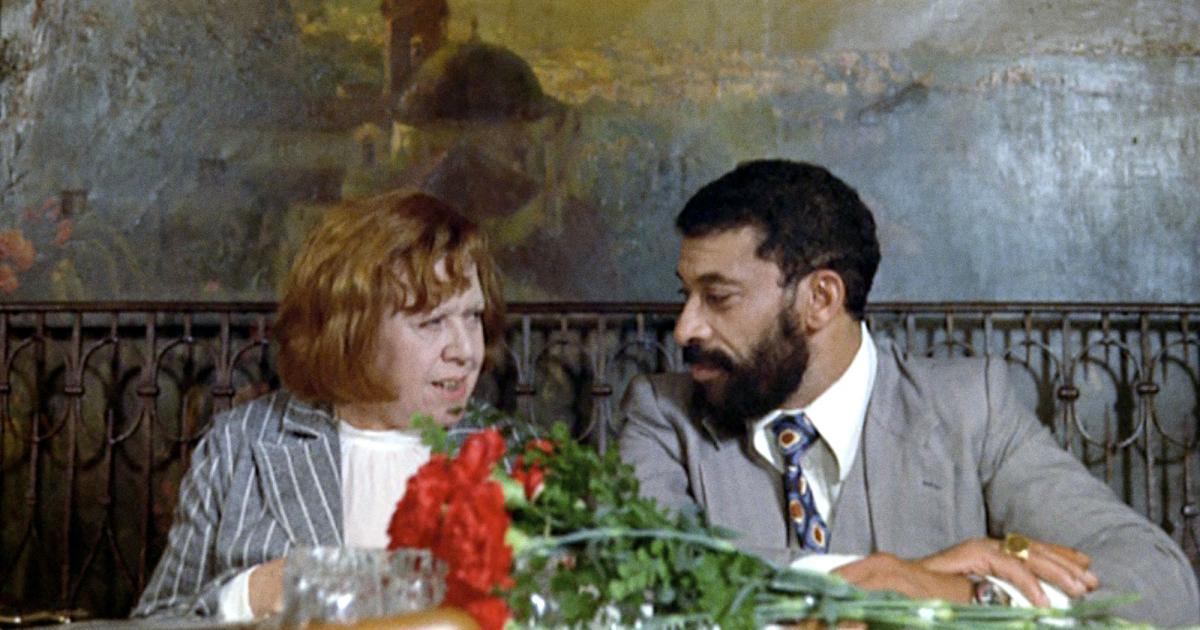
Image context: the lead image uses a BFI still of Emmi and Ali seated at a restaurant table with red carnations. It is the right recognition image for this essay because Fassbinder repeatedly stages intimacy inside spaces that should promise comfort and instead become public tests. The flowers, tablecloth, and formal seating try to confer dignity, but the surrounding room makes the couple look less hosted than exposed.[3]
Doorways turn ordinary rooms into testing devices
Chris Fujiwara's Criterion essay is especially useful because it explains how the film's visual style works through paired figures: restrictive frames around the couple, and wide shots that leave them stranded in visible emptiness.[2] The kitchen doorway in Emmi's apartment is the clearest example. A threshold that should simply connect one room to another becomes a device for measuring isolation. When Emmi and Ali stand or sit inside that frame, the room does not feel cozy or domestic. It feels provisionally granted, as if belonging could be withdrawn at any moment.
BFI's feature on the film makes a related point about rigid composition, windows, and doorways that seem to imprison the characters inside narrow bands of space.[3] Fassbinder keeps taking banal domestic architecture and converting it into social pressure. A stairwell is no longer just circulation; it is where neighbors gather their disgust. A workplace corridor is no longer a passage; it is where a group can rehearse exclusion until it feels like common sense. The film never needs to underline these moments with explanatory dialogue because the geometry has already done the work.
Julian Savage's essay for Senses of Cinema pushes this one step further by treating the stare itself as a system that implicates the viewer.[4] That matters because the film is not content merely to show that Emmi and Ali are watched. It makes watching the medium through which they are socially rewritten. Emmi becomes, in the eyes of others, not a cleaner, mother, widow, or customer, but the woman who is with Ali. Ali becomes not simply a man, but the man by whom Emmi can be judged. The couple's identities keep being reassigned according to who happens to be looking.
This is why Fassbinder's static compositions feel so severe. They do not simply record oppression after the fact; they stage the process by which ordinary space gets moralized. A doorway becomes a frame, the frame becomes a verdict, and the verdict becomes part of the room's atmosphere.
Restaurant tables and yellow chairs make public space feel punitive
The film's outdoor and commercial spaces are even harsher because they make humiliation look communal rather than intimate.[2][3][4] One of the most memorable images in the movie is the café scene in which Emmi and Ali sit surrounded by yellow chairs, nearly marooned inside a field of empty furniture.[2][4] They are not physically attacked. That would almost be easier to understand. Instead the environment performs withdrawal. Service slows. Looking intensifies. The distance around them becomes its own kind of sentence.
Fassbinder returns to tables because tables normally imply participation: a drink with strangers, dinner with company, a place in the room.[1][3] In Ali: Fear Eats the Soul, tables keep betraying that promise. The restaurant scene captured in the lead image looks, at first glance, almost ceremonially respectful. Emmi and Ali are dressed, seated, and centered. Yet the elegance of the setting only sharpens the exclusion. They seem placed for observation, not welcomed into company. The room offers form without fellowship.
That tension is central to Fassbinder's emotional method. He does not say that love is impossible in public. He says public life keeps trying to convert love into spectacle.[2][3][4] At the bar where Emmi first meets Ali, the possibility of warmth exists because the room is already full of people who live outside official respectability.[1][2] But once the relationship enters more respectable social spaces, respectability itself becomes punitive. The stare does not merely insult. It organizes the field, deciding who may relax and who must remain visibly aware of being present.
This is where the film's title begins to feel less metaphorical. Fear is not only inside the characters. It is distributed across chairs, aisles, doorframes, and pauses in service. It becomes the air pressure of a social scene.
The stripped-down style makes prejudice look routine rather than exceptional
One reason the film hits so hard is that Fassbinder strips away nearly everything that might soften or romanticize the mechanism.[1][3][5] BFI notes that he shot the film in just fifteen days, while Criterion's short piece on its style emphasizes the low-budget, compressed conditions under which he arrived at a minimalist approach.[3][5] That constraint became an aesthetic advantage. The movie does not overflow with decorative camera movement or lush melodramatic release. It keeps paring things down until small gestures become impossible to ignore.
The result is a melodrama without plush insulation. Douglas Sirk is the acknowledged point of departure, but Fassbinder hardens the inheritance.[1][2][3] He keeps the emotional clarity of Sirkian social melodrama while removing much of the cushioning elegance. Rooms look plain, pauses feel exposed, and the cuts arrive with a bluntness that makes every social reaction register as behavior rather than atmosphere. The film is compassionate, but it is never cozy.
That bareness helps explain why prejudice here looks procedural.[2][3][5] Nobody needs a grand speech to produce harm. A son can kick in a television. Coworkers can leave a silence hanging half a beat too long. A grocer can decide whether neighborliness is economically useful. The style is severe enough that each of these acts lands as part of one repeating pattern. Fassbinder is showing how exclusion survives precisely because it can disguise itself as habit.
The performances matter too. BFI points to the film's blend of warmth and a more distanced, Brechtian edge.[3] Brigitte Mira gives Emmi genuine tenderness, but Fassbinder never lets tenderness float free of social form. Even the sweetest scenes carry an awareness of posture, costume, and placement. The couple are not just feeling; they are being arranged.
What looks like acceptance returns as transaction
The film's nastiest insight comes in the second half, when some of the surrounding hostility appears to ease.[2][3] Fujiwara is especially good on this turn. The grocer softens once he realizes he needs Emmi's business. The neighbors rediscover cordiality once they want access to basement storage. Emmi's coworkers, having tired of excluding her, simply redirect their contempt onto someone else.[2] Social peace returns, but only by revealing itself as an opportunistic bargain.
That change matters because it keeps the film from collapsing into a simple persecution narrative. Fassbinder is not arguing that the world is divided between open enemies and secret friends. He is showing that prejudice can mutate into usability without becoming less damaging.[2][4] The social field begins to tolerate the couple, but only after it finds ways to instrumentalize them. Emmi, in turn, starts reproducing some of the same pressures inside the relationship, displaying Ali to others and trying to stabilize love through possession rather than mutual shelter.[2]
This is the point at which Ali: Fear Eats the Soul becomes more than a critique of racist spectacle. It becomes a study of how public judgment gets internalized. The stare does not disappear once the crowd grows polite. It moves inward, changing the rhythms of intimacy itself. Fassbinder's final achievement is to make that transfer visible without turning the couple into symbols too abstract to hurt.
The film remains devastating because it never mistakes civility for transformation.[1][2][3][4] Doorways still divide. Tables still expose. Public space still asks the same question in ever so slightly altered form: what kind of couple is allowed to take up room here? Fassbinder's answer is mercilessly clear. In this world, love survives only if it can endure being constantly made legible to others. That is the social test the film keeps staging, and the reason its simplest images still cut so deep.
Sources
- The Criterion Collection, "Ali: Fear Eats the Soul (1974)" film page.
- Chris Fujiwara, "Ali: Fear Eats the Soul: One Love, Two Oppressions," The Criterion Collection.
- David Morrison, "6 reasons to watch Fear Eats the Soul," BFI.
- Julian Savage, "The Conscious Collusion of the Stare: The Viewer Implicated in Fassbinder's Fear Eats the Soul," Senses of Cinema.
- The Criterion Collection, "The Stripped-Down Style of Ali: Fear Eats the Soul."