
The official StudioCanal trailer for Michael Powell's Peeping Tom lasts barely a minute, but it understands that the film should not be sold as a generic serial-killer shocker.[1] The plot can be stated in one lurid sentence: Mark Lewis, a cameraman shaped by childhood trauma, murders women and records their fear.[2][4] Yet the trailer's real intelligence lies elsewhere. It presents the movie as a system of contaminated looking. The camera lens, the projection screen, the studio lamp, the viewfinder frame, and the spectator's own eye all start to feel less like separate things than like parts of one machine.[1][3]
That emphasis fits the film's critical afterlife. Laura Mulvey's classic essay argues that Peeping Tom makes cinema spectatorship itself newly visible by foregrounding "the mechanics of looking" and forcing the audience into a disturbing proximity with Mark's voyeurism.[3] Criterion's current film page reaches a similar conclusion in more compact language, calling the movie a "metacinematic investigation into the mechanics of fear."[2] The trailer gets there without theoretical vocabulary. It does it by arranging shots so that every image seems to ask who is looking, through what instrument, and at whose expense.[1]
The restoration context makes that even sharper. BFI's restoration account stresses that the new version grew out of a scan of the original Eastmancolor negative, with painstaking work to preserve the image's organic texture while removing damage.[5] That matters because Peeping Tom is one of those films in which color, glare, emulsion, and screen surface are not secondary decoration. They are part of the argument. When the trailer flashes studio reds, projector whites, and that coldly polished camera metal, it is not merely advertising a catalog title in cleaner condition. It is restoring the tactile force of a film that treats cinema equipment like a nervous system.[1][5]
The trailer is therefore worth treating as a small but serious object. It does not try to summarize every layer of Powell's film, nor does it pretend that a one-minute preview can capture the whole moral ugliness of Mark Lewis. What it does do is teach a viewer how to watch. Do not begin with plot solution or genre expectation. Begin with apparatus. Begin with the fact that in Peeping Tom, the camera does not merely observe violence. It helps organize the world in which violence becomes thinkable.[1][2][3][5]
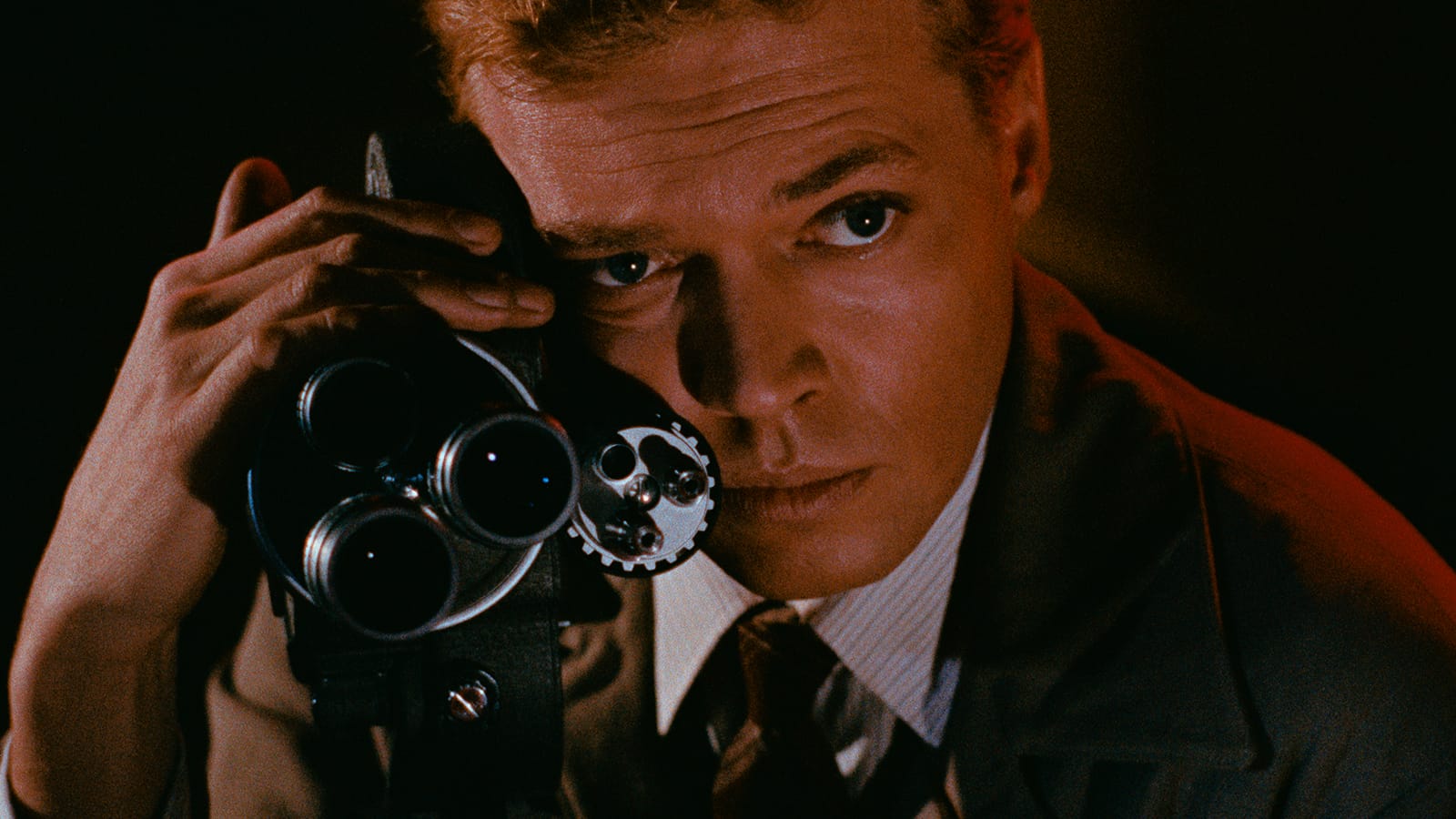
Image context: the lead still comes from Criterion's gallery for the film. It belongs here because the trailer repeatedly returns to the same unbearable equation: Mark's face narrows around the camera body until human expression and recording machinery seem to share one purpose. Even before motion begins, the still tells you that this film's horror is inseparable from the act of framing.[2]
At 0:00, the trailer opens on a lens that already behaves like an eye with bad intentions
The first important image is not a body in danger but a camera pushed toward the edge of abstraction.[1] Powell and the trailer editors refuse the ordinary thriller bargain in which the viewer first meets a victim, a city, or a crime scene. Instead we get machinery and flesh compressed together: metal, glass, darkness, and a partial face that seems to be hiding inside the device rather than standing behind it.[1] The shot matters because it strips away the comforting idea that the camera is neutral and that evil begins only once a human decision enters the frame.
Mulvey's essay helps clarify why that opening lands so hard. She writes that Peeping Tom foregrounds the secret observer and turns cinematic looking into the subject itself.[3] The trailer understands this perfectly. It begins by refusing to let the viewer settle into the passive role of recipient. If the first image is a lens that looks back, then watching becomes reciprocal and uneasy from the start. We are not simply being shown a story; we are being measured by the same optical logic that traps the film's characters.[1][3]
That is also why the darkness around the lens matters. The black space is not empty. It feels like undeveloped footage, projection-booth darkness, or the blank interval before fear has been fully exposed.[1][5] The trailer's opening gives the sensation that violence has not yet happened and has somehow already been recorded. In under five seconds, it establishes Peeping Tom as a film in which technology stores danger in advance.
Around 0:06, the trailer turns the screen-within-the-screen into a prison for performance
The next sharp move is the image of a woman seen within a boxed frame that looks halfway between a viewfinder, a projection surface, and a window cut into the shot itself.[1] That composition is the trailer's thesis. Peeping Tom is full of women who are first rendered legible as images, and only then as persons.[2][3][6] By presenting the woman through an internal frame before giving us any stable social context, the trailer shows how performance and threat occupy the same container.
This matters because Mark's murders are inseparable from staging. BFI's film page defines him simply as a cameraman, but the restoration essay is blunter: he kills women with the sharpened end of his tripod while filming their final moments.[4][5] The trailer does not need to explain the mechanism in literal detail. It only has to make us feel that the framed woman is already inside an apparatus she does not control. The internal border does that work. It makes visibility itself look coercive.[1][5]
Abbott's recent Criterion essay is useful here because it emphasizes how Peeping Tom connects trauma, sexuality, and self-conscious reflexivity.[6] The trailer condenses those larger arguments into a visual rule: whoever is boxed by the screen is already being translated into Mark's private image archive. The frame does not preserve; it traps. That is why the shot feels colder than a normal suspense preview. It does not ask, "What will happen to her?" It asks, "What has the image already done to her?"
Around 0:24, the trailer makes ordinary studio gear feel more dangerous than a knife
By the middle stretch, the preview starts cycling through the film's true arsenal: tripod legs, camera housing, glaring lamps, projection surfaces, and bits of studio space that look both practical and predatory.[1] One of the trailer's smartest choices is that it never pretends these are just props surrounding the drama. They are the drama. Mark standing with his camera in a workroom or under a hard lamp does not read like a filmmaker preparing to document life. He reads like someone building a ritual out of exposure, distance, and control.[1][5]
The restoration article makes this section richer because it describes the labor involved in preserving the film's image texture without sanding away its material roughness.[5] That is exactly the right way to think about Peeping Tom. The movie's horror is not separable from surfaces: the gleam on the lens barrel, the whiteness of projected light, the calibrated artificiality of studio interiors, the almost indecent cleanliness with which fear gets turned into footage.[1][5] The trailer's repeated marketing line about the new 4K restoration might look like boilerplate, but here it quietly supports the point. This is a film where sharper surfaces increase moral discomfort rather than reducing it.
There is also a bitter historical joke embedded in these images. Mulvey calls the film's portrait of Pinewood Studios "farcical, bitter, almost vengeful," and links it to Powell's anger at a complacent British industry.[3] The trailer does not spell out that history, yet it catches the same sourness. Studio space is not glamorous here. It is cramped, brightly exposing, and spiritually cheap. Cinema appears not as dream-factory transcendence but as a workplace where obsession has found the perfect tools.[1][3]
In the last ten seconds, the trailer refuses to let the viewer stand outside the camera's line of fire
The closing movement is brutally simple: Mark brings the camera up again, and the trailer lets his concentrated face and the machine's three-lensed stare occupy the frame together.[1] This is not a flourish added for recognition value. It is the preview's moral end point. After a minute of screens, women-as-images, lamps, and studio gear, the final close-up tells us that the camera in Peeping Tom is not an accessory to character. It is the form character has taken.[1][2]
That is why the trailer feels more accusatory than sensational. If it ended on screaming, running, or plot revelation, the viewer could retreat into ordinary horror-movie distance. Instead it ends on the fused face-and-camera image that Mulvey's essay prepares us to read as the collapse of voyeur, apparatus, and spectator into one continuum.[3] Abbott's essay adds another useful layer by describing the film's postmodern self-reflexivity and the way Mark is disclosed to us like a code to be unraveled.[6] The trailer's final shot refuses that unraveling comfort. It says that understanding Mark will not free us from the mechanism. We are already looking through it.
That is the real accomplishment of this short preview.[1][2][3][5] It sells Peeping Tom without domesticating it. The trailer knows the film is famous for scandal, for reputation, for its later influence on slasher cinema, and for Powell's career damage.[3][5][6] But it avoids flattening the movie into historical trivia. Instead it teaches the viewer the film's governing pressure: images do not simply show fear here, they manufacture the conditions under which fear becomes visible. The lens searches, the tripod pierces, the screen contains, and the spectator discovers too late that watching was never an innocent act.
Sources
- STUDIOCANAL, "PEEPING TOM | Official Trailer," YouTube video.
- The Criterion Collection, Peeping Tom (1960) film page.
- Laura Mulvey, "Peeping Tom," The Criterion Collection.
- BFI, Peeping Tom (1960) film page.
- Philip Concannon, "Peeping Tom: inside the restoration of Michael Powell’s shocking serial killer drama," BFI.
- Megan Abbott, "Peeping Tom: He Has His Father’s Eyes," The Criterion Collection.