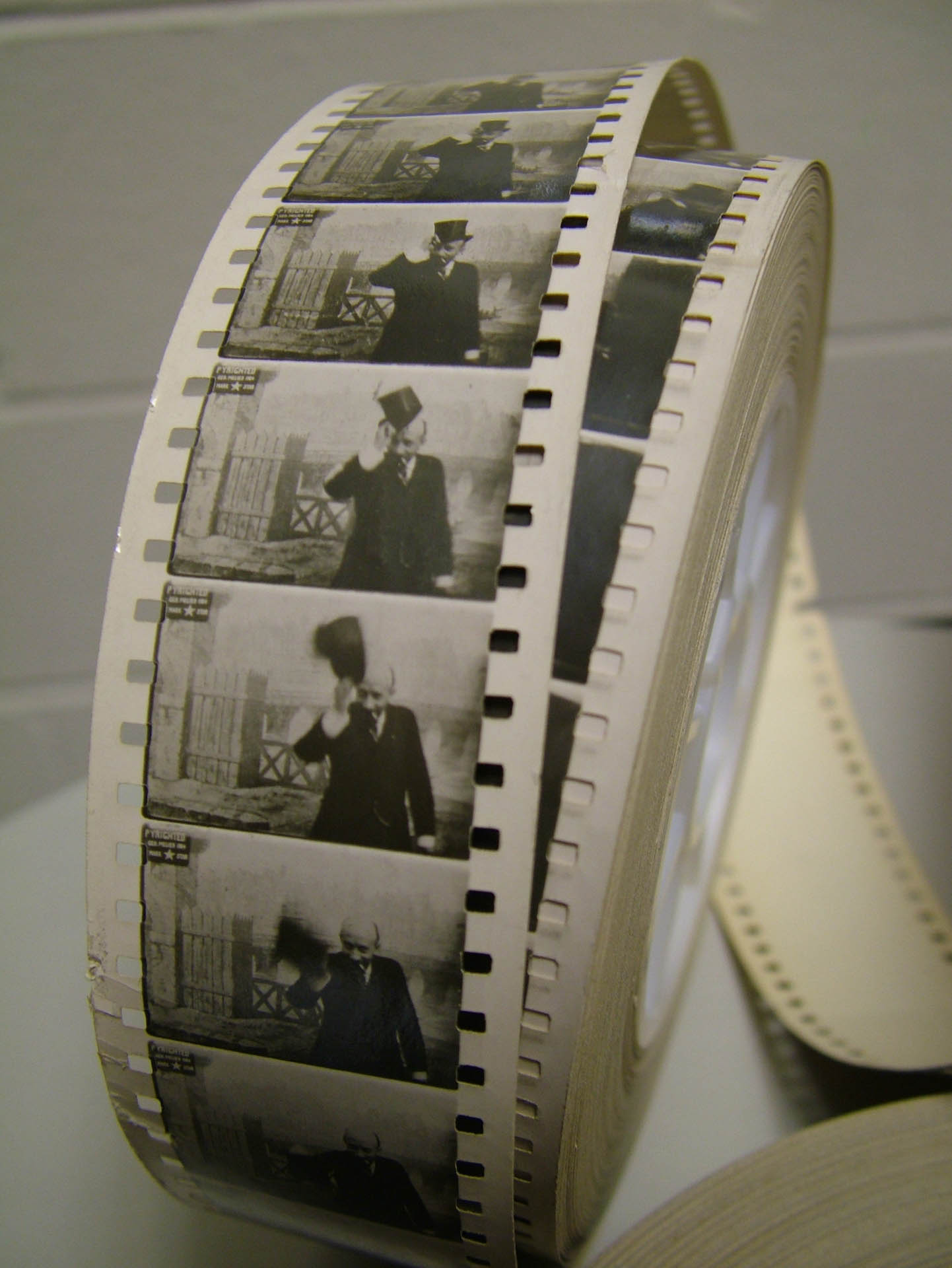
A roll of paper carries Georges Méliès through a gesture, one little photograph after another. The Library of Congress identifies the film as The Untamable Whiskers (1904). In the photograph reproduced here, cinema has acquired the physical presence of a document: an object to unroll and examine, with movement waiting inside its repetitions.[1][3]
The paper was a way of getting a new medium accepted by an older administrative system. Its later value exceeded that purpose. When so much early film disappeared, these photographic deposits provided material from which moving images could be recovered. But a surviving image and a watchable movie are different achievements. Between them stand copying equipment, the boundaries of the frame, and decisions about what the surviving evidence actually represents.
A movie entered the office as photographs
Before motion pictures received their own U.S. copyright categories in 1912, producers registered them through existing categories, principally photographs. Images from nitrate negatives were printed onto photographic paper and submitted to the Copyright Office. Nitrate was flammable and vulnerable to deterioration; the paper deposits became an alternative material record of a young industry.[2]
There was an administrative decision inside that material choice. As the Library's Mike Mashon explained in 2014, the photographic sequence could be accepted as one work rather than requiring a separate registration and fee for every frame. A movie's continuity was recognized even though its deposit took the form of still images.[3]
For a producer, this was a practical route to protecting a product. For a future archivist, it could preserve the intervals between poses: the changes that make a hand rise or a face turn. A publicity portrait offers an actor's likeness. A continuous sequence offers the possibility of recovering a performance.
Yet the deposits were uneven. The Library received complete rolls alongside fragments and individual frames.[3] That distinction matters before any restoration begins. Evidence that a film existed does not necessarily contain enough images to show what happened throughout it. No improvement in a scanner can supply frames that were never deposited.
The second camera had a different job
Mashon's 2016 account credits Copyright Office employee Howard Walls with rediscovering the collection in 1942 and supervising early preservation efforts. In the early 1950s, Kemp Niver began the extensive conversion of paper prints to 16mm film. Mashon noted that those copies still supplied much of the collection's research access when he wrote.[4]
The technical reversal is easy to underestimate. The original camera had recorded an action. The copying apparatus had to record the resulting photographs, preserving their sequence so that the action could be seen again. Paper could hold the pictures without functioning as a transparent projection print. Returning those pictures to film restored a means of exhibition as well as a succession of images.
Niver's own 1953 film, Reclaiming American History from Paper Rolls by the Renovare Process, documented the preservation work. The title's emphasis on a process is apt: recovery depended on repeatable labor, not simply the discovery of an extraordinary object.[4]
A roll on a shelf could be inspected by a researcher. A film copy could put changes of expression and the rhythm of movement back into view. That difference helped turn stored evidence into something film historians could compare as cinema.
A smaller frame can remove the point of a scene
Access came with limits. In her 2024 account of the Biograph Project, Film Preservation Society founder Tracey Goessel shows how copying and framing affect interpretation. Her comparison from A Cry for Help is especially revealing: Lionel Barrymore's character examines an empty palm after begging unsuccessfully, then turns the hand over. In the illustrated 16mm version, the hand falls outside the image. A meaningful gesture becomes an apparently unmotivated look toward his lap.[5]
This is more consequential than softness or grain. The viewer has lost the object of the actor's attention. An assessment of the performance made from that copy could blame the actor for an obscurity introduced by the surviving version.
Goessel also describes using a paper-derived copy to recover original intertitles for An Arcadian Maid, whose later reissue had changed them.[5] Different materials can therefore preserve different parts of a film's identity. A sharp image alone cannot settle whether the words, order, and framing belong to the version being reconstructed.
The paperwork still changes the history
Even the collection's beginnings have required revision. In 2022, scholar Claudy Op den Kamp identified The Blacksmith Shop as the film behind the 1893 registration recorded under the generic title “Edison Kinetoscopic Records.” The decisive evidence was a November 14, 1893 letter from W. K. L. Dickson, accompanied by eighteen small images showing men around an anvil.[2]
That finding gives the paperwork a second kind of value. A picture can survive without being securely connected to its registration; a title can survive without identifying a particular sequence. Bringing the records together changes what an archive can confidently say. A transfer to a newer medium does not finish that work.
Look again at the Méliès roll. Each repeated figure invites the eye to imagine the next instant. The photograph also makes the distance between preservation and exhibition unusually tangible. The images are there, but they still need to be brought into time.
The achievement of the paper prints rests in that unfinished potential. A commercial deposit preserved something its makers could not have expected future audiences to need. Successive generations then had to build, test, and question the copies through which those audiences would encounter it. The paper saved the possibility of movement. People had to make it visible again.
Sources
- Wikimedia Commons, “Paper print of The Untamable Whiskers (Le roi du maquillage, 1904), Georges Méliès greeting to the camera” — film identification and photograph credited to S. Frank Wylie, Library of Congress.
- Library of Congress, “Scholar at the Library of Congress Identifies the First Motion Picture Ever Copyrighted,” October 13, 2022 — photographic deposits, nitrate vulnerability, and the Dickson letter identifying The Blacksmith Shop.
- Mike Mashon, “Where It All Began: The Paper Print Collection,” Library of Congress, May 27, 2014 — acceptance of sequences as single works and the distinction between complete rolls, fragments, and frames; its account of the earliest registrations predates the 2022 discovery in source 2.
- Mike Mashon, “10th Orphan Film Symposium (April 6–9, 2016): Bill Morrison and the Paper Print Collection,” Library of Congress, March 10, 2016 — Walls, Niver's 16mm conversion program, and his 1953 film documenting the Renovare process.
- Tracey Goessel, “The Biograph Project,” Journal of e-Media Studies, 2024 — especially figures 10 and 13.