Spoiler note: this essay discusses the final scene and the fate of Nelly's hoped-for reunion.
A woman is hired to impersonate herself. Johnny believes his wife died in Auschwitz; the stranger who resembles her could help him collect her inheritance. The stranger is Nelly, alive after facial reconstruction, still hoping to recover their marriage. Christian Petzold's Phoenix (2014), starring Nina Hoss and Ronald Zehrfeld, makes this impossible arrangement the center of a story set in Berlin after the war.[1]
The premise asks us to watch something more troubling than a successful disguise. Each time Nelly gets better at playing Johnny's wife, she helps him decide which parts of her can return. Clothes, gestures, and entrances become a shared project. Her experience in the camp remains outside it. The final song breaks that arrangement by changing who gets to direct the scene.
Permission to be seen
At the opening checkpoint, an American guard demands to see the face beneath Nelly's bandages. Petzold withholds the wound from the audience and shows the guard's response instead. Catherine Wheatley's Sight and Sound review draws attention to this refusal of a direct view.[2]
That small choice establishes a disturbing imbalance: someone else can require Nelly to make herself visible. Her body must answer his question before she can continue her journey. By keeping the injury offscreen, the film also makes the guard's inspection available for inspection. We watch a man discover what his demand entails.
Later, Johnny treats her appearance as something he can correct. He finds fault with her height, walk, and hair, and arranges clothes and lipstick for the impersonation.[2] His attention is intimate in its detail and devastating in its purpose. Looking closely provides no guarantee of recognizing the person in front of him.
Lessons in being Nelly
Johnny's basement becomes a rehearsal room. In his interview with Nicolas Rapold, Petzold compares it to a workshop where men manufacture images of women. He also stresses the complication that keeps Nelly from becoming merely a victim of this arrangement: she wants Johnny to help recreate her, while trying to tell him what happened to her.[3]
This is why the repeated practice has such an uneasy tenderness. Instruction gives them something to do together. A correction can resemble care; the next attempt promises another moment of attention. For Nelly, submitting to the exercise keeps open the possibility of recognition. For Johnny, the exercise supplies a reason to dismiss recognition as a convincing performance.
Even her handwriting can be absorbed into the deception. In the film's press kit, Zehrfeld describes Johnny resisting the evidence of Nelly's appearance and writing because accepting it would undo his defenses.[4] The scheme can explain away its own failure: the more the supposed impostor resembles Nelly, the more useful she appears to be.
There is a cruel asymmetry in their knowledge. Nelly knows whose life she is performing. She still needs to learn what her husband will allow that life to contain.
A homecoming with the history removed
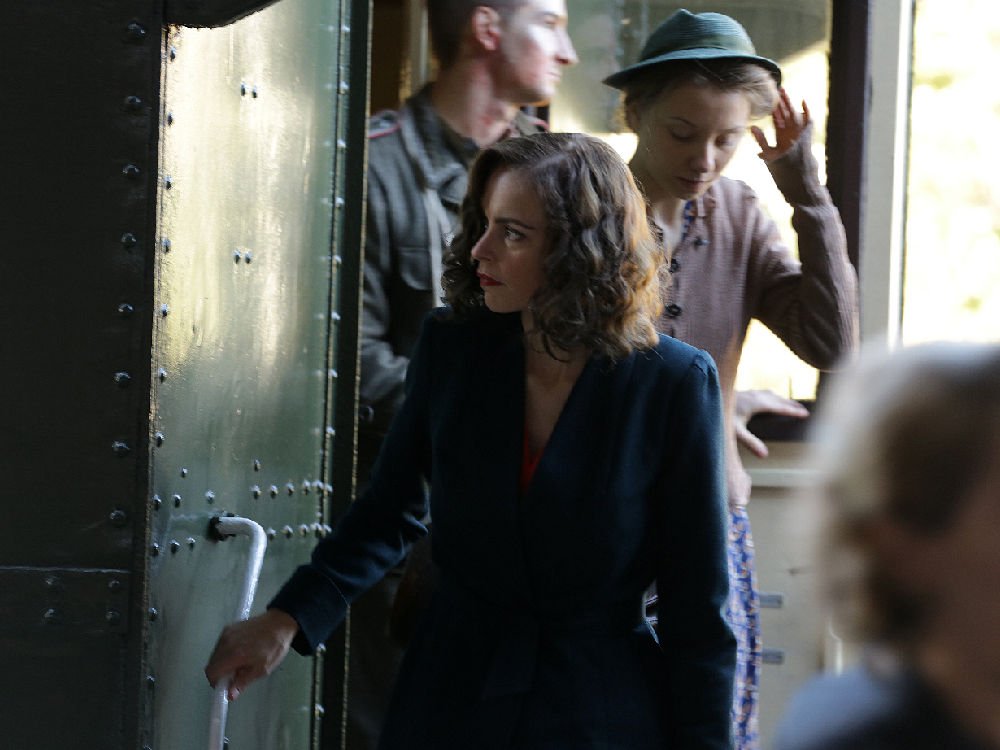
The planned train arrival enlarges the rehearsal to include their friends. Johnny prepares the reunion in advance, supplying the behavior that will make the return legible.[2] A railway platform should mark the end of a journey. Here it becomes a place where the journey's meaning is decided before the traveler can speak.
Petzold explains the stakes in the press kit: a familiar dress and shoes let the surrounding people welcome the old Nelly, while her restored appearance threatens to become an excuse to erase what she endured. Hoss identifies Johnny's assurance that nobody will ask questions as a particular shock for her character.[4]
The absence of questions is the scene's most chilling hospitality. A welcome can close a conversation as effectively as a refusal at the door. Nelly is offered a place among people who have already chosen the acceptable account of her absence.
This gives the clothes a function beyond period atmosphere. They help produce a seamless transition between the woman people remember and the woman they want to greet. The seam is precisely where her story belongs.
When the accompaniment stops
At the final gathering, Nelly asks Johnny to accompany her in “Speak Low.” Her initially hesitant delivery becomes singing. The exchange of looks, the familiar voice, and the camp number visible on her forearm bring the recognition he has resisted. Jennifer Ruth Hosek's analysis in TRANSIT emphasizes the sequence's interplay between her voice, his face, and the tattoo.[5]
Sound and image now make incompatible demands on his fiction. He can hear someone he knew and see evidence of what happened to her. The song lets those two facts occupy the same moment. Neither the remembered performer nor the survivor can conveniently be put aside.
As Johnny stops playing, Nelly continues.[1] That withdrawal changes the relationship we are hearing. Accompaniment once made them a performing couple; its disappearance leaves her able to finish without his participation. Her voice carries across the silence he has created.
My reading is that the scene's force lies in this transfer of control. For much of the film, Johnny determines whether an entrance or gesture is convincing. Here, his judgment ceases to govern the performance. The person being evaluated decides how long the encounter lasts.
Leaving the scene
Nelly walks away. The film gives us no settled account of where she will live or how she will recover. Discussing the ending with Nick Newman, Petzold recalls Farocki distinguishing the completion of the story from the continuation of a life.[6]
That distinction keeps the ending from turning suffering into a neat lesson in renewal. A decisive act can end an arrangement without repairing everything that made it necessary. Nelly's departure has a narrower, harder-earned certainty: she no longer needs this audience to approve her return.
Johnny's rehearsals offered her a place inside an old picture. Her final performance leaves him looking at a doorway she has chosen to walk through.
Sources
- The Criterion Channel, Phoenix — film, director, cast, year, setting, and synopsis.
- Catherine Wheatley, “Phoenix review,” Sight and Sound, originally published January 14, 2016 — checkpoint, coaching, train-arrival staging, and the accompanying film still.
- Nicolas Rapold, “Interview: Christian Petzold,” Film Comment, January–February 2015 — the basement workshop, Nelly's competing desires, and the director's account of Johnny.
- Films We Like, Phoenix press kit — statements by Petzold, Hoss, and Zehrfeld, especially “Homecoming,” “Intervention,” and “Points of Rupture,” printed pages 10–11 and 18–21.
- Jennifer Ruth Hosek, “Towards a European Postmigrant Aesthetics: Christian Petzold's Transit (2018), Phoenix (2014), and Jerichow (2008),” TRANSIT 13.1, 2021 — the Phoenix section's account of silencing and the final performance.
- Nick Newman, “Christian Petzold Talks ‘Phoenix,’ Flipping the ‘Vertigo’ Perspective, and Letting Go of Auteurism,” The Film Stage, July 30, 2015 — the director on the film's perspective and its open ending.