Discusses the opening and the film's central relationships, without revealing the ending.
A field moves before we can see who is crossing it. In the opening of Onibaba, fleeing samurai pass through tall reeds; their progress disturbs the vegetation above them. Then spears emerge from darkness. Reviewing the film in 1966, Tom Milne singled out this passage for the force of its photography.[2] It establishes a frightening bargain with the viewer: movement supplies information, but a clear view may arrive too late.
Kaneto Shindo's 1964 film follows an older woman and her daughter-in-law surviving a medieval war by killing stragglers and selling their equipment. Nobuko Otowa and Jitsuko Yoshimura play the women; Kiyomi Kuroda photographed their world, and Hikaru Hayashi composed its music.[1] The landscape makes their business possible. It conceals the women, channels their victims, and offers somewhere to put what remains.
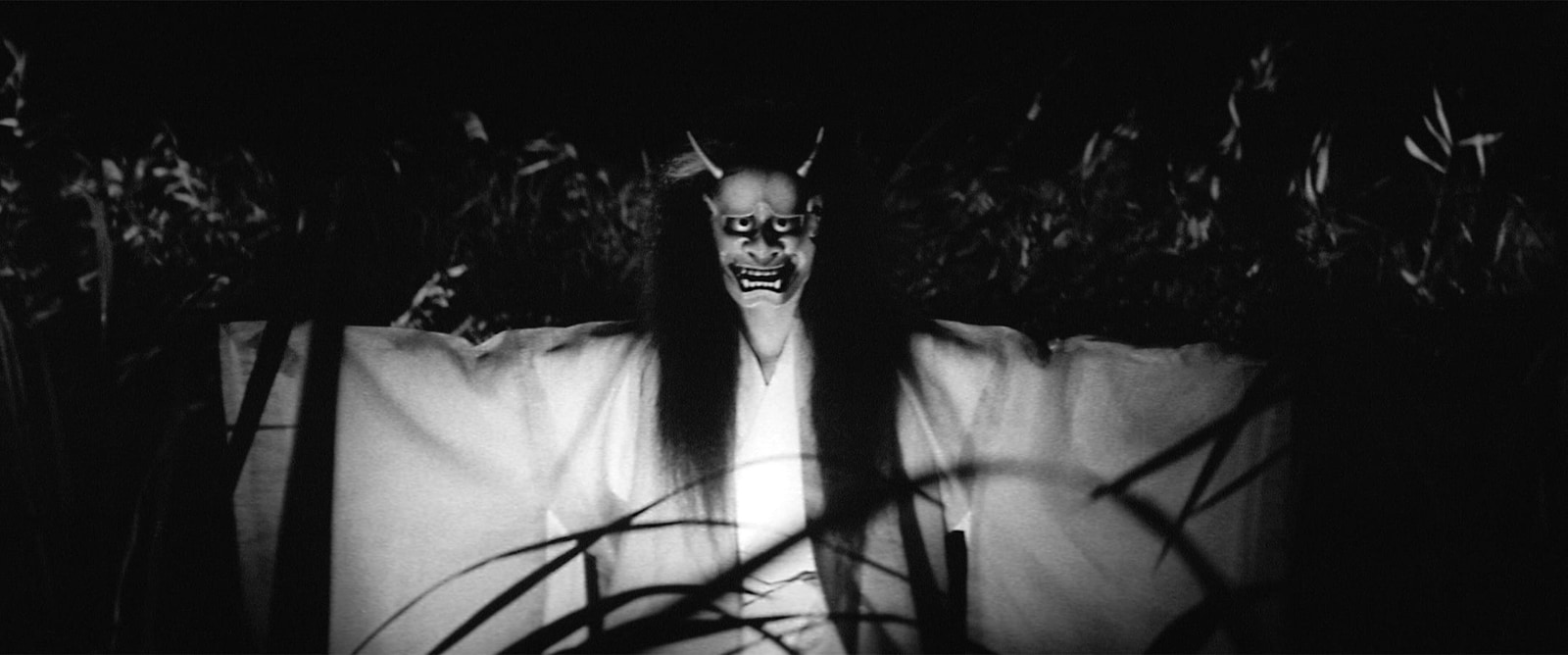
A wide frame with nowhere to look past
Criterion presents Onibaba in a very wide 2.39:1 frame.[1] Yet the width offers little reassurance. Tall stalks can fill a broad image just as thoroughly as a narrow one. Expanding the frame gives the eye more ground to search while leaving the distance difficult to read.
The opening makes that uncertainty productive. Milne's description distinguishes the disturbance in the reeds from the bodies causing it.[2] We can register a route without knowing exactly what occupies it. In this reading, suspense comes from the gap between noticing movement and identifying its source. Vegetation performs some of the work that a wall or a closed door might perform indoors, with the added complication that it keeps moving.
This was a particular place. Criterion identifies the filming location as Inba Swamp in Chiba Prefecture, where the production worked in summer 1964; its archive includes silent Super 8 footage of the shoot.[3] A location can provide abundant detail while the framing withholds a useful overview. Here, physical specificity and disorientation belong together.
Give the movement a pulse
Hayashi's music adds another kind of activity. Chuck Stephens's account of the score emphasizes its drums, sudden vocal sounds, and brass.[4] These are sharply bodily resources: impacts, breath, bursts of pressure. Their energy gives the film an insistent forward drive.
Criterion credits Tetsuya Ohashi for sound and Hayashi for music, and its restoration retains a monaural soundtrack.[1] The visual concealment gives the audience something to listen into. With so much of the field hidden, an emphatic soundtrack can make an apparently empty image feel occupied.
The useful relationship here is between an obscured view and an emphatic pulse. A landscape can remain hard to decipher while the music makes bodily urgency unmistakable. We may be uncertain about the space, yet feel how strongly someone wants to cross it.
The same path can carry a different desire
When Hachi, a neighbor returned from war, becomes the younger woman's lover, movement through the reeds acquires another purpose. Elena Lazic's essay draws attention to the woman's nighttime runs to meet him and to the changing expressive force of the swaying grass.[5]
The practical arrangement remains useful: separate huts, intervening vegetation, bodies passing through it. What changes is the urgency of the journey. A place first associated with ambush can also provide privacy and a route toward pleasure. This makes the landscape emotionally flexible without requiring a new setting every time the relationships shift.
The older woman's fear has an economic dimension. Her partner's attachment to Hachi threatens the two women's dependence on each other for survival, as Stephens emphasizes.[4] An apparently intimate journey therefore carries a material consequence. Each departure can look different to the person waiting behind.
This is where the craft becomes especially economical. Repetition lets us learn the terrain; changing motives prevent that familiarity from settling into comfort. The audience recognizes the physical obstacles while having to reassess what a crossing means.
Whose view of the world?
Shindo gave the reeds a precise social significance. Speaking to Joan Mellen in 1972, he described them as the society surrounding his characters and placed his camera's perspective at the bottom of that society. He wanted to depict people largely absent from official history and beyond political protection.[6]
That statement sharpens the significance of the restricted view. The film's inhabitants must act within a world whose wider arrangements they do not command. Concealment is a resource they can use, even as isolation helps keep them vulnerable. Reading the framing through Shindo's account connects a perceptual experience—difficulty seeing beyond the stalks—to the characters' position.
The pit concentrates the same problem differently. The women dispose of their victims there after stripping them; the opening makes the killing, salvage, and disappearance part of one practical sequence.[2] Where the reeds impede a horizontal view, the hole removes bodies downward. The setting helps violence become a routine that can leave little visible trace.
Onibaba gives its landscape several jobs at once. It obstructs sight, permits passage, shields intimacy, and conceals evidence. Its reeds remain recognizable grass throughout. The terror develops from how thoroughly human needs have occupied them.
Sources
- The Criterion Collection, Onibaba — film year, premise, cast and technical credits; the edition's aspect ratio, monaural restoration specifications, and official gallery still reproduced above.
- BFI Southbank, Onibaba programme notes, November 2021 — includes Tom Milne's December 1966 Monthly Film Bulletin review describing the opening, concealment in the reeds, and disposal of the victims.
- The Criterion Collection, “Kaneto Shindo on Location,” May 30, 2012 — written identification of Inba Swamp, Chiba Prefecture, and the summer 1964 production footage.
- Chuck Stephens, “Onibaba: Black Sun Rising,” The Criterion Collection, March 2004 — the score's percussion, voices and brass, and the older woman's dependence on her partner.
- Elena Lazic, “Onibaba: Masks and Faces,” The Criterion Collection, October 5, 2021 — the reeds, the lovers' movements, and the landscape's changing expressive force.
- Joan Mellen, “My Mind Was Always on the Commoners,” The Criterion Collection, October 28, 2011 — excerpt from a 1972 interview, published in Voices from the Japanese Cinema in 1975; Shindo on Onibaba's reeds, social viewpoint, and excluded protagonists.