Spoiler note: this essay discusses the ending of After Life (1998).
Eternity needs a crew. In Hirokazu Kore-eda's After Life, the newly dead must choose one memory to carry forward. Staff at a modest way station will recreate it on film. The premise sounds like an invitation to search inward: isolate the happiest instant, hold it still, let everything else fall away.[1]
Yet the film keeps putting other people to work around that private choice. Someone must ask a useful question. Someone must listen to an uncertain answer. Eventually, someone must build the scenery. The intimacy of the memory creates a practical obligation for strangers: make something that its owner can recognize.
That obligation gives After Life its unusual warmth. Its vision of remembrance has room for hesitation, cooperation, and the possibility that a person cannot discover alone what deserves keeping.
First, someone has to listen
The interviews have a particular liveliness because the production itself began by asking people about their memories. Kore-eda's team gathered responses from more than five hundred people, including visits to nursing homes and a shrine. Some ordinary people's recollections became those of the film's fictional dead. In his afterword to the novelization, the director credits these contributions with enlarging the world he could create.[2]
Listening, then, precedes invention. A filmmaker arrives with a question but cannot supply every worthwhile answer. The same limitation becomes part of the fictional institution's job. A memory has to be offered before it can be staged.
Leigh Singer's BFI account draws attention to the mixture of scripted performance and personal testimony, and to the work of acquiring props and constructing sets.[4] Those activities belong together. The interview is already a kind of preparation: before a crew can find the right object, it must understand why that object matters to somebody.
The film gives this small act of explanation unusual dignity. An experience need not sound impressive to deserve careful attention.
A recording cannot make the choice
Watanabe struggles to identify a memory worth taking. His counsellor, Mochizuki, obtains videotapes of his life to help him. As Viet Thanh Nguyen points out, these recordings offer fragments rather than a complete account. Their existence does not remove the need to interpret what they show.[3]
This is the uneasy distinction at the center of Watanabe's problem. Having evidence that something happened does not settle what it meant. A life can be available for review and still resist the person trying to understand it.
The tapes also create a chain of attention. Watanabe watches footage of himself and his wife; Mochizuki watches Watanabe; Shiori watches Mochizuki. Nguyen singles out the faces and looks that connect them.[3] A supposedly private encounter with the past becomes an event in the room. Nobody watches from quite the same position.
For me, the scene suggests a limit to the fantasy of a perfect personal archive. Even the most useful recording cannot supply the circumstances of its next viewing. Those circumstances can change what becomes visible.
The seriousness of cotton clouds
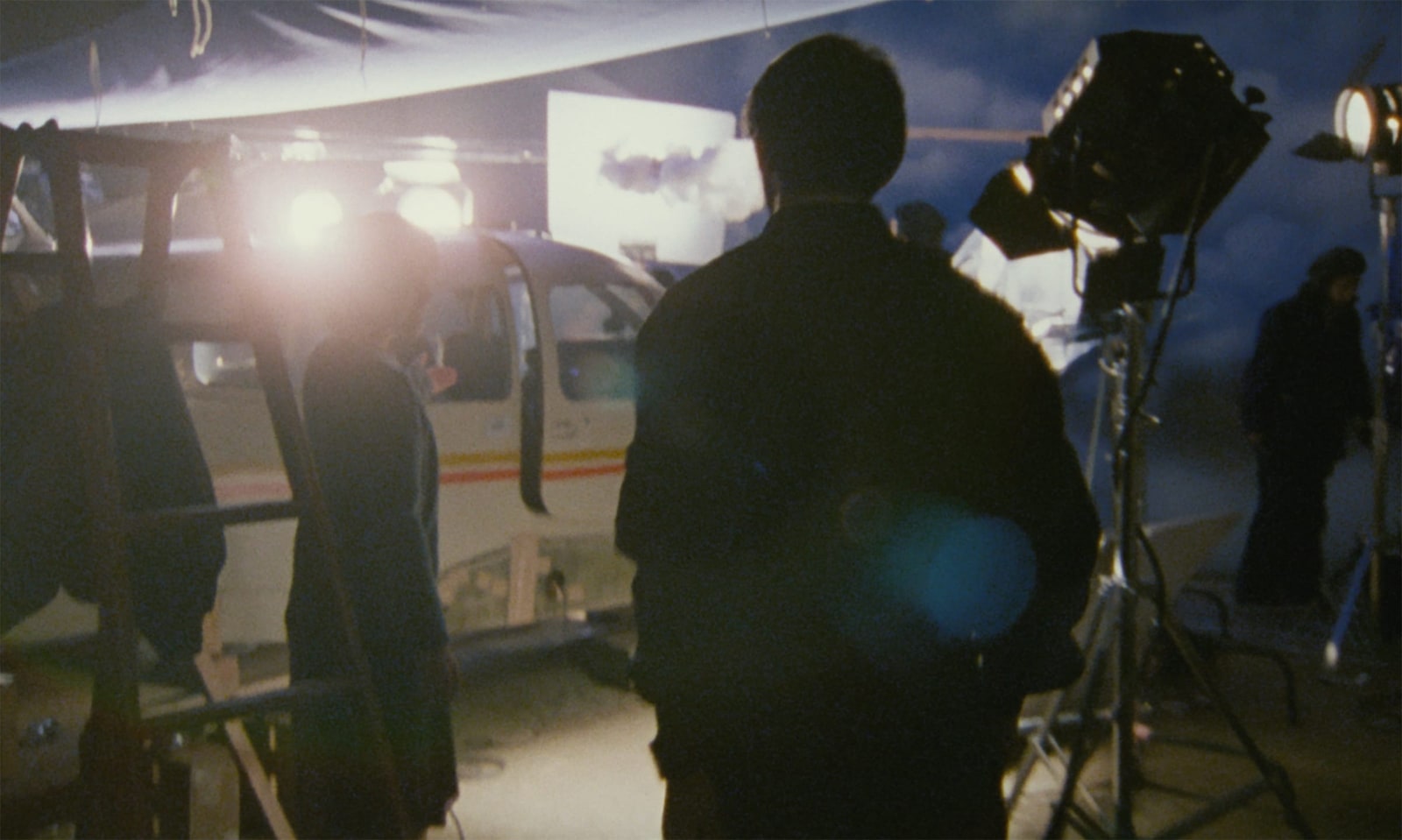
The workshop makes remembering wonderfully tangible. A pilot's flight can be suggested with cotton clouds; the heat of a childhood tram ride becomes water sprayed onto a young actor's face. Nguyen describes these modest solutions alongside the crew's discussions of camera position and effects.[3]
The comedy comes from the care being spent on materials so obviously makeshift. The workers have accepted an extravagant commission, and their tools remain ordinary. That mismatch allows the scene to be funny without making the remembered pleasure ridiculous.
Kore-eda told Tony Rayns that the cheap effects expressed affection for the process. Recreating a scene could prompt people to amend a recollection or recover feelings that conversation alone had missed.[5]
An imperfect prop can therefore be productive. It gives the person remembering something to respond to: closer, different, almost right. The crew's effort makes room for another attempt. What looked like a simple assignment to reproduce a finished memory becomes an exchange through which the memory develops.
The present has a say
Years later, discussing The Truth with Hillary Weston, Kore-eda explained that After Life had helped turn his attention toward remembering as an activity performed in the present. Returning to the past can change one's understanding of it.[6]
That distinction matters to the emotional bargain of After Life. The selection cannot be made by a younger self preserved untouched inside an old event. It belongs to someone looking back now, with all the intervening disappointments, attachments, and discoveries that looking entails.
The imagined finality of the choice gives that ordinary process pressure. We continually decide which experiences to tell, which to revisit, which to let explain us. Here, one decision must bear an impossible weight. The patient labour around it becomes moving because no counsellor can simply issue the correct answer.
Who gets into the picture
Mochizuki eventually includes the colleagues filming him in his own chosen memory. Asked about this by Rayns, Kore-eda confirmed that the choice embraces his time working at the way station. He also wanted the other staff to encounter the discovery that they belonged to someone else's remembered experience.[5]
The people helping construct a memory have become part of what is worth remembering. This changes the meaning of their apparently temporary workplace. What seemed to be time spent assisting other people's departures has acquired value of its own.
It is an especially tender answer to the film's opening demand. A person asked to select one moment might fear choosing badly, overlooking something grander or more representative. After Life allows the work of choosing to matter too. The conversation, the shared task, the attention paid by another person can become an experience one would hate to lose.
The crew has been preparing a way out. In the process, they have given someone a reason to treasure being there.
Sources
- The Criterion Collection, “After Life” — 1998 film, premise, cast, credits, and director-approved restoration information.
- Hirokazu Kore-eda, “On the Novelistic Afterlife of After Life,” translated by Allison Markin Powell, The Criterion Collection, September 2, 2021 — the director's afterword on interviews, collaborators, and the relationship between documentary and fiction.
- Viet Thanh Nguyen, “After Life: In Memoriam,” The Criterion Collection, August 10, 2021 — Watanabe's videotapes, the chain of watching, practical memory recreations, and the accompanying film still reproduced here.
- Leigh Singer, “10 great films about the afterlife,” BFI, November 30, 2017 — the After Life entry on personal testimony and the labour of building memories.
- Tony Rayns, review and interview with Hirokazu Kore-eda, Sight and Sound, October and March 1999, reprinted in BFI Southbank's After Life programme notes, December 2023 — the purpose of the recreations and Mochizuki's inclusion of the crew in his chosen memory.
- Hillary Weston, “Hirokazu Kore-eda's Parisian Rendezvous,” The Criterion Collection, July 28, 2020 — the director on remembering as an activity in the present.