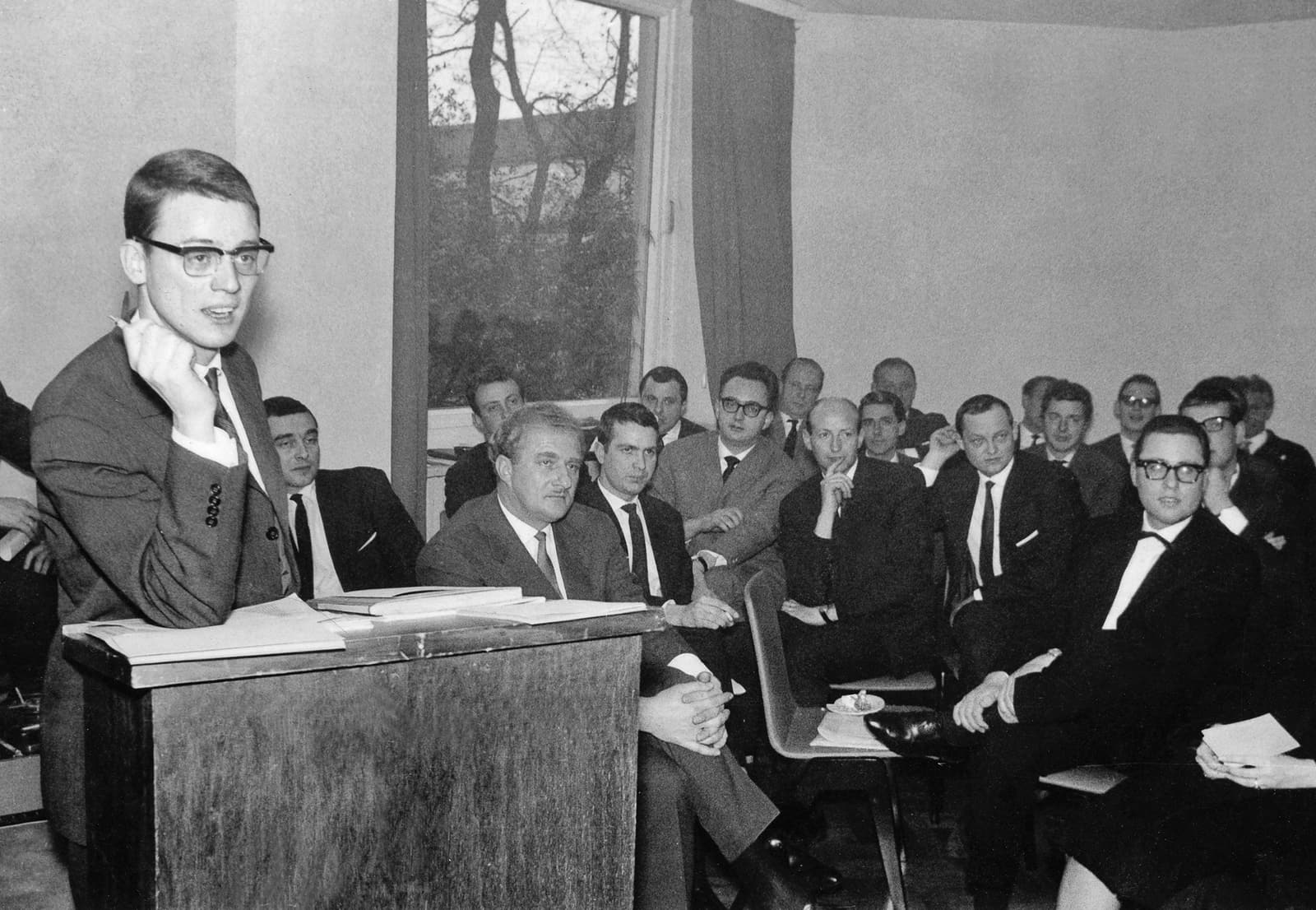
The photograph looks more unified than the cinema that followed. Alexander Kluge stands at a wooden lectern, one hand lifted near his face. Behind him, rows of men in dark suits lean forward, fold their arms, or stare toward the camera. On February 28, 1962, at the West German Short Film Festival in Oberhausen, 26 filmmakers used this press conference to declare that the old film was dead and that they believed in a new one.[1][2]
It is tempting to treat the room as the birth photograph of a style: young rebellion assembled, photographed, and ready to exchange postwar respectability for jump cuts, handheld cameras, difficult history, and restless protagonists. The manifesto itself refuses that tidy reading. It does not prescribe a lens, an editing rhythm, a kind of acting, or even a preferred subject. Its central words are about permission and power. The filmmakers claim the right to make features, name short film as their school and experimental field, promise to share economic risk, and demand freedom from industry convention, commercial interference, and pressure groups.[2]
That production language is the document's lasting intelligence. New German Cinema did not become important because one generation agreed on how movies should look. It became possible because filmmakers kept turning a declaration into a chain of material conditions: workshops and schools, selective funding, small production companies, festival recognition, collective distribution, television partnerships, and eventually archives. The films could then disagree—in montage and melodrama, road movie and activist essay, historical allegory and domestic realism—because the infrastructure gave disagreement somewhere to exist.
A manifesto written like a production brief
The opening of the manifesto makes an economic diagnosis before it makes an artistic boast. Conventional German cinema, it argues, has lost the material base that sustained a mentality the signatories reject. That collapse creates an opening. Their proof that another cinema can occupy it is not theoretical prestige but completed work: young West German directors, writers, and producers have made short films that won international prizes and the attention of critics.[2]
This sequence matters. The signatories do not say, in effect, Give us money because our intentions are virtuous. They say that the short has already functioned as research, training, and evidence. A generation has tested a film language at a scale it could reach; now it is claiming access to the more expensive feature. The declaration converts festival recognition into bargaining power.
Even its famous last line—“The old film is dead. We believe in the new one”—does not define what the new film must resemble.[2] The sentence clears a space without furnishing it. The document mentions intellectual and formal ideas, but it deliberately joins them to economic ones. Freedom is not imagined as inspiration arriving after the budget has been settled. It includes the ability to decide how a film is financed and whose approval can alter it.
That is why Oberhausen differs from a rule-based manifesto such as Dogme 95. There is no vow about props, lighting, genre, or camera support. The target is dependency. If a commercial partner, an inherited convention, or an interest group can veto the movie before form becomes possible, then aesthetic freedom is merely a private wish. The manifesto asks for the conditions under which form can become public.
The short film was already a working prototype
Origin stories often make the manifesto sound as though a speech created filmmakers from nothing. The archive shows the reverse. Kluge and Peter Schamoni had already made Brutality in Stone (1961), a short that examines the monumental remains of Nazi architecture rather than treating those buildings as neutral heritage. Kluge had entered Oberhausen through a film that made historical analysis out of surfaces, fragments, and an accusatory relation between image and voice.[3]
The other signatories did not share one method. When the festival reconstructed their early work for the manifesto's 50th anniversary in 2012, it programmed 24 shorts and described a difficult recovery: companies had dissolved, rights were unclear, and surviving materials were often in poor condition. The resulting program had to be researched, gathered, conserved, and in some cases restored with the Deutsche Kinemathek and the German Federal Archives.[1][2]
That preservation project changes how the press-conference photograph reads. The people in the room were not a future canon waiting to be announced. They were workers carrying evidence from an unstable short-film economy. Some would become familiar names; many would not. Their collective force came from placing separate experiments behind one demand, not from pretending those experiments were identical.
Short film also supplied a practical model of autonomy. A short needed less capital, could travel through festivals, and could earn recognition outside the feature-distribution system that had no reason to welcome it. Its limits were real—it did not create a sustainable career by itself—but those limits taught the precise lesson the manifesto articulates. A new image requires a route from experiment to production. Talent without that route remains a sample reel.
The declaration had to become institutions
Kluge's activity after Oberhausen makes the transition unusually visible. In 1962 he and Edgar Reitz worked on the film program at the Ulm School of Design, linking theory to production, while Kluge also established his company Kairos. He later helped shape the legal framework of the Kuratorium junger deutscher Film, the hard-won funding body for young German filmmakers, and pressed broadcasters to participate in financing auteur cinema.[3] The manifesto did not simply precede these efforts; its demand for “new freedoms” supplied a public vocabulary for them.
By 1966, the argument had acquired films that international institutions could no longer ignore. Peter Schamoni's No Shooting Time for Foxes won a Silver Bear in Berlin, Volker Schlöndorff's Young Törless received the critics' prize at Cannes, and Kluge's Yesterday Girl won the Silver Lion in Venice. In the same period, the new German Film and Television Academy Berlin and other film schools began professionalizing film education in West Germany.[4] Four years after the declaration, training, production, and festival circulation were beginning to form a usable circuit.
Federal support added another layer, though not a magic solution. The Film Funding Act first took effect in 1968 and created an enduring statutory basis for the Filmförderungsanstalt.[5] A funding mechanism could move a project toward a set; it could not guarantee a sympathetic distributor, an available screen, or an audience. Public money also introduced new criteria and committees capable of becoming their own gatekeepers. Institutionalization was the necessary answer to the manifesto, but it was never the same thing as unrestricted freedom.
Distribution exposed the missing link. In April 1971, a group including Wim Wenders, Hark Bohm, Peter Lilienthal, and others founded Filmverlag der Autoren as a collective attempt to produce and bring their films to cinemas. The distributor became a vehicle for work by filmmakers such as Rainer Werner Fassbinder and Wenders, but it remained financially precarious and faced stubborn domestic indifference even while New German films gained prestige abroad.[6]
This is the less glamorous meaning of a film movement. A camera can be liberated from studio convention and still have nowhere to send its negative. A director can win a prize and still lack a route to an audience. Oberhausen mattered because it let each later bottleneck be described as part of the same problem. Funding, education, production, distribution, exhibition, and broadcasting were not chores surrounding the art. They were the channels through which formal choice reached a viewer.
The result was plural, not pure
The easiest New German Cinema survey turns Kluge, Fassbinder, Werner Herzog, and Wenders into four versions of the same rebellious author. Their films make that grouping productive only if it remains loose.
Kluge's Yesterday Girl (1966) uses interruptions, compressed episodes, mismatched registers, and documentary abrasion to prevent Anita G.'s collision with West German institutions from settling into a smooth case history. Fassbinder's Ali: Fear Eats the Soul (1974) takes another route: classical melodrama, charged color, doorways, empty space, and the gaze of neighbors make social exclusion visible inside an accessible love story. Herzog's Aguirre, the Wrath of God (1972) turns a historical expedition into physical delirium in landscape. Wenders's Alice in the Cities (1974) lets roads, stations, temporary rooms, and Polaroids organize a quieter crisis of perception.[7]
No shared camera grammar joins those films. What joins them is a refusal to let postwar normality appear innocent. The past persists inside courts, marriages, tabloid language, industrial ambition, sexual convention, and the fantasy of America. Even that thematic account has limits: it cannot flatten Rosa von Praunheim's activist address, Jean-Marie Straub and Danièle Huillet's rigorous historical fractures, Margarethe von Trotta's political narratives, or the collective response of Germany in Autumn into one national mood.[7]
Nor were the later movement's best-known directors simply the 26 signatories growing into maturity. Fassbinder, Herzog, and Wenders did not sign the Oberhausen document. The declaration is better understood as an enabling break than a membership list. It helped make “new German film” a claim that later filmmakers could enter, revise, and fight over. A movement becomes culturally useful when its boundary is porous enough for people who were absent from the founding photograph to change the meaning of the founding demand.
The photograph contains the movement's first limit
The official photograph is crowded, but it is crowded with men. The signatory list reproduced in the 2012 festival catalogue makes the exclusion just as visible.[2] The manifesto speaks in a collective “we,” yet the group able to turn festival success into a public claim on the feature film was narrow. Treating that “we” as the whole future of West German cinema would repeat the photograph's blind spot.
The institutions that followed created openings the original group did not represent. From 1966, the new DFFB and other schools helped professionalize film education in West Germany. Sander entered the DFFB; the same wider moment brought early work by Stöckl, Meerapfel, and Spils into view, though their routes were not identical and no single school can claim them as its products.[4][8] Sander's later archive records what the heroic movement story tends to hide: production contracts, correspondence with broadcasters and distributors, and the continuous labor required to remain an independent director and producer. Her political and formal work made her a pioneer of both the women's movement and New German Cinema, but continuity was an achievement she had to negotiate project by project.[8]
This distinction prevents a generous infrastructure reading from becoming a self-congratulating one. Funding bodies and schools can widen access while reproducing old judgments. In 1973 Sander launched West Germany's first women's film festival; in 1974 she founded the journal Frauen und Film; and in 1979 she and Helma Sanders-Brahms helped found an association that pressed for equal funding and stronger distribution and exhibition support.[9] A declaration of freedom made by men did not automatically distribute that freedom. Queer filmmakers such as von Praunheim likewise changed what political address and public cinema could do rather than merely inheriting a completed program.[7]
Oberhausen's strongest legacy is therefore not that the signatories anticipated everyone who followed. It is that they made production conditions available for public dispute. Later filmmakers could ask the manifesto's question more sharply: freedom from whose convention, financed by which institution, granted to which author, and distributed to which public?
A movement survives through its routes
The 2012 restoration effort completes the logic that began in 1962. The manifesto presented short films as proof that a new language already existed. Half a century later, archives had to rescue those films so the claim could still be tested rather than merely repeated.[1][2] Preservation is the final production stage: without a print, a rights trail, a catalog record, and a screen, a movement shrinks into its slogan.
That slogan remains thrilling because it is so compact. But the real achievement of Oberhausen lies in everything the sentence cannot fit. A short becomes a credential. A declaration becomes leverage. Leverage helps create a fund, a school, a production company, a distribution cooperative, or a broadcasting alliance. Each institution opens a route and imposes a new negotiation. Through those routes come films that do not resemble one another and filmmakers the original photograph failed to imagine.
The Oberhausen Manifesto put production freedom before film style because style was the result it could not honestly dictate. Its authors did not design the look of New German Cinema. They helped make room for incompatible looks to become films—and for the argument over who received that room to continue.
Sources
- International Short Film Festival Oberhausen, “About us” — official history of the February 28, 1962 declaration, the 26 signatories, later funding consequences, 2012 restoration project, and source page for the archival press-conference photograph.
- International Short Film Festival Oberhausen, 58th Short Film Festival Catalogue (2012), pp. 114–121 — bilingual manifesto text, full signatory list, early-film program, and archival account of recovering the signatories' work.
- Goethe-Institut, “History was his obsession” — Alexander Kluge's Brutality in Stone, the Ulm film program, Kairos, the Kuratorium junger deutscher Film, and his film-policy work with broadcasters.
- Deutsche Kinemathek, “Germany 1966 — Redefining Cinema” — 1966 festival breakthroughs, West German film-school formation, and early work by women directors.
- Filmförderungsanstalt, “Rechtsgrundlagen” — official record that the Film Funding Act first took effect in 1968 and remains the statutory basis of the federal film board.
- Christian Berndt, “Gründung des Filmverlags der Autoren vor 50 Jahren.” Deutschlandfunk, April 18, 2021 — the 1971 collective, its production-and-distribution purpose, international reach, and domestic economic limits.
- Carmen Gray, “10 great New German Cinema films.” British Film Institute, January 11, 2024 — the movement's historical pressures and formal range across Kluge, von Praunheim, Herzog, Fassbinder, Wenders, von Trotta, and collective filmmaking.
- Deutsche Kinemathek, “Helke Sander” — archival record of Sander's feminist filmmaking, production papers, broadcaster and distributor correspondence, and independent production labor.
- Erica Carter, “Germany Pale Mother: a rediscovered classic of New German Cinema.” British Film Institute, May 22, 2015 — women's filmmaking institutions, feminist production politics, and Helma Sanders-Brahms's place in the movement.