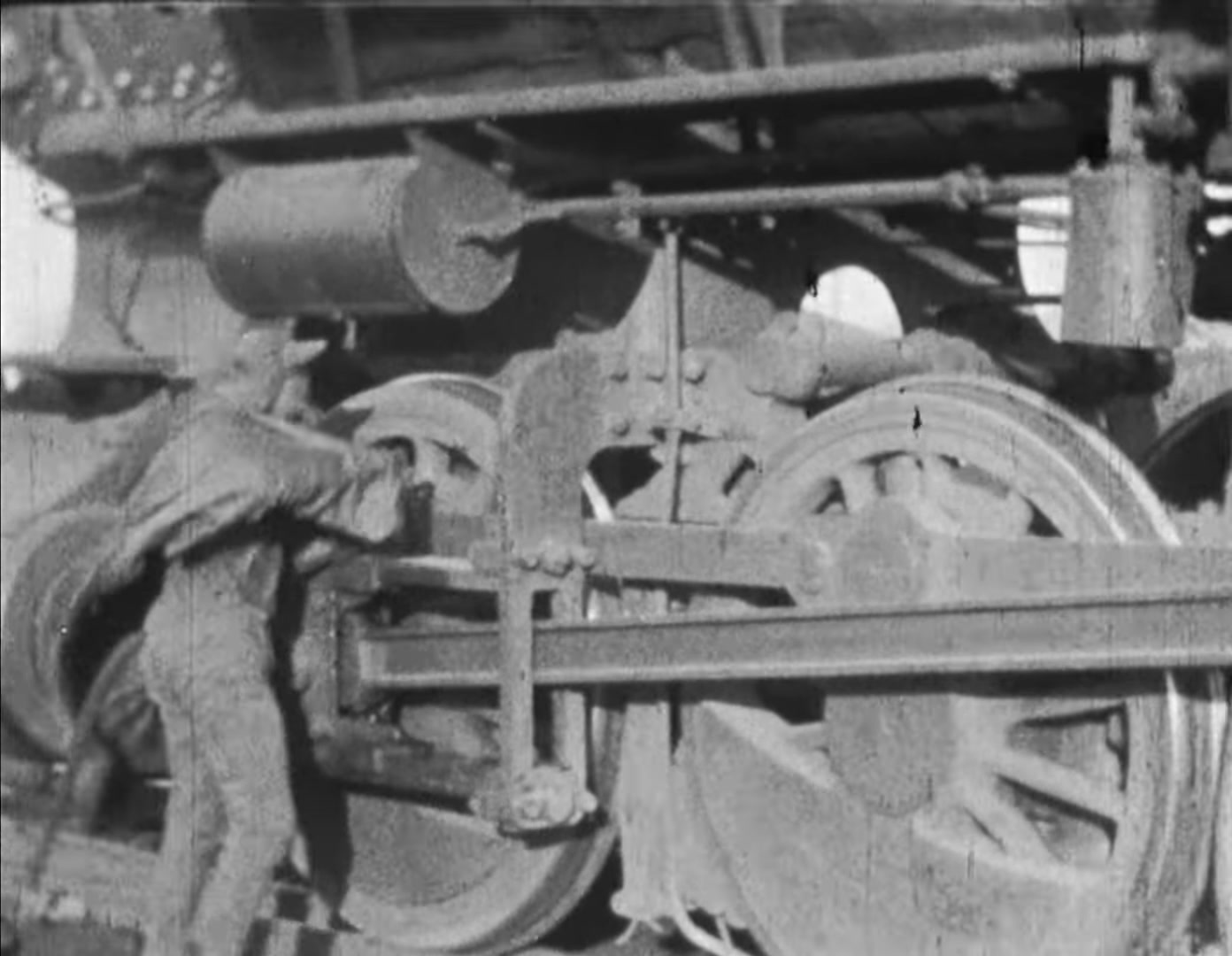
The first special effect in Hell-Bound Train is access. A hooded devil walks beside an actual locomotive, ducks beneath its rods, and leans into the enormous grammar of wheels, pistons, and steel. The costume appears handmade; the railway does not. For a moment, allegory and infrastructure occupy the same frame.
That collision explains more about James and Eloyce Gist's film than the familiar label “low-budget” does. Working with handheld 16 mm equipment, natural light, and no synchronized sound, the self-taught evangelist filmmakers did not build a studio inferno. They did something more ingenious: they organized ordinary rooms, streets, performers, title cards, railway views, and one masked figure into a machine an audience could complete.[1]
The resulting film is commonly dated circa 1930 and survives today in a roughly fifty-minute digital restoration made from Library of Congress elements. Its original chronology is less secure than that date suggests. The AFI Catalog has found advertisements for screenings as early as March 1927, and the surviving print was reassembled by S. Torriano Berry from more than one hundred 16 mm reels.[1][3] This essay therefore analyzes the restored version, not an assumed definitive first cut.
Spoiler note: the essay discusses the film's final descent and derailment.
Image context: the lead image is a frame from the restored film. The devil's cape, soft mask, and pointed hood almost dissolve into the locomotive's dark running gear. It is an accurate film image rather than a later illustration, and it belongs here because the movie repeatedly turns real machinery into the hard surface of its handmade theology.[7]
The train is also a production plan
Hell-Bound Train does not develop one protagonist through a continuous plot. It announces a moral railway and then moves coach by coach through a catalog of offenses: dancing, bootlegging, deception, gambling, theft, cruelty, adultery, hypocrisy, and Sabbath breaking. An intertitle names the next coach; a short episode supplies recognizable behavior; the devil rejoices; the train moves on.[1][4]
That structure is more than a sermon metaphor. It also affords a practical way to make a feature from parts that do not need to match perfectly. A new “coach” can introduce different performers, a different house, another patch of street, and a fresh moral problem without requiring the previous room to connect physically to it. The surviving evidence does not prove that the Gists planned the form for this reason; the finished film nevertheless gains that production flexibility. It rarely needs to show anyone walking down a real railway corridor. Once the titles declare that an ordinary interior is a coach, the audience performs the set construction.
The Gists reinforce that agreement with recurring locomotive footage. Engines approach, tracks converge, wheels turn, and smoke crosses the frame between domestic scenes. These shots do not establish a coherent journey in the geographic sense. They establish direction. Whatever the passengers do in bedrooms, kitchens, pool rooms, or streets, the railway inserts keep insisting that all activity has acquired the same destination.
This is modular editing with a moral arrow. Each episode can be understood on its own, but the repeated train views deny it independence. One person's drink, another person's wager, and another person's betrayal become adjacent cars in a single system. The metaphor lets the film accumulate examples without pretending that they form a conventional causal plot.
The form also suits the movie's first life outside commercial theaters. The Gists took their films to African American churches and meeting halls, where Hell-Bound Train accompanied a sermon and, according to Kino Lorber's restoration notes, the passing of a collection plate.[1][2] A sequence of discrete coaches gives a speaker multiple points of entry. The screen supplies the image and category; the live event can enlarge, redirect, or contest the lesson.
The devil edits with his body
The costumed devil is the film's continuity system. He belongs beside the locomotive at the opening, but he also appears inside the social episodes, sometimes watching, sometimes tempting, sometimes celebrating. No realistic geography explains how he moves between rail yard and parlor. His costume makes geography unnecessary.
The figure is visually blunt: horns, cape, mask, restless gestures. That bluntness is useful. In crowded, unevenly lit interiors, a subtle expression could disappear; a black cape and pointed silhouette remain legible. The devil can enter a scene like a punctuation mark. He signals that an illustrative episode has become part of the larger journey even before a title card explains the connection.
At twenty-first-century distance, the performance may look impish or comic rather than terrifying. MoMA aptly describes the figure as an impish companion through the film's sins.[2] But comedy does not break the mechanism. A live sermon needs an antagonist an audience can instantly recognize, and the devil behaves less like a psychologically shaded character than an emcee who keeps the program moving. His delighted motion turns judgment into showmanship.
The contrast with the passengers matters. They wear ordinary clothes and occupy recognizable homes, shops, and streets. The devil is the only person who looks wholly fabricated. By placing that fabricated body among actual people and actual railway hardware, the Gists avoid building a separate fantasy world. Hell is not elsewhere. It is an interpretation laid over the visible community.
That decision gives the opening locomotive material unusual force. The devil does not merely pose in front of a train. He crouches among its connecting rods and wheels, dwarfed by a machine whose scale the production could never reproduce. The location provides texture, danger, and mechanical authority for free. Costume supplies the impossible figure; documentary access supplies everything around him.
Sixteen millimeters made another circuit possible
Kodak introduced 16 mm in 1923 as a smaller alternative to the 35 mm theatrical standard. The gauge quickly became useful to amateurs, home users, and filmmakers working without studio resources, then spread through educational, industrial, documentary, and other nontheatrical settings.[6] Hell-Bound Train exploits that alternative circuit at both ends: 16 mm shapes how the film could be made and where it could be shown.
Handheld shooting and available light produce unstable exposure and framing, especially inside the film's borrowed-looking rooms. Faces sometimes crowd the edge; windows burn white; action arrives before a composition has settled. Treating every irregularity as deliberate expression would romanticize constraint. Yet the constraint produces evidence a controlled studio version would lose. The film preserves clothing, storefronts, snow-lined streets, interiors, gestures, and groups of Black performers seldom granted this kind of screen space by mainstream American production.
Allyson Nadia Field notes that early Black cinema's restricted budgets often brought actual streets, shops, churchgoers, and mixed professional and nonprofessional performance into view. She places the Gists' biblical parables within an especially important nontheatrical history: works made to demonstrate ideas during sermons rather than simply to imitate the commercial feature.[5] In Hell-Bound Train, rough production and community record cannot be cleanly separated. The fiction survives partly as a record of the resources and people available to make it.
Portability changes authorship as well as logistics. Modern institutions credit both James and Eloyce Gist, but the exact division of labor remains uncertain. MoMA reports that Eloyce rewrote, re-edited, and partially reshot material after James filmed it; Kino Lorber is more cautious about how much she contributed to the earliest production while affirming her central role in their subsequent work.[1][2] The seams in the restored film should not be flattened into a tidy single-author story. They may hold different stages of production, revision, touring, and survival.
This is a useful boundary for craft analysis. We can see what the surviving arrangement does: titles divide behavior into coaches, train footage restores forward motion, and the devil links incompatible spaces. We cannot assume that every surviving splice occupied the same place at every historical screening.
The screening was the final apparatus
A silent film shown with a sermon is not a mute object waiting for later technology to fix it. It is an open apparatus. The picture controls sequence and visibility; live voices control emphasis, timing, and application. The Gists' documented church programs combined projected image, preaching, and collection into one local event; the recorded Samuel Waymon score belongs to the much later restoration.[1][2]
That setting helps explain the intertitles' directness. They do not cultivate ambiguity. They announce categories, address conduct, and tell viewers where the journey goes. On a commercial screen, such repetition can feel excessive. In a church program, repetition works like a refrain: it returns a room to the governing proposition after each illustrative scene.
The film's final movement tightens that refrain. Documentary railway images accelerate the sense of approach. A figure receives a warning and tries to flag the train. The journey continues. Then the production solves catastrophe with a sudden change of scale: a miniature train is thrown into real flames.[1]
Nothing about the model asks to be mistaken for a full-size derailment. The cut works through symbolic completion, not seamless illusion. For most of the film, real locomotives lend mass and momentum to the metaphor; at the instant of destruction, a toy can stand in because the audience already understands what the train means. Literal fire finishes the bargain.
The restored version then returns from inferno to address. A preacher stands before a large illustrated railway chart, and titles convert spectacle back into warning.[4][7] This ending reveals why the film's rough transitions are not merely failed continuity. Hell-Bound Train was built to cross a stronger boundary than the one between shots: it had to move from photographed parable into a live room and hand authority back to the speaker.
The Gists' craft is clearest in how well the surviving film supports that handoff. The train provides a repeatable spine, the coaches function as self-contained modules, the devil becomes embodied punctuation, 16 mm supplies a production and distribution route, and the church program is the place where the apparatus becomes complete. The movie is portable not because its physical reels are small. It is portable because its meaning can be reassembled wherever projector, congregation, image, and voice meet.
Sources
- Kino Lorber, “Hell-Bound Train” — official restoration and distribution page covering the 16 mm production, modular “car-by-car” structure, church exhibition, live sermon context, and S. Torriano Berry restoration.
- Museum of Modern Art, “Hell-Bound Train. 1930. Written and directed by James Gist, Eloyce Gist” — program note on the Gists' touring church practice, Eloyce Gist's reported rewriting and re-editing, the preserved print, and Dr. Samuel Waymon's score.
- AFI Catalog, “Hellbound Train” — historical record documenting screenings as early as 1927, the film's religious exhibition, disputed dating and runtime, and reassembly from more than one hundred 16 mm reels.
- Library of Congress, “Hell-bound train” — National Screening Room record, digital viewing copy, film summary, preservation collection, credits, and National Film Registry status.
- Allyson Nadia Field, “Black Cinema at Its Birth.” Current, Criterion Collection, March 3, 2020 — early Black film exhibition, nontheatrical work, community locations, survival gaps, and the Gists' films as sermon demonstrations.
- Library of Congress, “For Your Consideration: All About Film Formats!” October 18, 2023 — 16 mm's 1923 introduction and its use by amateurs, budget-constrained documentarians, and nontheatrical exhibitors.
- Wikimedia Commons, “File: Hell-Bound Train (1930).webm” — 49:44 restored viewing file and lead-image source, credited to James and Eloyce Gist and restored by the Library of Congress and S. Torriano Berry from preserved 16 mm material.