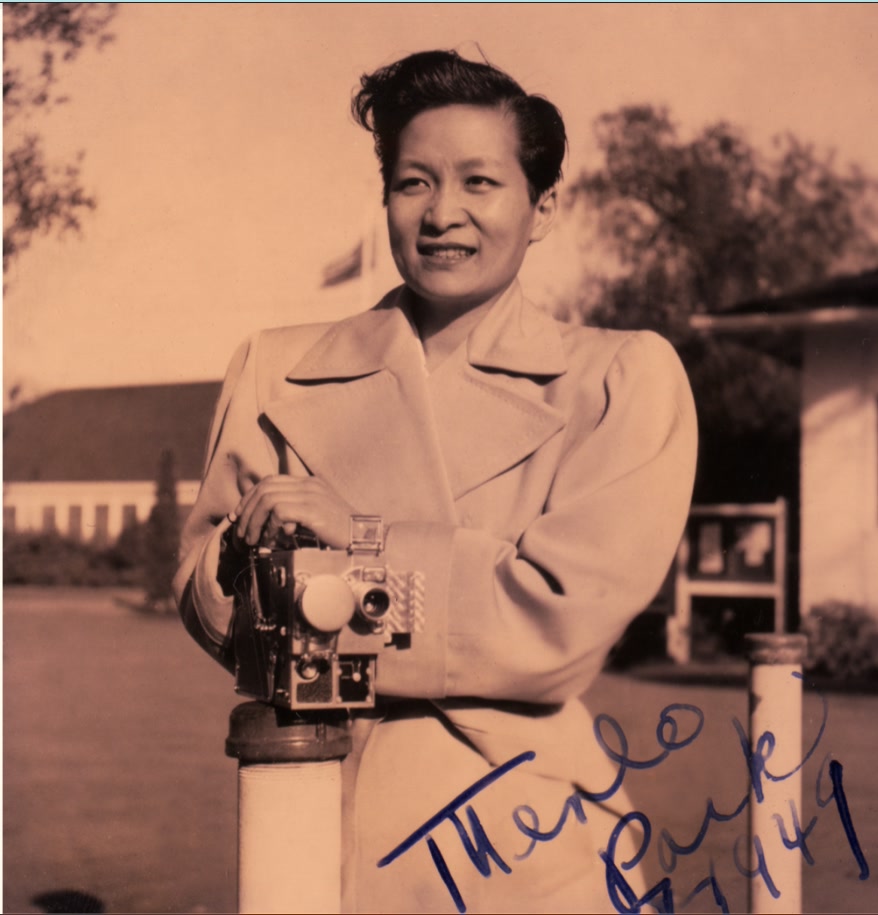
In a photograph that the Museum of Chinese in America dates to 1949 and tentatively links to the Honolulu production of Mad Fire, Mad Love, Esther Eng stands beside a camera with one hand on its body. There is no studio spectacle around her—just tropical foliage and equipment that has arrived from somewhere else. Eng had stopped in Hawaii while taking Back Street and its star Siu Fei-fei toward Hong Kong. A local merchant offered to finance another picture, so the stop became a set and Mad Fire, Mad Love became, according to the surviving record, the first Chinese-language feature produced in Honolulu.[1][2][3]
The detour was not an exception to Eng's career. It was the career in miniature. Between the mid-1930s and the beginning of the 1960s, she worked through San Francisco, Hollywood, Hong Kong, Honolulu, and New York; bought films for circulation through Chinese communities in the Americas; and treated production, exhibition, and distribution as connected problems. The Hong Kong Film Archive's program for S. Louisa Wei's documentary Golden Gate Girls maps eleven Cantonese-language productions involving Eng—some directed alone, some shared, and some undertaken in other roles—across those places before, during, and after the Second World War.[1][2][4]
Calling that cinema “portable” does not mean that Eng used unusually lightweight technology, or that her films belonged nowhere. It means that she repeatedly rebuilt the conditions for Cantonese filmmaking when distance, war, cost, and a scattered audience made a permanent studio insufficient. Her direction began before a camera rolled and continued after a print left the laboratory.
There is also a necessary limit to any profile of Eng as an artist. Most of her films are lost. Only two features are known to survive, both with shared directing credits, while scripts, publicity, reviews, photographs, and family testimony carry much of the remaining history.[1][3][4] Those materials can reveal the stories she chose, the people she organized, and the routes she built. They cannot justify a confident catalogue of camera movements or editing habits in films no one can now see. Eng's importance lies partly in learning to read a director's work without pretending that absence is evidence.
The box office was her first film school
Eng was born Ng Kam-ha in San Francisco in 1914, into a Chinese American family with roots in Taishan. As a teenager she worked at the Mandarin Theatre on Grant Avenue, close to the family home. The venue combined film exhibition with live Cantonese performance; the box-office job let her watch movies and remain close to opera artists as sound cinema and Cantonese talkies changed what the theater could present.[1][3]
This was an education in audiences as much as images. Eng learned cinema from the place where a film met ticket buyers, local performers, imported stories, and a language community. When her father and other investors formed Kwong Ngai Talking Picture Company, she became co-producer of Heartaches, made in 1935 and screened at the Mandarin in February 1936. The production rented a Hollywood facility and brought Chinese performers together with established technicians, including cinematographers Paul Ivano and James Wong Howe. The Museum of Chinese in America describes it as the first Chinese-language film made in Hollywood.[1][3]
That first job already crossed the usual boundaries around a director. Eng helped assemble capital, studio space, performers, and technical skill for a movie intended to travel between Chinese audiences in the United States and Asia. She then traveled with its star, Wai Kim-fong, to promote the film in Hong Kong. A trip expected to last two months became a stay of more than three years.[3]
Her heroines moved before the industry did
In Hong Kong, Eng registered a branch of the family company and directed National Heroine in 1937. Wai played a female pilot who enters national defense—a significant change from Heartaches, in which her opera-singer character relinquishes a romance so that a male aviator can return to China. Eng's new heroine occupied the action rather than merely enabling it. The film arrived as the conflict with Japan intensified, and the Cantonese Women's Association recognized its representation of women's wartime participation.[1][3]
Success brought offers from several companies. Eng directed four more Hong Kong pictures through 1939, moving among social satire, comedy, romance, and melodrama rather than settling inside one studio. The boldest surviving premise belongs to It's a Women's World, co-written and co-directed with Lo Si: its advertised cast comprised thirty-six women in roles across professions and social classes. S. Louisa Wei cautions that the lost film cannot support a detailed analysis of how it constructed female subjectivity. Its scale and selection nevertheless show an ambition to make many kinds of women's lives—not one exemplary wife or mother—the film's organizing field.[1][2][3]
Eng's public identity also unsettled the categories around her. She wore tailored suits and slacks, was open about relationships with women, and was affectionately called “Brother Ha” within film and opera circles. Contemporary coverage could be admiring, intrusive, or confused; Eng converted that attention into authority on sets without making her private life a condition of professional apology.[1][3][6] It would be too simple to treat every female-centered plot as a direct expression of her sexuality. What the record does establish is a sustained alignment between the freedom of her working persona and her interest in women whose options exceeded the roles allotted to them.
War broke the center, not the circuit
Eng returned to the United States in October 1939 as war expanded in Asia. Yet San Francisco could become a production center precisely because Hong Kong and Shanghai were under pressure. She collaborated with exiled Hong Kong filmmakers Joseph Sunn Jue and Kwan Man-ching on Golden Gate Girl (1941), shooting Chinese American working life in and around Chinatown. Those local images then traveled back across the Pacific to audiences hungry for new Cantonese films while older prints were being shown repeatedly.[1][4]
The pattern continued after the war. Eng visited Hong Kong, judged the industry there too costly and constrained, bought distribution rights, and returned to the United States. Wei's archival research reports that Eng calculated American production at roughly one-third of the cost then prevailing in Hong Kong. She had also studied Hollywood's fast, economical B-picture system and saw how its short schedules could serve Chinese-language production without requiring Hollywood's market.[1][3]
Economy did not mean passivity. Eng established Silver Light, self-financed Back Street (1948), and adapted Fannie Hurst's story for Cantonese-speaking audiences. On the journey to present that film in Hong Kong, Honolulu became the site of Mad Fire, Mad Love. A route built for promotion generated another production. The photograph beside the camera matters because it records infrastructure in motion: Eng brought equipment and actors, found local finance, and made location itself answer to an audience network.[1][2][3]
Distribution was not an afterthought
Film history often separates the creative act from the business that follows it. Eng's career makes that division look artificial. While directing in prewar Hong Kong, she helped her family acquire films for American release. Later she ran Ngon Kwong Film Company, purchased rights to dozens of pictures, and distributed them through the Americas, with the Hong Kong Film Archive tracing the network as far as Cuba.[2][3]
The work required more than shipping cans. Prints needed theaters, publicity, language communities, and trusted intermediaries. Eng traveled through ports in North and South America and understood that a Cantonese film could be made in one country, set in another, financed in a third place, and find its public through neighborhood cinemas far from all three. Law Kar's study of Eng appears, appropriately, in the “Migration, Diaspora, and Transcultural Practice” section of Chinese Women's Cinema: the border crossing was not colorful biography around the movies but a condition of their existence.[5]
After moving to New York in 1950, Eng helped operate the Central Theatre, which screened Cantonese films and presented Cantonese opera. She also built a restaurant business whose rooms became gathering places and employment networks for visiting and stranded performers. In 1961 she returned to production for Murder in New York Chinatown, writing from a local murder case and directing the New York location material while Wu Pang handled Hong Kong studio scenes.[1][2] Even her final credit was divided across cities and rejoined as one film.
The archive preserves the route better than the view
Portability solved access; it did not guarantee preservation. The very network that let Eng make and circulate films outside a stable national studio system left negatives, prints, scripts, and ownership dispersed. MOCA reports that only two films and three copy scripts have survived in identified archives. Wei reconstructed the larger career from trade reporting, posters, stills, oral history, and six personal albums. MOCA also reports that photographs from Eng's albums were recovered from a San Francisco dumpster in 2006, an unlikely rescue that helped inspire Golden Gate Girls.[1][4][6]
This uneven survival changes the responsible way to describe Eng. It is safe to say that she repeatedly centered active women, chose stories that could speak across Cantonese diasporic markets, and understood production and distribution as a single circuit. It is not safe to turn fragmentary synopses into a complete visual signature. The distinction does not diminish her as a director. It shows another dimension of directing: creating the social and material arrangements through which an image can be made at all.
Eng's cinema was never placeless. San Francisco's Chinatown laundry, Hong Kong's professions, Honolulu's Chinese community, and New York's streets each mattered as more than interchangeable backdrops. What traveled was not a generic product but a method: find the audience, assemble the collaborators, translate a story's address, and keep the print moving.
The Honolulu photograph holds that method in one gesture. Eng's hand on the camera does not make her a solitary auteur claiming a machine. It places her at the junction of equipment, crew, local capital, performers, and a journey already underway. Esther Eng made Cantonese cinema portable because she understood that a film is not only a sequence of images. It is also the route that allows those images to exist and arrive.
Sources
- Museum of Chinese in America, “Esther Eng” — collection story, career chronology, surviving materials, and source page for the 1949-dated camera portrait associated with the Honolulu production.
- Hong Kong Film Archive, “Esther Eng” — official filmmaker record covering her films, production companies, distribution network, theaters, and final location-directing credit.
- S. Louisa Wei, “She Wears Slacks: Pioneer Women Directors Esther Eng and Dorothy Arzner,” in Transcending Space and Time: Early Cinematic Experience of Hong Kong, Book III, Hong Kong Film Archive, 2014 — archival reconstruction, production history, press record, and evidentiary limits.
- Hong Kong Film Archive, “Golden Gate Girls” — program record detailing Eng's eleven-film transpacific geography and the photographs, press, clips, and surviving films used to reconstruct it.
- Lingzhen Wang, ed., Chinese Women's Cinema: Transnational Contexts. Columbia University Press, 2011 — publisher record and contents for Law Kar's chapter “In Search of Esther Eng: Border-Crossing Pioneer in Chinese-Language Filmmaking.”
- Women Make Movies, “Golden Gate Girls” — distributor page for S. Louisa Wei's archival documentary and its recovery of Eng within Asian American, Chinese, queer, and women's film history.