Spoiler note: this essay discusses Charlotte's transformation, the fate of Mrs. Vale, Charlotte's bond with Tina, and the film's ending.
The line most people remember from Irving Rapper's Now, Voyager (1942) comes at the end: "Don't let's ask for the moon. We have the stars."[1][5] The image most people remember may be the two cigarettes Paul Henreid lights at once before handing one to Bette Davis.[5] Both details are famous for good reason, but they are often treated as detachable glamour: the quotable line, the swooning gesture, the essence of studio-era romance. The movie is doing something more exact. It keeps turning desire into a question of scale, distance, and framing. Charlotte Vale's great achievement is not that she wins the full romantic destiny promised by a makeover melodrama. It is that she learns how to build a livable self inside limits that once would have crushed her.[2][4][6]
That is why the film feels richer than a simple ugly-duckling narrative.[1][2][4] Criterion's Patricia White is especially useful on this point, because she stresses the film's symbolic objects and therapeutic structure rather than reducing it to glamour alone.[2] The BFI's note on films about happiness goes further, arguing that the film's decisive relationship is not Charlotte and Jerry's affair but Charlotte's movement toward confidence, self-worth, and forms of happiness that do not depend entirely on possession.[4] Once that shift comes into view, the cigarettes, the portholes, and the stars stop looking like decorative touches. They become the movie's grammar for partial freedom.
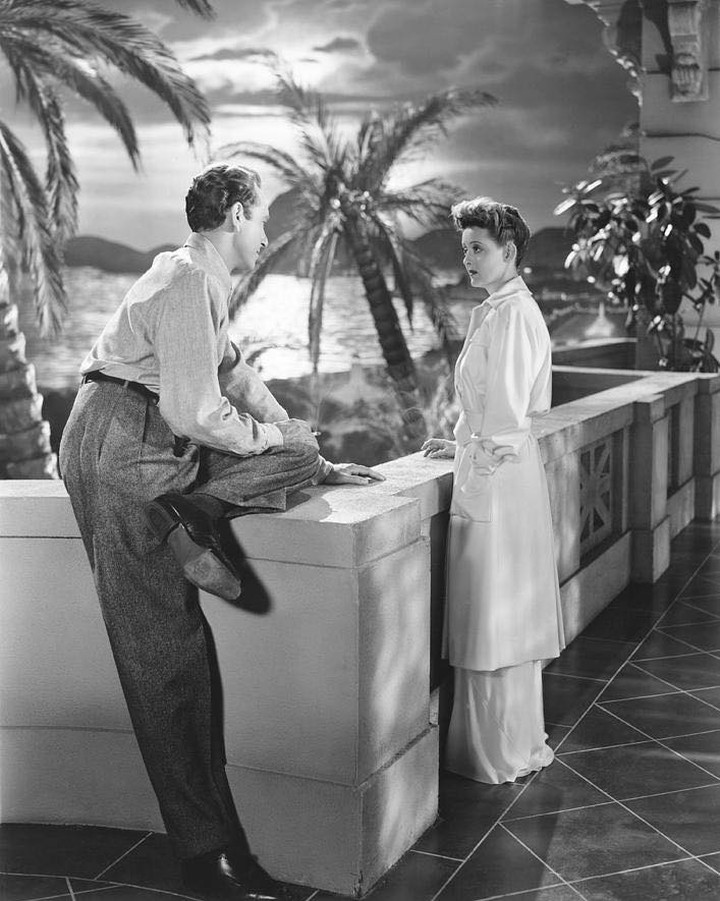
Image context: the lead image uses a real 1942 studio publicity still of Paul Henreid and Bette Davis from Now, Voyager.[8] It fits this essay because the film's emotional world is made of framed intervals: a terrace, a rail, a patch of water, two people suspended between proximity and separation.
Portholes and terraces teach Charlotte how to see herself at a different scale
The first half of Now, Voyager is often summarized as transformation by psychiatry, wardrobe, and travel, and all three matter.[1][2][4] Charlotte begins in the Vale house as a woman compressed by her mother's supervision, her own self-disgust, and the ritual humiliations of Boston family life.[6][7] Ella Taylor's Criterion piece on Gladys Cooper captures the severity of Mrs. Vale's rule: she governs the house through icy command, making Charlotte feel permanently juvenile and permanently observed.[7] Inside that world, Charlotte cannot occupy space without apology.
The cruise changes the problem by changing the frame.[2][4][6] White notes how objects such as eyeglasses, flowers, hats, and cigarettes become part of Charlotte's self-conjuring.[2] The ship's architecture belongs on that list too. Portholes, decks, terraces, and hotel balconies keep placing Charlotte inside bounded openings that are no longer punitive. Instead of being trapped in the family mansion's line of judgment, she begins to appear within circles and thresholds that make self-observation possible. She is still framed, but the frame now gives her air.[2][6]
This matters because the film's title already imagines freedom as departure rather than arrival.[5][6] TCM and the Library of Congress essay both point back to the Whitman line that gives the movie its name: sail forth, seek, and find.[5][6] Charlotte's voyage is therefore less a trip toward possession than a training in distance. She learns to occupy a view, to look out, to hold herself in suspension long enough for another life to become thinkable. The porthole is a perfect emblem for that state. It is open to the world, but only through a precise boundary. Freedom in Now, Voyager arrives in measured apertures.
The two-cigarette gesture makes love feel equal because it cannot become ownership
The most celebrated bit of business in the film works for the same reason.[5] Roger Fristoe's TCM note recounts the long-running dispute over the origin of the cigarette routine, while making clear how central it became to the movie's identity.[5] Jerry does not merely offer Charlotte a light. He places two cigarettes in his mouth, ignites them together, and passes one across. The gesture is seductive, but it is also formal. Two flames begin at the same instant. Intimacy appears as simultaneity rather than absorption.
That distinction is crucial to the film's emotional logic.[2][4][5] Charlotte and Jerry can share intervals, confidences, and a style of attention; they cannot build a settled household. The cigarette ritual compresses that truth into one movement. It is glamorous, but it is also honest. Nothing in it suggests conquest. The scene creates nearness while preserving separateness, which is exactly what this romance will keep doing for the rest of the film.[5][6]
White's essay helps explain why this does not play as mere compromise.[2] She describes the movie as one in which Charlotte uses symbolic objects to call a self into being. The cigarette belongs to that process. It is not just a token of Jerry's charm. It is one of the props through which Charlotte briefly inhabits a world of adult reciprocity instead of maternal correction.[2] For a woman trained to feel like an afterthought, equality in a moment can be revolutionary even when permanence is unavailable.
That is why the romance remains moving after one accepts that it cannot end conventionally.[1][4][5] Many Hollywood love stories promise completion through marriage or reunion. Now, Voyager keeps redirecting passion into forms of poise, memory, and bearing. The cigarettes burn down. What lasts is Charlotte's newly practiced relation to herself.
The stars are smaller than the moon, and that is the point
The ending is often misread as noble resignation, as though Charlotte simply learns to take less than she wanted.[4][5] The film is sharper than that. The BFI's happiness essay argues that Charlotte comes to recognize several kinds of happiness: confidence, beauty, companionship, usefulness, and self-acceptance, not only romantic capture.[4] The Library of Congress note similarly emphasizes how unusual the film is in allowing its heroine to live outside the rules normally assigned to the genre's women.[6] The final line about the stars does not shrink desire into piety. It resizes desire into something she can actually keep.
Tina matters here.[4][7] Taylor's account of the film's maternal pattern is valuable because it sees Tina as the child through whom Charlotte can answer her own damaged upbringing.[7] Charlotte does not simply substitute one dependency for another. She chooses a relation in which care becomes active rather than humiliating. That decision belongs to the same emotional re-scaling as the cigarette gesture and the porthole view. She stops demanding total possession, but she also stops accepting total subordination.[4][7]
This is what makes the famous final line so exact.[1][5] The moon would be absolute, singular, and cinematic in the most obvious way. The stars are plural, distant, and sufficient. They imply a life made of distributed lights rather than one grand consummation. Charlotte's ending is therefore neither defeat nor naive uplift. It is a self-authored arrangement in which love survives, but does not monopolize meaning.[4][6]
That arrangement is the film's deepest modernity.[1][2][4] Now, Voyager understands that liberation may begin in romance without finishing there. It understands that style, therapy, travel, and flirtation can all matter without magically erasing history. Most of all, it understands that self-invention is not the same as self-delusion. Charlotte does not get the moon. She gets a vocabulary for living: an opening, a gesture, a constellation. The portholes teach her how to inhabit a frame, the cigarettes teach her how to share a moment without surrendering herself, and the stars teach her that partial happiness can still be real. That is why the ending lingers.[2][4][5]
Sources
- The Criterion Collection, "Now, Voyager (1942)" film page with credits, restoration notes, and cast information.
- Patricia White, "Now, Voyager: We Have the Stars," The Criterion Collection.
- BFI, "Now, Voyager (1942)" film page.
- David Morrison, "10 great films about happiness" - Now, Voyager entry, BFI.
- Roger Fristoe, "Now, Voyager" production note, TCM.
- Charlie Achuff, "Now, Voyager" essay for the National Film Registry, Library of Congress.
- Ella Taylor, "Mother Monster: Gladys Cooper in Now, Voyager," The Criterion Collection.
- Wikimedia Commons, "File:Paul Henreid and Bette Davis in Now, Voyager publicity still.jpg" - 1942 publicity still used as the cover image.