

Jackie Chan's action scenes look miraculous the first time because the stunts are real enough to hurt, but they stay rewatchable for a deeper reason: the movies never let you lose the line of force.[1][3][4][5][6] Bodies move through rooms, ladders, buses, shopping malls, clocks, windows, and railings in ways that remain unusually easy to follow even when the speed spikes. The frame does not confuse impact for intensity. It clarifies impact, then lets the danger register on Chan's body.
That is why these two videos belong together. The first, Every Frame a Painting's "Jackie Chan - How to Do Action Comedy," isolates the formal mechanics: wide enough framing, full-body movement, clean geography, and a rhythm built around setup, failed attempt, adjustment, and payoff.[1] The second, a short Criterion excerpt in which Edgar Wright describes Chan's charisma, explains why that mechanical clarity never feels cold.[2][3] Chan is not staged as a granite superman. He fights from a defensive posture, gets rattled, looks offended by pain, and wins by improvising through embarrassment, fear, and momentum.[2][3]
Criterion's overview of Chan's early rise is useful here because it describes the persona and the craft as inseparable.[5] He did not merely add jokes to martial arts. He refined a star image in which slapstick vulnerability and acrobatic expertise occupy the same body.[3][5] BFI's recent survey of 1980s Hong Kong action pushes the point further by placing Project A and Police Story inside a broader moment when Hong Kong action cinema turned aggressively modern, contemporary, and stunt-forward.[6] Chan's breakthrough was not that he looked stronger than everyone else. It was that he made modern space playable. A bus, a mall atrium, or a clocktower could become comic equipment without ceasing to be dangerous.[4][6]
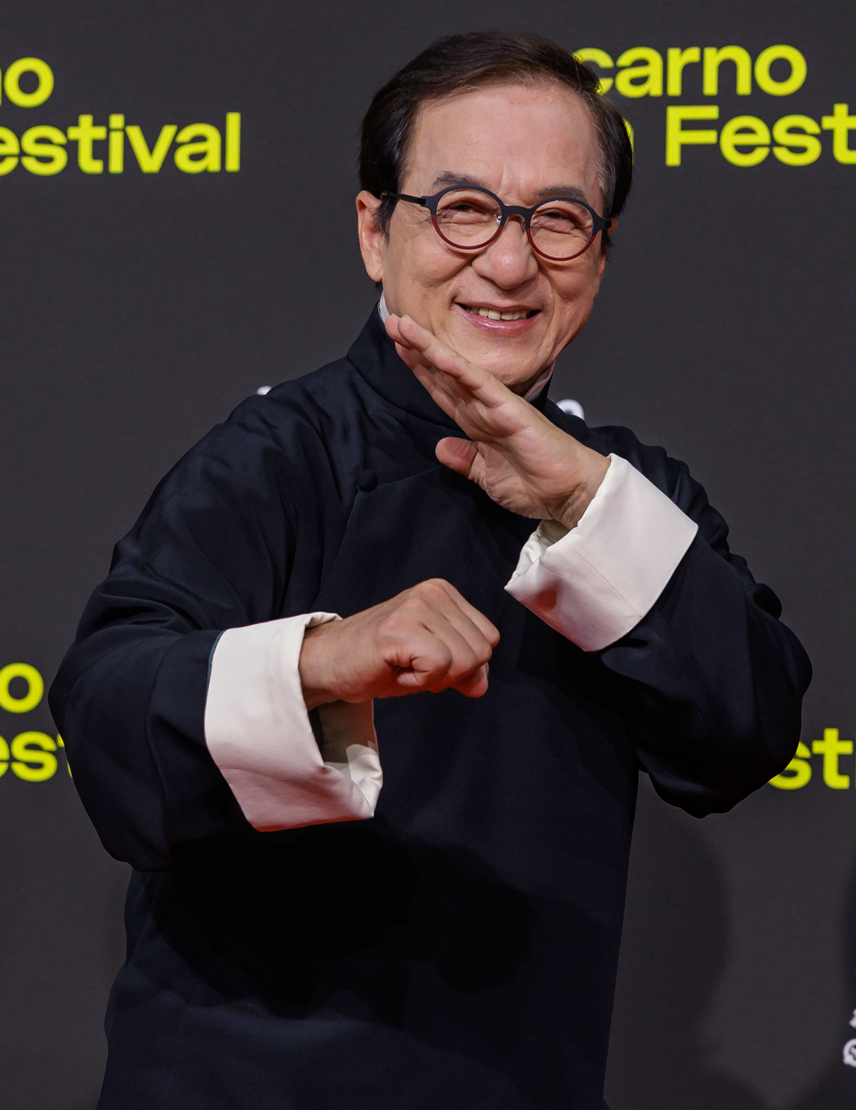
Image context: the cover uses a 2025 red-carpet photograph from Wikimedia Commons rather than a single-film still because this article is about one performer-director's repeated screen logic across several movies and several decades.[7] A public portrait fits that structure. Chan's smile is part of the argument: the most punishing action in his cinema still arrives through a face that invites the audience to read pain, panic, and ingenuity in the same instant.
Video one: action stays funny because the frame keeps faith with the body
The Every Frame a Painting essay is valuable because it begins with a simple claim and then proves it visually: a Jackie Chan action scene usually gives the audience the information it needs before asking for amazement.[1] That means fewer hyperactive cut-ins, less fake velocity created in the edit, and much more trust in full-body performance. The video keeps showing how Chan and his collaborators let the viewer see the whole problem. A wall is too high, a gang is too large, a chair is in the wrong place, a staircase has one more landing than expected. The comedy is born from the body's negotiation with those facts, not from a punchline pasted on top after the stunt is over.[1][4]
This is where BFI's description of Project A becomes especially useful.[6] The article notes that Chan moved away from pure kung fu display toward death-defying stunts shaped by silent-comedy ancestors such as Harold Lloyd and Buster Keaton, and that the result was a freer mixture of acrobatics, martial arts, and barroom chaos.[6] The video essay shows the formal consequence of that inheritance. In Chan's best scenes, the environment is never generic background. It is a sequence of readable obstacles. Comedy depends on that readability. If you do not understand where the table is, how far the drop goes, or why the ladder keeps opening new risks, the gag cannot ripen into suspense and then release.[1][6]
The clip's strongest insight is that Chan turns retrying into spectacle.[1] Hollywood action often treats mastery as instantaneous: the hero sees, acts, and dominates. Chan's cinema prefers a different rhythm. He grabs the umbrella and nearly loses the bus. He uses one object and discovers it rebounds badly. He lands but not cleanly, then must convert the bad landing into the next move.[1][4] Criterion's essay on Police Story calls the mall finale a pinnacle of recording "fragile, imperiled human bodies moving propulsively in concert," and that phrase gets at the real point.[4] Fragility is not an interruption of the thrill. It is the thrill. The audience feels awe because the body in motion looks exposed enough that failure remains imaginable.
Video two: the persona makes the danger social instead of abstract
Edgar Wright's short Criterion segment matters because it answers the question left open by the first video: why does this clarity feel so warm rather than merely efficient?[2][3] Wright isolates a quality many Chan admirers sense without naming. Chan's athletic brilliance never hardens into aloofness. He can do impossible things, but he rarely behaves as though impossibility were beneath comment. His face registers irritation, alarm, calculation, and the indignity of being hit. He is superhuman in execution yet stubbornly human in attitude.[2][3]
That distinction is central to his break from the action masculinity that surrounded him in the 1980s.[2][3] Criterion's companion page frames Chan as a startling contrast to both Bruce Lee's severity and the stony confidence of American stars such as Stallone, Eastwood, and Schwarzenegger.[3] The point is not that Chan lacks authority. It is that his authority is relational. He does not stand above the scene like a mythic solution delivered from elsewhere. He remains inside the mess, often looking faintly exasperated that the mess has happened to him again. The result is that each stunt has social texture. We do not only admire the feat. We watch a person endure the feat, react to it, and then scramble into the next decision.[2][3][5]
This is also why Police Story became such a decisive film.[4][6] BFI's capsule on the movie emphasizes the scale of the bus stunt, the smashed glass, and the famous slide down the live light-strung pole, but it also notes that Chan keeps his "ordinary guy" persona intact throughout the destruction.[6] That phrase is doing important work. Chan's cinema does not make the ordinary guy impressive by pretending he was exceptional all along. It makes him impressive by forcing ordinariness to invent techniques under pressure. Wright's admiration for the "defensive posture" is exactly right.[2][3] Chan often looks like a man trying to survive the space one second at a time, and that survival logic keeps the comedy inseparable from the action.
When this second video is placed beside the first, the larger design becomes clear. Formal legibility alone would produce a lucid but emotionally thinner cinema. Persona alone could produce charm without architecture. Chan's distinction lies in the weld between the two.[1][2] We can read the room, the trajectory, and the risk, and we can also read the performer's changing feelings toward that risk as it unfolds. Danger becomes legible twice over: in space and in expression.
What the two videos reveal together
Taken together, these videos explain why Jackie Chan's action-comedy has aged better than countless louder, more expensive spectacles.[1][2][3][4][5][6] The scenes do not depend on surprise alone, and they do not ask editing to manufacture force that was never present in the performance. They build force out of visible problems, visible consequences, and a star who lets the audience see the cost of solving those problems. That is why even a tiny reaction shot after a fall can matter as much as the fall itself. The joke is not a break from danger. The joke is the body's commentary on danger.
This is also why Chan belongs in a lineage that runs through silent comedy as much as through martial-arts cinema.[1][5][6] He keeps asking what a body can do when space refuses to cooperate, then adds a modern velocity and impact level that silent comedians could only imply. Ladders, clocks, buses, glass, poles, railings, and escalators become not just props but moral tests: can the performer stay readable while the world turns hostile? Chan's answer is yes, but only if the film honors both the mechanics of movement and the embarrassment of being a body in peril.
The two videos therefore complement each other perfectly. Every Frame a Painting gives the engineering drawing.[1] Edgar Wright supplies the missing weather report on the face inside the machine.[2][3] Put them side by side and the enduring Jackie Chan formula stops looking mysterious. He makes action coherent enough to admire and vulnerable enough to care about.
Sources
- Every Frame a Painting, "Jackie Chan - How to Do Action Comedy," YouTube video.
- CRITERION, "Edgar Wright on the Charisma of Jackie Chan," YouTube video.
- The Criterion Collection, "What Makes Jackie Chan One of a Kind."
- Nick Pinkerton, "Police Story and Police Story 2: Law and Disorder," The Criterion Collection.
- The Criterion Collection, "Jackie Chan: Emergence of a Superstar."
- David West, "10 great Hong Kong action films of the 1980s," BFI.
- Wikimedia Commons, "File:Jackie Chan.jpg" - the Locarno 2025 portrait used as this article's lead image.