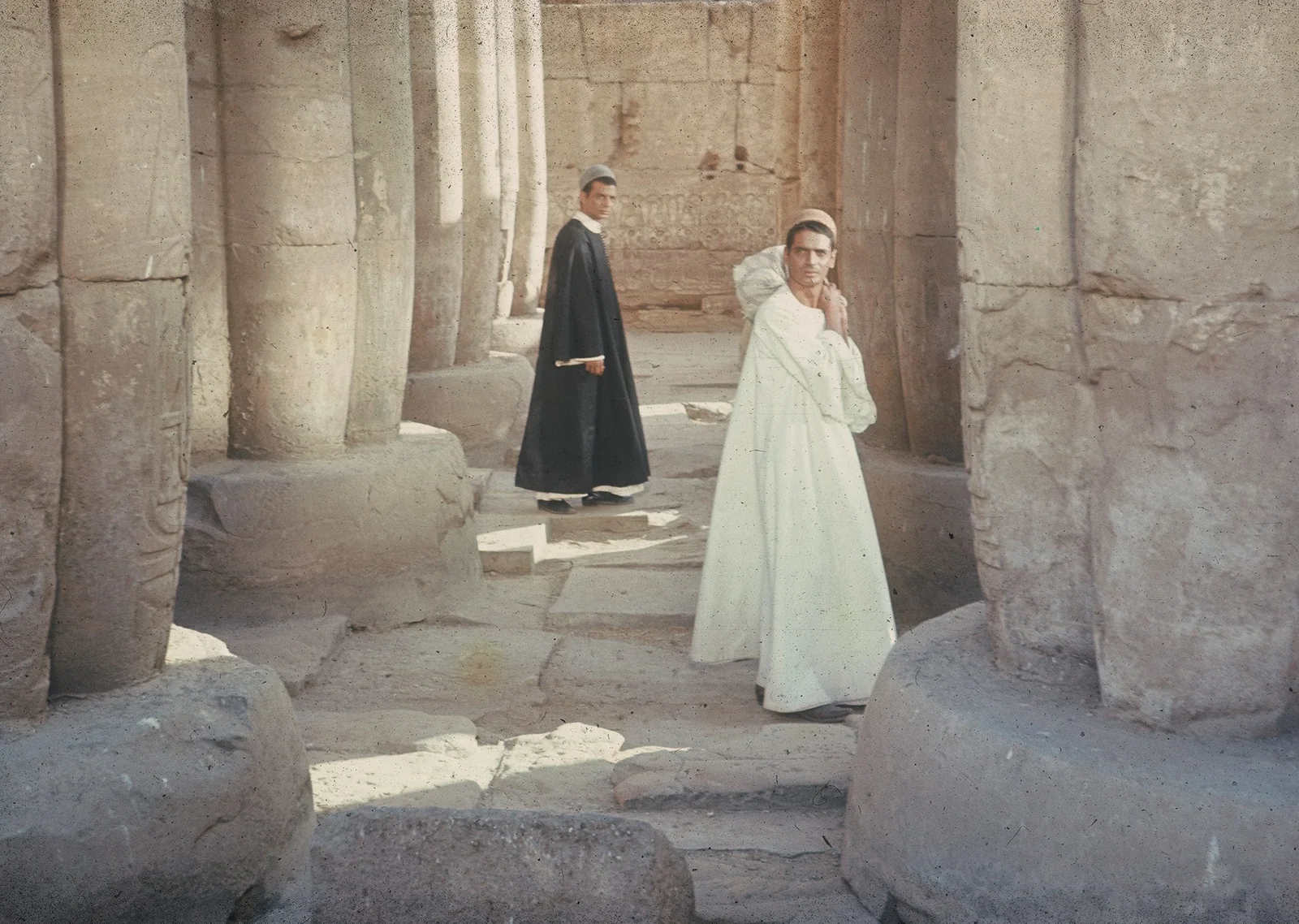
Near the end of The Night of Counting the Years, royal coffins emerge from the mountain in a slow procession. They are archaeological evidence, national patrimony, museum-bound objects—and bodies being disturbed yet again. Shadi Abdel Salam refuses to let any one of those meanings settle the image. The recovered cache has been saved from piecemeal sale and further desecration, but rescue still requires removal. Men carry the ancient rulers into a future that has already decided where history ought to live.
That unresolved movement gives Abdel Salam's 1969 film, also known as Al-Momia or The Mummy, its extraordinary pressure. The plot is drawn from the 1881 discovery of a cache of royal mummies near Thebes: members of a local clan have survived in hard times by selling objects taken from hidden tombs, while government archaeologists follow the antiquities appearing on the market.[1][2][4] Yet the film is not a contest between enlightened preservation and primitive theft. It asks a more difficult question: when the past has been buried, forgotten, traded, studied, and claimed by institutions, what would it mean to inherit it honestly?
Spoiler note: this essay discusses the film's central betrayal and ending.
Version note: This essay refers to the 103-minute 2009 restoration by Cineteca di Bologna/L'Immagine Ritrovata, the World Cinema Project, and the Egyptian Film Center.[1][3]
A livelihood inside the tomb
Abdel Salam begins with two forms of mourning. The Horabat clan buries its chief; the state antiquities service worries over a civilization leaking away object by object. After their father's funeral, the chief's sons learn the family secret. For generations, the elders have known the entrance to a royal cache and converted pieces of the tomb into income. The older brother refuses the inheritance and is killed. Wanis, played by Ahmed Marei, is left between silence that protects his living community and disclosure that protects the violated dead.[1][2][6]
The moral knot matters because the objects are never merely treasure. To the traders, they have prices. To the archaeologists, they carry names and dynasties. To the clan, they are the material basis of a survival arrangement whose origins have hardened into custom. To Wanis, they become evidence that his people have lived beside ancestors they can neither name nor understand. One object can therefore be food, commodity, document, sacrilege, and kinship claim at the same time.
A conventional tomb drama would turn knowledge of the entrance into leverage: whoever possesses the secret controls the plot. Here, possession makes Wanis less powerful. The secret arrives with an order to repeat what the fathers did, and with proof of what happens to a son who refuses. His inheritance is not wealth but enforced complicity.
This is why the film does not flatter its protagonist as a clean modern individual escaping a backward collective. Wanis's eventual disclosure of the tomb is also a betrayal of people whose economic precarity is real. The clan elders' violence cannot be excused, but neither does the film pretend that law and a museum will feed the families whose illicit trade is being closed. Preservation wins the argument without cancelling the cost.
Twilight is a historical tense
The landscape holds that contradiction before the dialogue explains it. Richard Peña noted that Abdel Salam and cinematographer Abdel Aziz Fahmi shot the exteriors between 4 and 6 a.m. or 4 and 6 p.m.[3] The light seems to be arriving and withdrawing at once. Sand, cloth, skin, and carved stone share a muted range of ochre, chalk, rust, and black; figures can look etched into the terrain until a turn of the head releases them from it.
Twilight is more than atmosphere here. The story takes place in 1881, one year before the British occupation of Egypt, while the film itself was made in the aftermath of Egypt's 1967 defeat.[1][5][6] Abdel Salam was therefore filming one historical threshold through the shock of another. The older order is not securely past, and the new one has no innocent authority. Even the film's production carried that tension: it arose within Egypt's public-sector cinema, departed sharply from popular commercial forms, circulated at European and Arab festivals, and then waited five years for a domestic release.[1][2]
The camera rarely races to solve this instability. Its measured pans and held compositions make each crossing of the landscape feel ceremonial. Mario Nascimbene's score, which the Film Foundation describes as moving among European, Middle Eastern, and Egyptian folk sounds, does not assign the film to a single cultural clock.[1] It produces an unease appropriate to a world in which the distant past is physically present but no longer speaks in a language everyone shares.
Even the classical Arabic dialogue creates distance. Viola Shafik notes that Abdel Salam rejected the Cairene vernacular familiar from Egyptian popular cinema, while arranging actors against walls, horizons, and desert spaces with the stillness of relief figures.[2] The result is not archaeological realism. It is a deliberately estranged present: people speak as if history has made their ordinary crisis monumental, yet their bodies remain tired, frightened, hungry, and exposed.
The wall can be seen and not read
Again and again, Wanis stands beside inscriptions he cannot decipher. The fact is simple, but the image is devastating. He is not separated from ancient Egypt by geography; he can touch its walls. What separates him is a broken chain of meaning. The archaeologists possess a scholarly vocabulary for the names and signs. His clan possesses the location of the dead. Neither knowledge is complete on its own, and each becomes power because the other side lacks it.[2]
Abdel Salam's compositions turn this division into scale. Human figures occupy a small portion of a frame crowded by columns, cliffs, doorways, and incised surfaces. The ruins do not function as picturesque proof that the production visited Egypt. They are the film's active social architecture. Wanis is surrounded by an inheritance large enough to organize national identity and mute enough to leave him asking what an ancestor is.
That question complicates the familiar language of “reclaiming” heritage. Reclamation sounds like an object returning to a self that has always known it. The Night of Counting the Years shows discontinuity instead: religious change, poverty, antiquities commerce, state bureaucracy, archaeology, and colonial pressure have all altered the relation between living Egyptians and the pharaonic past. Youssef Rakha's book-length engagement with the film treats that fracture as a way into Egypt's postcolonial modernity, where Arab, Muslim, and ancient Egyptian identities cannot simply be stacked into seamless continuity.[5]
The film does want reconnection; its solemnity makes that clear. But it distrusts the fantasy that reconnection restores an untouched original bond. Wanis cannot go backward into knowledge his community no longer holds. He can only decide what to do with the break.
Preservation without a victory lap
When Wanis finally tells the archaeologists where the cache lies, he changes the ownership of the secret. Private, inherited knowledge becomes public, institutional knowledge. That transfer stops the piecemeal sale of the tomb goods, but Abdel Salam stages it as grief rather than conquest. There is no triumphant unveiling, no villain defeated beside an opened chest. The recovered coffins pass through the landscape with the gravity of a second funeral.
The procession also refuses to make the state transparent. The government service can preserve, catalogue, and interpret what the clan has been stripping for sale. It can also remove. Set immediately before foreign occupation, the film's archaeology cannot be isolated from the politics of who names Egypt, who administers its past, and where recovered bodies are taken.[6] Wanis's choice may be necessary; necessity is not the same as innocence.
This is where the title's “counting” acquires its force. The film counts more than chronological years. It counts the accumulated claims placed upon the dead: the ancient priests who hid the royal mummies from earlier robbers, the clan that guarded and exploited their location, the dealers who broke objects into prices, the archaeologists who turned them into national history, and the modern filmmakers and viewers who look again.[2] No claimant begins at the beginning. Everyone inherits an earlier act of custody or disturbance.
The procession leaves a modern viewer with an ethical limit the film does not resolve: the dead remain the one party that cannot consent. Its duration keeps that discomfort in view. The slow pace makes looking feel less like access than obligation, as though the camera must spend time before it can claim even to have seen.
The film had to be recovered too
There is a material afterlife to this argument. From the 1970s onward, Al-Momia became extremely difficult to see; Martin Scorsese recalls encountering a faded 16 mm print that had turned magenta.[1] In 2009, Cineteca di Bologna's L'Immagine Ritrovata laboratory, the World Cinema Project, and the Egyptian Film Center restored the film from the original 35 mm camera and sound negatives preserved in Giza.[1][3]
The parallel is almost too neat: a film about objects rescued from damaging circulation was itself rescued from disappearance. But the differences are instructive. Restoration did not return Al-Momia to some untouched state. It required institutions, funding, technical judgment, surviving elements, and decisions about color. The Film Foundation notes that Abdel Salam shot on saturation-rich Eastman Color 5254 and that the restoration involved work with three-strip separations.[1] Preservation here, too, is an active transfer of custody rather than time reversed.
That second rescue lets the film's twilight breathe again. More importantly, it keeps its question open. The Night of Counting the Years does not define inheritance as ownership. Ownership closes around an object: mine, yours, the family's, the state's. Inheritance is more troubling because it includes burdens one did not choose and damage one cannot undo.
Wanis inherits a secret, an economy, a murdered brother, and a past he cannot read. His answer is to break the secret, knowing that disclosure will not make him whole. The coffins leave the mountain, but the film denies us the comfort of calling that movement home. Honest custody begins, Abdel Salam suggests, when possession gives way to responsibility—and when responsibility is allowed to retain the sorrow of everything it cannot repair.
Sources
- The Film Foundation, “August 2023 / Al Momia and The Eloquent Peasant” — credits, historical and production context, score and language commentary, 1967 context, original film stock, and 2009 restoration provenance.
- Viola Shafik, “The Night of Counting the Years: A Unique Work in and on History,” Cinemayaat — plot, public-sector production and delayed release, classical Arabic, visual composition, and the film's treatment of estrangement from the pharaonic past.
- New Zealand International Film Festival, “The Night of Counting the Years” — 2009 restoration and festival record, principal credits, and Richard Peña's account of the dawn-and-dusk exterior photography.
- Sam Wigley, “5 things to watch this weekend — 11 to 13 August,” BFI (August 11, 2023) — the film's meditation on time and heritage and source page for the restored film still used above.
- Youssef Rakha, Barra and Zaman: Reading Egyptian Modernity in Shadi Abdel Salam's The Mummy. Palgrave Macmillan, 2020 — book record and overview of its reading of Egyptian postcolonial modernity through the film.
- Arsenal Institute for Film and Video Art, “Al Momia” — 1881 setting, the clan's livelihood and fratricide, the approach of British occupation, and the film's twilight landscapes and production design.