Audiences saw a steady rectangle. Behind them, the light source was eating itself.
For much of film exhibition history, the brightness on the screen came from an electrical arc struck between carbon rods. The arc was ferociously luminous, but it was not a sealed bulb that could be switched on and forgotten. Its electrodes burned away. Their spacing changed. Heat accumulated. A mechanism—or, on earlier machines, a projectionist's hand—had to feed the carbons toward one another so the light did not weaken, wander, or go out.[1][2][9]
That makes carbon-arc projection more than a retired piece of theater hardware. It reveals something easy to miss when a movie arrives as a file: exhibition used to be a live manufacturing stage. The release print contained the photographed and edited work, but the screen image still had to be made in real time. A projectionist balanced a consuming light source, moving film, optical sound, focus, framing, and reel changes while the audience was already watching. The best performance of that work looked like no performance at all.
The light source was a consumable
A carbon arc begins with two conductive rods held close enough for electric current to cross the gap between them. The resulting arc produces the intense light a projector needs to throw a small film frame across a long room and enlarge it onto a screen. It also consumes the rods. The University of Warwick's reconstruction of a 1912 projection box shows the arrangement plainly: carbon electrodes projected from the rear of each machine, while disc-shaped controls let the operator keep their burning tips at the proper distance. Later systems automated the feed, but automation managed the motion of the rods; it did not turn the booth into an unattended space.[1]
The surviving hardware is wonderfully literal. A W. Butcher lamp in the Science Museum Group's Kodak collection uses two 6-millimeter carbons in spring-loaded mounts, a ceramic block, and a helical screw to move the carbon carriage.[2] There is no mysterious “cinema” substance inside it. There are electrodes, insulation, a controlled gap, and a way of advancing material that is disappearing as it works.
Scale made that simple premise severe. In a Hong Kong Film Archive account, veteran projectionist Lam Chun described a large carbon-arc installation from Queen's Theatre as the most complicated part of a system divided among mechanics, sound, and optics. He recalled a lamphouse drawing roughly 4,000 to 5,000 watts and generating enough heat to require water cooling.[3] That account belongs to one theater and one machine, not every carbon-arc booth. It nevertheless restores the bodily reality hidden by the distant beam: the screen's cool silver light began inside a hot metal enclosure.
Light quality therefore had a time dimension. At the start of a run, the rods had length and the arc could be established at the intended position. As they burned, the feed had to preserve the gap and keep the source aligned with the reflector and optical path. The George Eastman Museum's Technicolor research notes show that changing arc size and shape could also shift color temperature.[9] A dim, uneven, or chromatically unstable picture was not necessarily encoded in the print. It could be happening now, behind the audience, because the light had drifted from the place where the lens expected to find it.
Twenty minutes, two machines, one continuous scene
The carbon rod was not the booth's only clock. A 35-millimeter release print commonly arrived on 2,000-foot reels, each holding roughly twenty minutes at sound speed. Queen's Theatre kept two carbon-arc projectors ready, Lam recalled, because both rods and reels had to be replaced on that working rhythm.[3] The reel standard and the consumable lamp were distinct constraints; neither can be reduced to the other. The projectionist was the person whose schedule made them meet.
While projector A sent one reel to the screen, projector B held the next. The incoming reel had to be inspected, threaded through its sprockets and gate, looped correctly around the sound path, and parked at its leader; the second machine's focus and framing had to be ready. Near the end of the outgoing reel, cue dots in the upper-right corner warned that the handoff was approaching. Giovanna Fossati notes that projectionists sometimes punched these marks into prints as signals to start the next projector; heavily circulated copies could accumulate several generations of such perforations.[4]
The changeover had to convert warning into continuity. The second machine came up to speed; at the appointed instant the projected image and sound moved from one apparatus to the other. Projector A could then be unloaded and prepared for a later reel while B carried the show. If the timing was right, a scene crossed the physical break without appearing to cross anything. If it was wrong, the audience could see a flash, a jump, a late start, a tail leader, or darkness.
This is why the familiar cue dot is such a rich artifact. To a viewer it may be a brief blemish. To the booth it was part of a score. It connected a mark carried by the print to a motor reaching speed, a hand on a control, two light sources matched closely enough, and an operator listening for whether sound and image had arrived together. The mark did not automate the cut. It gave a trained person just enough notice to perform it.
The booth was an instrument, not a cupboard
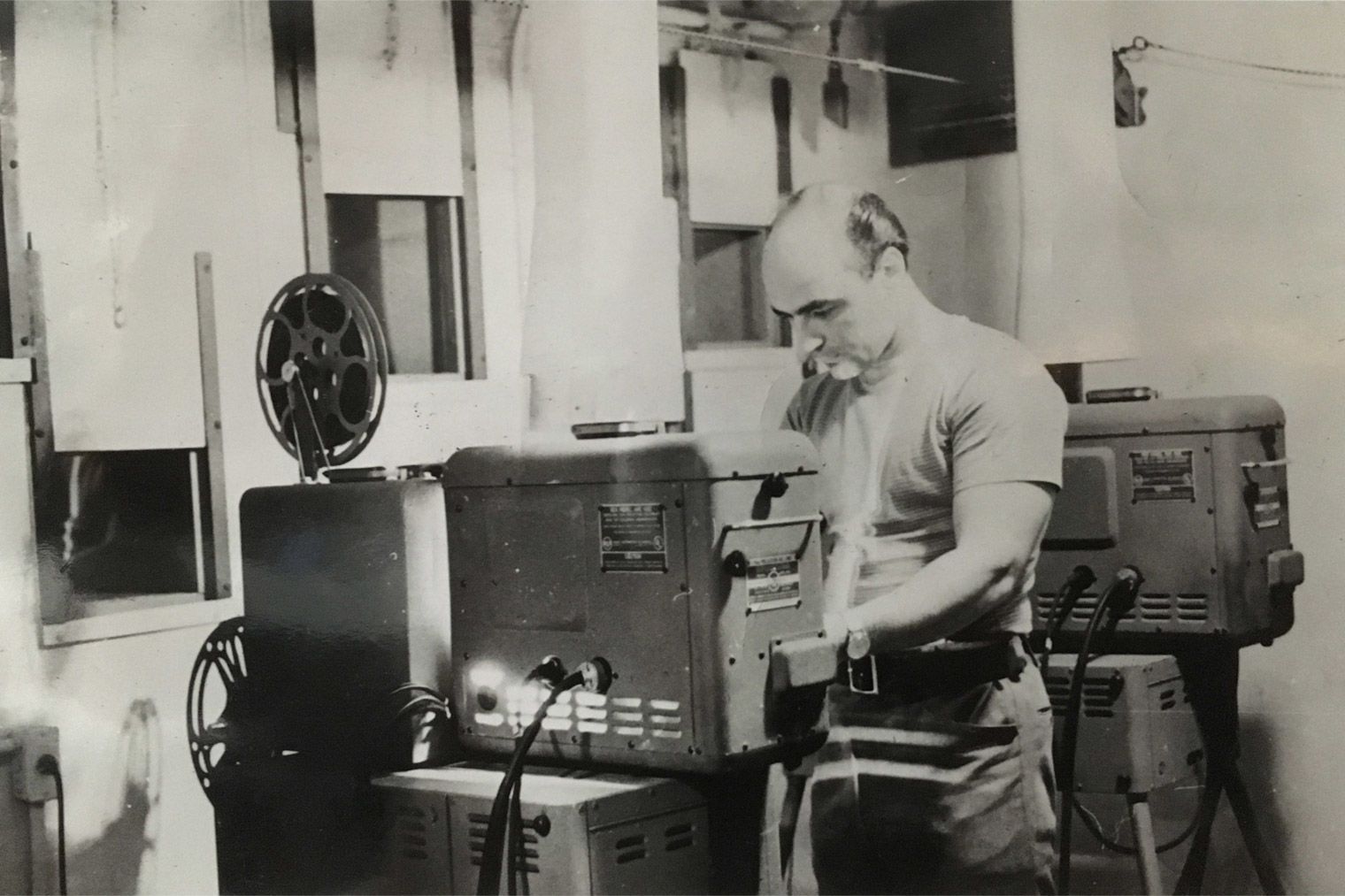
The archival photograph above catches Ray Cusie trimming the carbon arc of an RCA Porto-Arc 400 16-millimeter projector in The Met's Junior Museum auditorium booth, sometime from the 1960s to the early 1970s.[7] His hands are inside the work the audience experiences only as brightness. The machine is not a sleek object on a plinth but a working assembly of reel arms, housings, vents, cables, controls, and consumable light. The image turns “projection technology” back into an action performed by a person.
Carbon-arc work intensified that dependence on attention. Lam Chun remembered large public screenings staffed by five or six projectionists and booths so hot that operators worked drenched in sweat.[3] That staffing level should not be treated as universal; theater size, equipment, period, and local practice varied enormously. What his account establishes is the upper end of presentation as coordinated labor. A big screen did not merely demand a brighter specification. It could demand more heat management, more hands, and a division of duties inside the room the audience was trained to ignore.
Even after carbon arc ceased to be the norm, archival projection standards preserved the same idea of active custody. The Library of Congress's film-projection guidelines call for a qualified projectionist to remain in the booth, specify a target screen brightness of 16 foot-lamberts at the center, and require checks of alignment, film tension, rollers, loop size, focus, gate cleanliness, and take-up equipment.[5] Those instructions make presentation sound less like pressing play than maintaining a chain of tolerances.
The chain matters artistically. A lens appropriate to the wrong aperture can crop a composition. Poor focus can soften a face that the cinematographer rendered sharply. Excessive tension or a dirty gate can damage the very print being shown. Incorrect lamp alignment can make the corners feel starved of light. None of those failures changes the title on the marquee, yet each changes the movie the room actually receives.
Xenon changed the labor along with the light
FIAF's technical glossary describes carbon arc as the standard intense projector light until the late 1960s and xenon arc as the high-pressure gas source commonly used after carbon's phaseout.[6] In the United States, the George Eastman Museum dates xenon's introduction to 1963 and its ubiquity to the 1970s, while emphasizing its longer life and freedom from constant rod supervision.[9] The transition was not a single global date, and xenon did not abolish projection craft. It did, however, remove the paired carbon electrodes from the center of every show. Light no longer depended on continually advancing two rods toward a vanishing gap.
That distinction opened the way for a different theater workflow. Longer-burning lamps could support long-play film systems, including platters on which a feature's reels were joined into one continuous roll. Reel-to-reel changeovers persisted in archives, repertory houses, and venues committed to traditional presentation, but the mainstream booth could be organized around fewer interventions and, eventually, fewer workers. The replacement of a light source was also a reallocation of attention.
The change was not a pure march from error to perfection. Platters removed visible reel changes but required heads and tails to be cut from individual reels, added film-contact points, and concentrated an entire feature on one transport path. The Library of Congress guidelines therefore advise against using a platter for rare archive and studio prints unless the lender specifically agrees.[5] One system reduces a class of live handoffs; another preserves reel structure and limits the consequences of a single threading failure. “Automation” names a trade, not the disappearance of risk.
Carbon arc also did not become meaningless when it became obsolete. At Bologna's Il Cinema Ritrovato, specialist screenings have used carbon-arc projection for silent films, making the historical light source part of the encounter rather than a backstage curiosity.[8] The value is not nostalgia for sweat or danger. It is the chance to understand that a medium includes the conditions under which its images become visible.
A perfect show concealed its maker
Carbon-arc projection complicates the idea of a definitive film image. The print was fixed, but every screening still had variables: arc position, brightness, focus, framing, reel timing, sound level, dust, wear, and the judgment of the person responsible for them. Variation did not mean that projectionists were casually rewriting films. It meant fidelity was an achievement renewed in time.
That achievement had a peculiar aesthetic: invisibility. The operator succeeded when the cue dots barely registered, the changeover vanished inside a cut or movement, the corners stayed bright, the soundtrack held steady, and the audience forgot there were two machines and a consuming electrical arc behind its heads. The booth produced presence by hiding its own activity.
Digital cinema has made that concealment even easier. A server and projector can deliver a feature without carbon rods, shipping reels, punched cues, or a handoff between paired machines. But carbon arc leaves a useful correction to the story technology tells about itself. Movies have never reached audiences through images alone. They arrive through standards, rooms, maintenance, heat, timing, and labor. For decades, the beam crossed the auditorium only because someone behind the wall kept feeding light into it.
Sources
- The Projection Project, University of Warwick, “Using the Projectors” — carbon-electrode layout, manual rod adjustment, later automatic feeds, and the continuous attention required by a reconstructed 1912 projection box.
- Science Museum Group, “W. Butcher Carbon Arc Lamp” — Kodak collection record describing the lamp's two 6-millimeter carbons, spring-loaded mounts, ceramic block, and helical-screw carriage.
- Winnie Fu, “Take Two for Old Projector,” Hong Kong Film Archive Newsletter 44, May 2008, pp. 15–16 — Lam Chun's account of Queen's Theatre's carbon-arc projector, electrical load, heat, cooling, reel rhythm, two-projector setup, staffing, and booth conditions.
- Giovanna Fossati, From Grain to Pixel: The Archival Life of Film in Transition, 3rd rev. ed., Amsterdam University Press, 2018 — open-access study discussing projection prints, punched cue dots, repeated exhibition, and the material traces that projection leaves on film.
- Library of Congress National Film Preservation Board, “Film Projection Guidelines” (August 1994) — qualified booth supervision, target screen brightness, equipment alignment, film tension and handling, and the preservation tradeoffs of platter projection.
- International Federation of Film Archives, “Glossary of Technical Terms” — definitions and historical boundary for carbon-arc and xenon-arc projector lamps.
- Robin Schwalb, “A View from the Projection Booth,” The Metropolitan Museum of Art, March 2, 2020 — institutional history and source page for the archival photograph of Ray Cusie trimming the carbon arc of an RCA Porto-Arc 400 projector used as this article's cover.
- Rebecca Hill, “Il Cinema Ritrovato, Bologna 2018: A first timer’s experience,” National Science and Media Museum blog, July 9, 2018 — first-person festival report describing a specialist carbon-arc screening at Piazzetta Pasolini.
- Kelsey Eckert, “Carbon Arc Film Projection and Technicolor,” George Eastman Museum, February 7, 2017 — carbon-arc physics, constant rod-gap adjustment, color-temperature variation, and xenon's longer-lasting replacement of projectionist-tended carbons.