Jules Dassin's Night and the City is not only a film about a hustler who chooses the wrong scheme. It is a film about a man whose idea of movement has gone bad. Harry Fabian runs through London as if speed itself were a business plan: down club stairways, through Soho streets, into wrestling rooms, across bridges of favor and debt, toward anyone who might mistake his velocity for promise. The tragedy is that the city has better geometry than he does. It lets him run, but it does not let him escape.[1][2]
That distinction is what gives the 1950 film its lasting force. BFI's basic record places the production between the United States and the United Kingdom, directed by Dassin, written by Jo Eisinger, and starring Richard Widmark, Gene Tierney, and Googie Withers.[1] TCM's production account adds the pressure underneath those credits: Dassin was directing in London as the Hollywood blacklist closed in, with Darryl F. Zanuck sending him abroad just as political danger was becoming professionally fatal.[2] The movie's plot can be summarized as a racket story, but the feeling is larger and more bodily. Harry's every new opening becomes another enclosed passage.
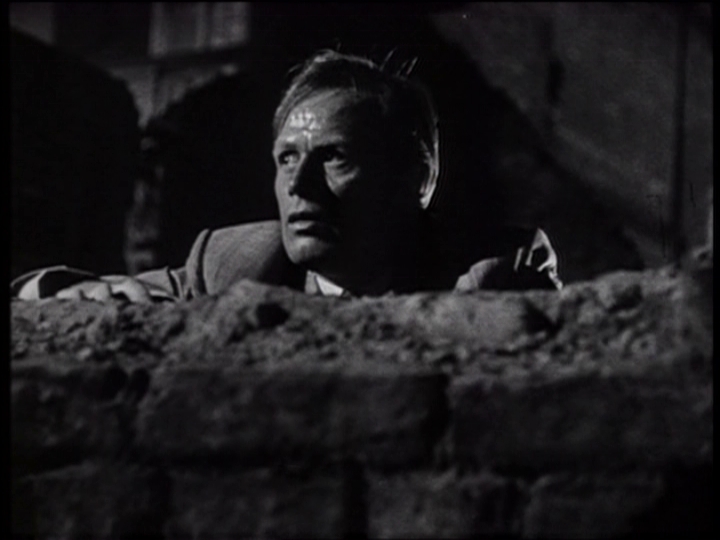
That is why the lead image matters. The still is a trailer screenshot of Widmark as Harry Fabian, not a poster abstraction or a later homage.[5] It catches the character in the register the film keeps returning to: wired, exposed, and already too far into the performance to admit that performance is failing. Harry is not a mastermind. He is a man addicted to the sensation of almost having a door open.
London Becomes A Labyrinth Because Harry Treats It As A Shortcut
The cleanest way to read Night and the City is through Harry's misunderstanding of London. He thinks he knows the city because he knows routes: who can be flattered, which club owner can be squeezed, where a wrestler can be found, which alley or phone call might buy one more hour. Adam Scovell's BFI location essay is useful here because it shows how much real London Dassin used: St Martin's Lane, Great Windmill Street, Trafalgar Square, Dean Street, and Hammersmith Bridge all become part of the film's noir map.[3]
Location realism, however, does not make the film comfortable. It makes the trap more convincing. Harry's London is not a city of stable neighborhoods but a network of opportunities that keep changing their moral price. St Martin's Lane can look like business; Great Windmill Street can look like launch; Trafalgar Square can look like public legitimacy; Hammersmith Bridge can look like a last route out. Each place promises transition. Each place ultimately narrows him.
Paul Arthur's Criterion essay names the governing structure directly: the urban labyrinth.[4] That term matters because the movie is not satisfied with a generic "dark city" mood. It keeps building frames inside frames: club doors, office cages, stairways, bridges, rings, alleys, riverside edges, and construction voids. Harry is rarely simply in London. He is inside some smaller piece of London that has learned how to close around him.
The Hustle Fails Because It Needs Everyone Else To Misread Him
Harry's ambition depends on a dangerous social fantasy. He believes other people are surfaces he can rearrange: Mary as a source of money and forgiveness, Helen as an investor in escape, Phil Nosseross as a mark, Gregorius as moral cover, Kristo as a force that can be outmaneuvered. TCM's plot summary makes the chain clear enough: Harry's wrestling scheme depends on borrowing prestige from Gregorius while bypassing the more brutal business of Kristo's wrestling empire.[2]
The scheme collapses because it asks everyone to stay inside Harry's preferred version of them. Gregorius must remain noble but useful. Helen must remain desperate but trusting. Phil must remain contemptuous but not active. Kristo must remain angry but containable. Mary must remain hurt but available. The movie's cruelty comes from showing that these people are not props in Harry's improvisation. They have their own leverage, fear, vanity, and exhaustion.[2][4]
That is why the wrestling material is more than colorful underworld business. The ring gives the whole film a grammar of forced visibility. A wrestling promotion sells control, rules, and spectacle, yet the violence underneath is always threatening to become real. Harry wants the clean profit of showmanship without the accountability of bodies. When the old and new wrestling worlds collide, the film makes his fantasy physical. A racket is not only an idea. It is a room where someone can be crushed.
Dassin Makes Motion Feel Like Panic Rather Than Freedom
The film's noir style is unusually kinetic, but it is not liberating. Arthur contrasts Night and the City with Dassin's earlier The Naked City, noting that this later film trades the earlier methodical urban organization for overheated lighting, odd angles, and claustrophobic compositions.[4] That is exactly how Harry experiences his own life. He keeps moving faster while the frame feels tighter.
TCM's production history makes the climax especially concrete: Dassin and cinematographer Max Greene staged the frantic final chase around limited morning light, using multiple cameras rather than stretching the sequence over several days.[2] The practical decision shows up in the movie's nerves. The climax does not feel polished into ordinary suspense. It feels like a city briefly caught at the moment when night has nearly finished its work but daylight has not yet made anything merciful.
Hammersmith Bridge is the right ending point because it turns the labyrinth horizontal. Scovell's BFI location comparison notes how much of the finale gathers around the Thames and the bridge, including Harry's refuge near the river and the final movement along the bridge after tragedy has done its work.[3] The river should imply passage, but in Night and the City it becomes a boundary. Harry can reach the edge of the city, but not a future beyond it.
The Blacklist Context Makes The Trap Sharper, Not Smaller
It would be too easy to reduce the film to disguised autobiography: Dassin under pressure, Harry under pressure, Hollywood as betrayal, London as exile. The connection is real but should not be made too neat. TCM records Dassin's blacklisting during the production aftermath and his inability to supervise later studio stages in the usual way.[2] Criterion's essay also reads Harry's predicament as partly resonant with Dassin's own forced movement away from Hollywood.[4]
The stronger point is formal. A blacklist story is a story about routes closing: jobs disappear, rooms become unsafe, names become liabilities, and old colleagues may no longer be usable contacts. Night and the City turns that social condition into space. Harry's London is full of professional doors that open only long enough to reveal another debt. He is not persecuted for politics inside the plot, but he lives in a world where every affiliation can become evidence and every connection can reverse direction.
That is why the film's bitterness still feels modern. It understands ambition as a network problem. Harry does not merely want money. He wants the city to confirm that he belongs among men who can make things happen. Instead, the city audits him. Every shortcut exposes a dependency; every dependency produces a witness; every witness becomes a risk. The film's darkness is not only moral. It is infrastructural.
Why Harry Fabian Still Hurts To Watch
Harry is not sympathetic in the simple sense. He lies, exploits, manipulates, and repeatedly mistakes Mary for a reserve fund of patience. Yet the performance is difficult to dismiss because Widmark makes the hustle look like a form of terror. Harry's grin often arrives too soon; his confidence burns too hot; his body seems to be running a few seconds ahead of the reality that will catch him. The trailer screenshot used here freezes that tension in one face.[5]
That is the film's bleakest insight. Harry does not fail because he lacks energy. He fails because energy without judgment becomes another form of enclosure. The more intensely he runs, the more completely the city can define him as prey. By the end, his quickness has stopped looking like adaptability and started looking like the reflex of someone who has never learned how to stand still long enough to understand the room.
Night and the City lasts because it makes that failure architectural. Clubs, offices, rings, alleys, construction sites, bridges, and the Thames do not decorate Harry Fabian's downfall. They build it. Dassin's London is a working maze, and Harry's special curse is that he thinks he is navigating it long after it has begun navigating him.[1][2][3][4]
Sources
- BFI, "Night and the City (1950)" - film page with production country, director, writer, producer, and principal cast.
- David Sterritt, "Night and the City (1950)," Turner Classic Movies - production history, blacklist context, plot summary, locations, climax, and credits.
- Adam Scovell, "Night and the City: 5 locations from the classic London noir," BFI - location analysis of St Martin's Lane, Great Windmill Street, Trafalgar Square, Dean Street, and Hammersmith Bridge.
- Paul Arthur, "Night and the City: In the Labyrinth," The Criterion Collection - essay on noir darkness, Dassin's blacklist-era context, London as urban labyrinth, and the film's spatial design.
- Wikimedia Commons, "File:Les forbans de la nuit.jpg" - source page for the 1950 trailer screenshot of Richard Widmark used as the article image.