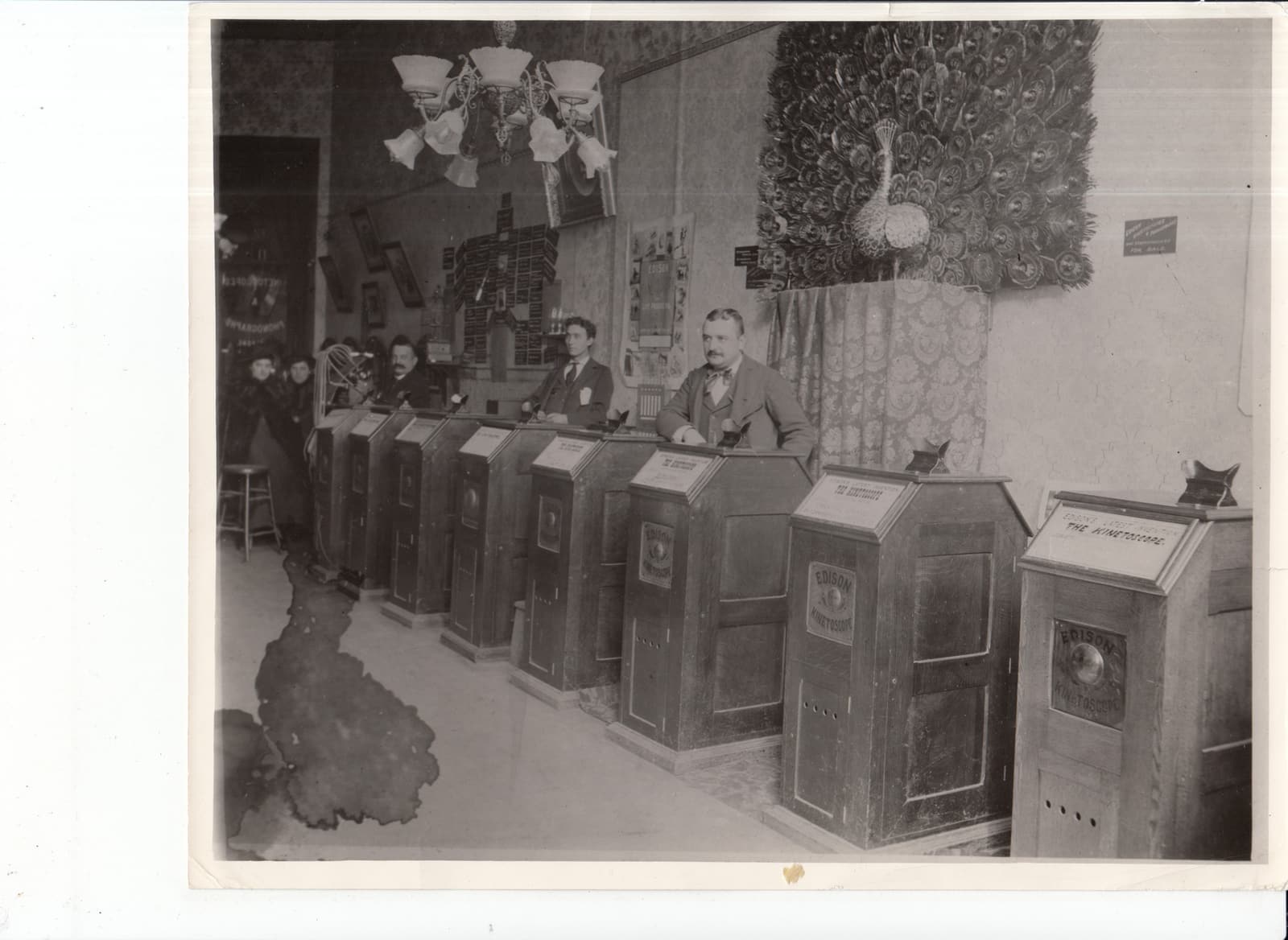
The Kinetoscope parlor is easy to misread because it looks like cinema before cinema learned its proper shape. A row of wooden cabinets, one viewer at a time, short films hidden inside machines: compared with the darkened theater, it can seem like a charming false start. That is the wrong lesson. The Kinetoscope mattered because it made moving pictures commercial before the movie theater became obvious. It turned film into a cabinet business: repeatable hardware, replaceable subjects, ticketed access, attendants, urban storefronts, and a stream of curious customers bending over peepholes.[1][2]
That makes it a technology story, not merely an invention story. The essential object was not just the camera or the viewer. It was the whole circuit from Edison laboratory work to Black Maria production, from Kinetograph negatives to short subjects, from machine sales to local exhibitors, and from a visitor's coin to a few seconds of private spectacle. Projection later won the social imagination. But the Kinetoscope parlor solved an earlier industrial question: how do moving pictures become a commodity before anyone has trained the public to sit together for them?
The answer was a machine that made novelty feel orderly. Inside the cabinet, film moved past a light source and shutter; outside the cabinet, the customer encountered a durable wooden object that looked more like an arcade instrument than a theater. The result was strange and practical. Motion pictures did not yet need a screen, a booth, a feature-length program, or a disciplined audience. They needed enough machines in a room to convert curiosity into throughput.
The cabinet made film retailable
The Edison Foundation's Black Maria exhibit gives the basic production chain: films were made with the Kinetograph camera at a purpose-built West Orange studio, then prepared for exhibition in Kinetoscope parlors where individual viewers paid to watch through cabinets.[1] That pairing matters because early cinema was not born as a single device. It was born as a production-exhibition system. A camera could make strips that a viewer could consume, and a viewer created demand for more strips.
Film Atlas makes the system more concrete. Edison drew up preliminary designs after meeting Eadweard Muybridge in 1888; W. K. L. Dickson developed both the Kinetograph and the viewer; a redesigned Kinetoscope was demonstrated at the Brooklyn Institute of Arts and Sciences on May 9, 1893.[2] The finished viewer became a standing cabinet: the spectator looked down through a peephole while film passed inside. This was not yet cinema as public architecture. It was cinema as controlled access.
The patent language shows why the cabinet should not be dismissed as a gimmick. Edison's kinetographic-camera patent describes a tape-like photographic film carrying successive images in single-line sequence, with intermittent movement and exposures fast enough to support motion reproduction.[5] The later parlor may have looked like a sideshow room, but it depended on a serious standardization problem: film had to be regular enough, durable enough, and mechanically guided enough that many short views could be produced, sold, and replayed in machines.
That standardization was the first business advantage. Projection required a roomful of people to share one image. The Kinetoscope required many images to be packaged as separate experiences. A parlor could line up cabinets, each holding a different attraction, and let customers move from one to another. The machine made the program modular before cinema had reels, showtimes, and marquee hierarchy.
The parlor made the audience granular
The commercial breakthrough came in New York on April 14, 1894, when Andrew and George Holland opened a ten-machine parlor at 1155 Broadway.[2] That configuration is more than a floor plan. It reveals the operating logic. A patron was not buying a seat for a shared show. The patron was buying a sequence of individual encounters with machines.
The first subjects also fit the cabinet economy. The Edison Foundation exhibit describes early films built around vaudeville performers, athletes, dancers, comedians, novelty acts, prizefights, acrobatics, and celebrity appearances; Film Atlas notes that Dickson and Heise filmed around 75 subjects during 1894.[1][2] Those films did not need elaborate narrative continuity. They needed immediate legibility. A viewer bent over the machine and saw a body, a trick, a gesture, an action, a novelty. The subject had to register quickly because the encounter itself was short.
This is where the Kinetoscope parlor starts to look less primitive. It understood attention as a series of paid glances. Each cabinet isolated the viewer, but the room multiplied viewing opportunities. The business model did not ask strangers to synchronize their reactions. It let traffic flow machine by machine. In modern terms, the parlor separated inventory from gathering: the films were stored as discrete attractions, and the crowd became a queue of individual users.
That individualization shaped taste. The early Edison catalog leaned toward visible performance because a body doing something could sell itself through a peephole. A strongman flexing, a dancer turning, a blacksmith striking, a sneeze arriving: these were not stories in the later feature-film sense. They were motion proofs. They told the viewer that photography had learned to move, and that movement could be purchased in small units.
The exhibitor mattered as much as Edison
The Kinetoscope parlor also complicates the Edison-centered version of film history. Edison and his laboratory supplied crucial apparatus and production capacity, but the commercial form depended on intermediaries. Film Atlas identifies the Kinetoscope Company consortium behind marketing and public exhibition: Alfred O. Tate, Norman C. Raff, Frank R. Gammon, and Andrew Holland among them.[2]
The Thomas Edison Papers' Raff & Gammon reel notes preserve that sales layer in document form: instructions for setting up and operating the Edison Kinetoscope in 1894, bulletins from late 1894 and early 1895, and a later film price list.[3] Those are dry records, but they point to the part of cinema history that can disappear behind inventors' names. A medium becomes an industry when it has setup instructions, sales agents, film lists, maintenance expectations, and customers beyond the laboratory.
Peter Bacigalupi's San Francisco arcade photograph makes that point visually. The National Park Service identifies the image as Bacigalupi's kinetoscope, phonograph, and gramophone arcade, created in 1895 and associated with Thomas Edison National Historical Park.[6] The room is not a neutral laboratory. It is theatrical retail. Cabinets line the floor. Attendants are present. Other sound-machine culture sits nearby. A taxidermied peacock presides from above like a store display turned into a joke about spectacle. The image shows an exhibitor packaging technology as an outing.
That packaging mattered because moving pictures had to borrow respectability and excitement from surrounding entertainment habits. The Kinetoscope could sit near phonographs, gramophones, curiosities, and arcade display. It did not yet need to defeat vaudeville or theater. It could live among them as another device for selling sensation.
Projection won by changing the social unit
The Kinetoscope's weakness is also its historical value. Film Atlas puts the decline inside the projection turn: as 1895 progressed, the small-scale peepshow experience lost novelty, running costs pressed exhibitors, and projected systems such as the Eidoloscope and then the Vitascope reorganized public film exhibition.[2] The cabinet had made film retailable, but projection made film social at scale.
That change was not only technical. It changed the unit of value. A Kinetoscope cabinet monetized individual looking. A projected show monetized collective attendance. Once an exhibitor could throw a large moving image onto a screen, the economics of one machine per viewer began to look cramped. The theater could sell many seats to one apparatus. It could also create a different emotional environment: shared laughter, shared astonishment, shared silence, and later the discipline of narrative attention.
The Who's Who of Victorian Cinema machine catalogue helps keep the hardware boundary clear. It describes the Kinetoscope as an electrically driven peepshow machine for films produced with the Kinetograph camera, and identifies Bacigalupi's San Francisco Kinetoscope parlour as a 1894 or 1895 example.[4] The word "peepshow" can sound diminishing, but it is technically clarifying. The Kinetoscope was not a failed projector. It was a successful viewer whose social form was overtaken by a stronger exhibition model.
That distinction changes how we read early film technology. The parlor did not fail because it misunderstood motion pictures. It succeeded in proving that motion pictures could sell, then lost because another interface made the same commodity more efficient and more dramatic. Projection did not simply improve the image; it reorganized the public around the image.
The cabinet still explains cinema's first business lesson
The Kinetoscope parlor's afterlife is therefore larger than nostalgia. It shows that cinema's first commercial problem was not "how to tell a feature story." It was "how to turn recorded motion into a repeatable paid encounter." The answer, briefly, was a room full of cabinets.
That answer left traces. Film as a business still depends on the relation among apparatus, content supply, distribution rights, user traffic, and the place where attention is sold. The objects have changed: theater projectors, television sets, videocassettes, multiplex screens, DVDs, streaming apps, phones. But the Kinetoscope parlor already contains the basic industrial grammar. Make a reproducible moving image. Package it in a device. Put it where customers are willing to spend attention. Refresh the program before novelty runs out.
The cabinet era was short because it sat at a hinge. It belonged to arcade culture, phonograph culture, laboratory demonstration, vaudeville attraction, and future cinema at once. That hybridity is exactly why it matters. The Kinetoscope parlor was not yet the movies as the twentieth century would know them. It was the moment when moving pictures first learned to behave like a business.
Sources
- Edison Innovation Foundation, "Black Maria Virtual Museum" - institutional exhibit on the Black Maria, Kinetograph production, Kinetoscope parlor exhibition, early subjects, distribution, and advertising.
- Film Atlas, "Edison Kinetoscope (1891-c.1900)" - technical and historical entry covering 35mm film, Dickson and Heise, 1893 demonstration, 1894 production, the Holland parlor, international spread, and projection-era decline.
- Thomas A. Edison Papers at Rutgers, "Raff & Gammon" - reel-note index for Kinetoscope Company operating directions, bulletins, Vitascope material, and film price-list documents.
- Who's Who of Victorian Cinema, "Machines" - illustrated machine catalogue identifying the Kinetograph, Kinetoscope, Kinetophone, and Peter Bacigalupi's San Francisco Kinetoscope parlour.
- Google Patents, "US589168A - Kinetographic camera" - patent text for Edison's kinetographic camera, including tape-film, intermittent motion, and single-line image-sequence claims.
- National Park Service NPGallery, "Peter Bacigalupi's kinetoscope, phonograph, and gramophone arcade" - archival photographic source for the article image, dated 1895 and held by Thomas Edison National Historical Park.