Digital intermediate is one of those movie technologies whose name sounds smaller than its consequence. It can be mistaken for a file format, a color-correction session, or a dull bridge between film and digital delivery. The better way to read it is as a change in movie architecture. Once a photographed negative could be scanned at high resolution, manipulated as data, and recorded back to film, color stopped being only a lab adjustment at the end of production. It became a programmable layer across the whole finishing chain.[1][2][3]
That shift did not make cinema instantly digital. It did something more interesting. It let film remain film while moving a large part of its final authorship into digital space. The negative still mattered. The print still mattered. But between them appeared a new room: scanner, storage, grading system, visual-effects integration, calibration, recorder, and intermediate stock. The movie image could now be rebuilt frame by frame without pretending that photography had become obsolete.
The old chain had limited handles
Photochemical color timing was powerful, but it was blunt compared with what later became normal. A timer could adjust printer lights, shift density and color balance, and work with lab processes, but the control was global in a way that made selective intervention difficult. If a landscape was too green, a face too cool, and a sky too dense, those issues were tied together inside the same strip of film. The lab could finesse, but it could not casually isolate a patch of grass from a skin tone from a cloud bank.
The digital intermediate changed the handle set. A scan converted film frames into high-resolution data. A colorist and cinematographer could then work inside a digital image, changing hues, density, contrast, saturation, windows, secondary corrections, visual-effects elements, and later deliverables before recording the finished result back to an intermediate film element or other master.[2][3][4] The key was not that the image became artificial. Film images had always been constructed through stock, exposure, processing, filters, printing, and projection. The key was that construction became more precise, repeatable, and integrated.
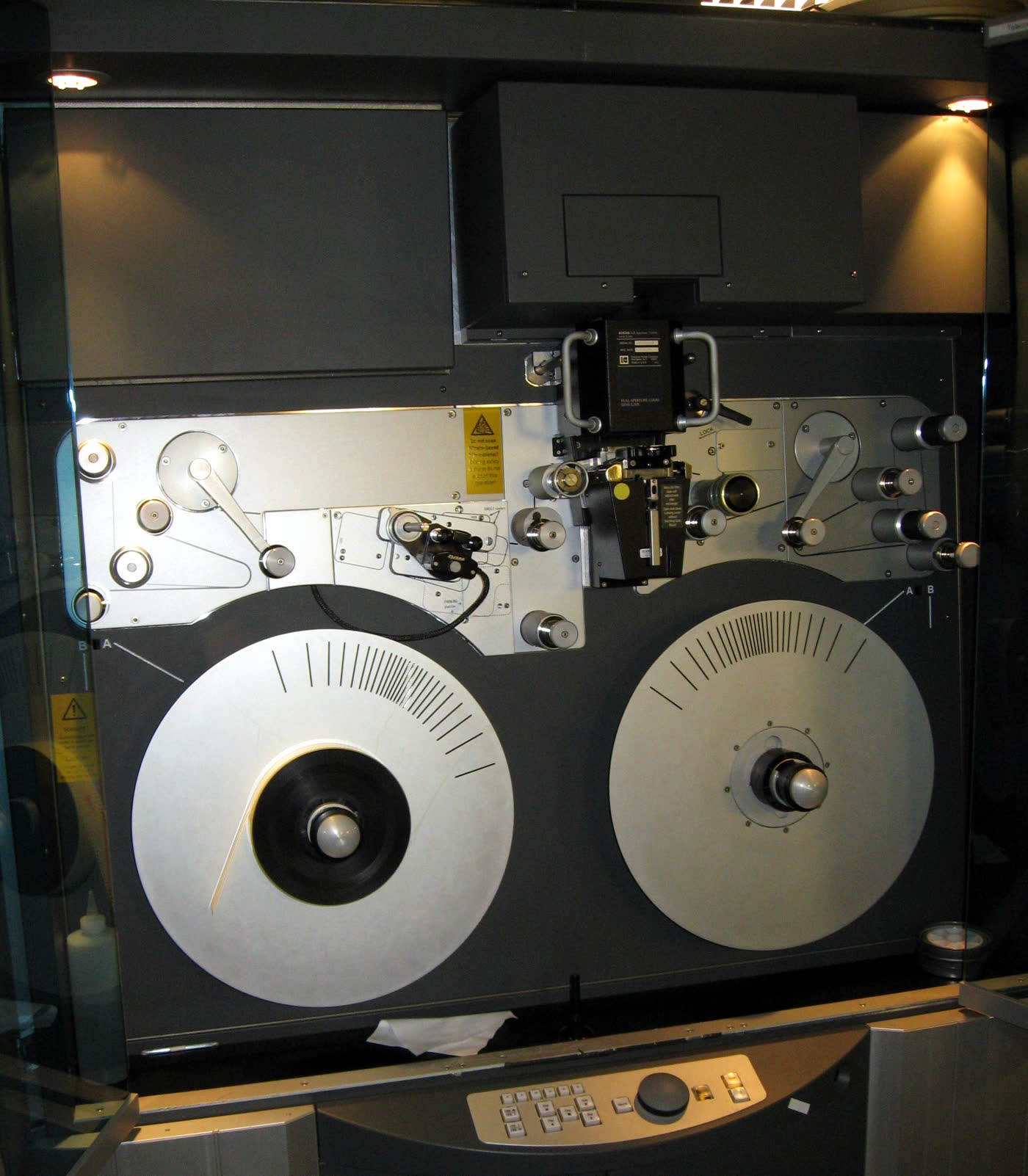
The DFT Spirit 4K data sheet describes the industrial logic clearly. In a digital intermediate workflow, the original camera negative could be scanned once, then processed through a high-resolution digital clone for output at the required resolution.[2] That line matters because it shows the workflow's promise: protect the negative, do the finishing work in data, then return to film or distribution masters with fewer compromises. The scanner was not just a transfer device. It was the gate into a new finishing system.
O Brother, Where Art Thou? made the tool legible
The breakthrough case remains Joel and Ethan Coen's O Brother, Where Art Thou? Roger Deakins and the Coens wanted a dusty, faded, Depression-era look that would suppress the lush greens of Mississippi without turning the whole movie into simple sepia. The American Society of Cinematographers account explains the practical finish: Cinesite recorded the digital files onto 35mm Eastman EXR color intermediate film using a Kodak Lightning laser film recorder, after which Deluxe processed the film and made a work print.[1]
That detail is easy to skip, but it is the whole story in miniature. The film was not "digital" in the casual modern sense. It was photographed on film, scanned, graded digitally, recorded back to film, processed, and printed. The aesthetic breakthrough came from the chain, not from one box. A look that would have been punishing or unstable through purely photochemical tests became achievable because every frame could be worked as image data and then returned to the theatrical film economy.[1][4]
Jonny Elwyn's color-grading overview is useful because it treats O Brother less as trivia than as a production threshold: a full feature digital intermediate whose behind-the-scenes value lies in seeing the photochemical and digital parts of the process side by side.[4] That is the important cultural turn. Digital finishing stopped looking like a genre effect and started looking like a cinematographic option.
The lesson was not "make every movie yellow." The lesson was that a movie's color world could be designed as a coherent system after photography, with the cinematographer still deeply involved. In that sense, DI did not reduce cinematography. It extended the cinematographer's argument deeper into postproduction.
The scanner and recorder made the promise expensive
Digital intermediate sounded like freedom, but it was never just software freedom. It was capital equipment, storage, calibration, trained operators, and lab coordination. A scanner had to move film safely and extract enough detail and density range to justify the process. A grading suite had to display images in a way that would predict the intended print or master. A recorder had to put the finished data back onto film with enough fidelity that the whole trip through digital space did not become a loss-making detour.
The Spirit 4K data sheet shows how specialized that infrastructure became: 2K real-time scanning, native 4K scanning at slower speeds, 16-bit signal handling, DPX file output, Infiniband data paths, film-gate options, printer-light style controls, and features meant to reduce transfer errors in DI work.[2] Those are not decorative specs. They reveal the pressure points. Resolution, dynamic range, color precision, transport stability, and data movement all had to be good enough for cinema finishing, not merely for video viewing.
Kodak's technical backgrounder on VISION3 Color Digital Intermediate Film 5254/2254 reveals the other side of the loop. Kodak describes the stock as optimized for contemporary film recorders, intended to preserve the nuances of digitally manipulated color, contrast, and image character after film-out.[3] In other words, the film industry did not abandon chemistry when DI arrived. It redesigned chemistry to accept digital authorship. Even the stock was being tuned to the scan-grade-record chain.
That is why the transition matters historically. The digital intermediate was not a clean break from film. It was a hybrid infrastructure built because production, exhibition, and archival habits did not all change at the same speed. Movies could be finished digitally while still circulating through film prints, and the workflow had to honor both sides of that reality.
Color became part of continuity, not decoration
The most visible DI effect was color, but the deeper effect was continuity. Once the full feature could pass through a digital intermediate, color decisions could travel consistently across reels, effects shots, opticals, titles, restorations, previews, and later home-video or digital-cinema versions. The image no longer had to be split between a photochemical main body and special digital islands that risked looking pasted in.
That mattered especially for visual effects. A digital intermediate let effects shots, non-effects shots, and color design meet in the same finishing environment. It also changed how filmmakers could think about weather, season, day-for-night, period texture, skin, costume, and production design. Instead of treating the grade as a rescue operation, productions could plan for it. A green location could be chosen because the final look would redirect it. A muted palette could be built through costume and art direction, then unified later. A restoration could scan an old negative and use digital tools to stabilize or rebalance images before film-out or digital release.[2][3]
The danger was obvious from the beginning: more control can mean less judgment. A bad grade can flatten faces, crush shadow, sterilize grain, or impose a fashionable wash on material that needed a subtler finish. DI made color more available, but availability is not taste. The best use of the tool still depends on a clear photographic idea before the image reaches the grading room.
That is why O Brother remains such a useful example. Its grade is strong, but it is not arbitrary. The color logic serves a world of dust, folk tale, heat, distance, and comic myth. The process matters because the look and the story answer each other.[1][4] DI at its best is not a filter placed on top of a movie. It is a finishing architecture that lets the movie's image system become legible.
The afterlife is everywhere and easy to miss
The digital intermediate won so completely that it became hard to see. Modern viewers expect theatrical releases, restorations, streaming masters, and disc editions to have precise color continuity. They expect older films to be scanned, cleaned, graded, and reissued. They expect new films shot on film to pass through digital postproduction. They expect digitally photographed films to be finished in grading systems whose logic descends from the same promise: the final image is authored in a calibrated postproduction environment, not merely delivered from the camera.
That expectation can obscure the original oddity. Around 2000, the digital intermediate was a costly, risky, high-end bridge. It asked filmmakers to trust that a photographed negative could become data and return with its cinematic identity intact. It asked labs and post houses to coordinate machines that had previously belonged to different worlds. It asked cinematographers to treat postproduction color as a primary creative space.
The technology's importance is therefore not that it made film "less real." It made the final movie image more explicitly constructed. The old chain had construction too, but much of it lived inside lab craft and stock behavior. DI made that construction programmable, visible, and repeatable. It turned color from a finishing correction into an image architecture, and then made that architecture normal.
Sources
- American Society of Cinematographers, "Inside the Cinematography of O Brother, Where Art Thou?" - account of Roger Deakins's digital intermediate workflow, Cinesite, Kodak Lightning recording, and film-out process.
- DFT Digital Film Technology, "Spirit 4K High-Performance Film Scanner with Bones and DataCine" data sheet - scanner capabilities, DI workflow description, DPX output, 2K/4K scanning, and signal path details.
- Kodak, "Kodak Scientists Discuss Why and How the New Intermediate Film Was Developed" - technical backgrounder on VISION3 Color Digital Intermediate Film 5254/2254 and film-out requirements.
- Jonny Elwyn, "The First Full Feature Digital Intermediate" - color-grading overview and behind-the-scenes reference for O Brother, Where Art Thou? as a full feature DI case.
- Wikimedia Commons, "File:Spirit Datacine 4k doors open.jpg" - source page for the real scanner photograph used as this article's image.