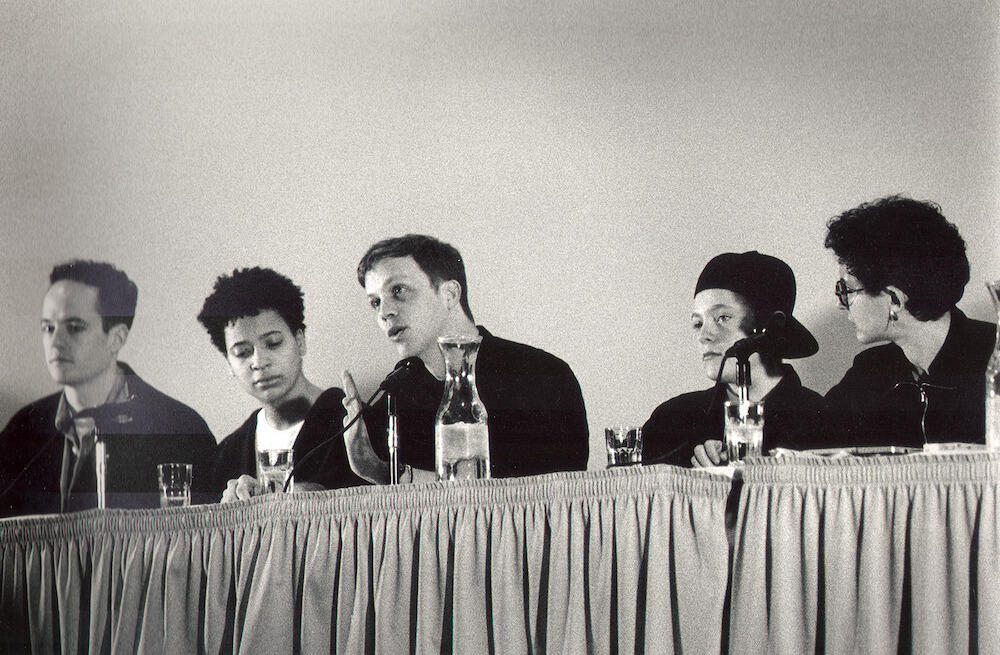
The photograph above does not look like the unveiling of a school. Five people sit behind a pleated conference table, each caught in a different posture: listening, speaking, looking aside. There is no common uniform, set, or manifesto—only microphones, water glasses, and the provisional architecture of a festival panel.
The occasion was “Barbed-Wire Kisses,” a discussion hosted by critic B. Ruby Rich at the 1992 Sundance Film Festival. The wider gathering included filmmakers and writers such as Gregg Araki, Sadie Benning, Todd Haynes, Isaac Julien, Derek Jarman, Tom Kalin, Jennie Livingston, and Lisa Kennedy.[2] They had not arrived as members of an organized wave. They were working in different cities, countries, media, genres, and racial and gender positions. What made the room historic was recognition: films that had seemed scattered could suddenly be seen exerting pressure together.
Rich gave that pressure its durable name, New Queer Cinema. The phrase is often treated as if it describes a visual style—grainy independence, punk attitude, explicit sex, perhaps a taste for fractured narrative. But the films refuse to line up so neatly. Rich's original dispatch moves among road movies, period films, experimental video, documentary, melodrama, appropriation, and camp.[1] A later BFI guide makes the problem explicit: the filmmakers did not share one aesthetic vocabulary, strategy, or concern.[3] They did have family resemblances. Rich identified appropriation, pastiche, irony, and the rewriting of socially constructed histories as recurrent tactics.[1] A repertoire of ways to challenge cinema is not the same thing as a house style.
That absence of uniformity was not a weakness in the category. It was its central fact. New Queer Cinema functioned as a provisional coalition formed by urgency, circulation, and a shared refusal to make queerness safe for inherited forms. Its unity was not a look. It was an action performed on cinema.
The name arrived after the encounter
By the time the phrase stuck in 1992, much of the work already existed. Jarman's Edward II, Haynes's Poison, Julien's Looking for Langston, Livingston's Paris Is Burning, Marlon Riggs's Tongues Untied, and Araki's The Living End had been made or were moving through festivals. Rich first registered the surge across Toronto, Amsterdam, Park City, Berlin, London, and New York rather than inside one production company or national industry.[1]
This sequence matters. A manifesto usually announces principles that films then attempt to realize. New Queer Cinema worked in reverse: films collided in public, and criticism made their simultaneity legible. The name described an encounter before it described a shelf.
It also named a historical pressure greater than cinema. The AIDS epidemic had entered a second devastating decade. Twelve years of Reagan and Bush administrations had intensified the sense of political siege in the United States, while art funding became a target in the culture wars. Small-format video widened access to production and distribution; AIDS organizing forged new alliances; queer film festivals gave exhausted communities places to gather, argue, and see themselves as an audience.[2][4][5]
None of those conditions mechanically caused an aesthetic. They changed what a film could be for. A work might be testimony, counter-history, erotic address, memorial, provocation, or communal signal before it was a calling card to the commercial industry. The audience was not an abstract public waiting to be persuaded that queer people deserved sympathy. Often it was the community that had supplied the film's language, labor, urgency, and first route into the world.
Genre became material to seize
If the films had a recurring maneuver, it was not rejection of genre but repossession. Familiar forms were useful because they arrived carrying rules about who could desire, whose death counted, what history looked like, and which bodies were allowed to survive an ending. New Queer Cinema took those rules personally.
The Living End borrows the outlaw-couple road movie, then gives its flight to two HIV-positive men—one furious, one disaffected—who have no interest in becoming respectable symbols. Rich saw the film's force in the way it put queer figures into a genre landscape that had long converted heterosexual fugitives into romantic legend.[1] The appropriation is not decorative pastiche. It changes what “nothing to lose” means when illness, homophobic violence, and public contempt have already narrowed the future.
Edward II performs a different temporal theft. Jarman keeps Christopher Marlowe's royal tragedy while letting contemporary queer protest enter the frame. Minimalist court ritual, modern dress, music, and OutRage activism occupy the same historical space.[1][3] Adaptation stops being the respectful delivery of a classic from past to present. The past is made to answer to people the official heritage story would rather exclude.
Haynes's Poison refuses even one genre at a time. Its three intercut stories pass through tabloid mock-documentary, 1950s science fiction, and a Jean Genet-inflected prison romance. The styles do not resolve into a neutral master voice; contagion, persecution, desire, and social disgust migrate uneasily among them.[7] The film's politics live in that formal instability. A culture obsessed with classifying bodies receives a movie that will not keep its own bodies, genres, or tones in their assigned rooms.
Riggs's Tongues Untied makes the inadequacy of a house-style definition clearest. Documentary footage, poetry, dance, music, performance, and Riggs's own on-camera disclosures build a collective Black gay address without pretending the collective has only one voice.[6] Riggs later explained that the elements did not cohere until he risked placing his own experience among them.[6] Here experimentation is not a veil over testimony. It is the structure capable of holding testimony, critique, pleasure, anger, and self-implication together.
Across these films, “queer” therefore describes more than represented sexuality. It names a relation to form. History can be re-edited. A classic can be occupied. Documentary authority can be broken into chorus. Disreputable genres can expose the respectability demanded of marginalized people. The films do not ask an existing cinematic language for admission; they demonstrate that the language was never owned by its gatekeepers.
A movement needed rooms as much as cameras
Formal audacity alone does not create a movement. Films must find one another, and audiences must find them. New Queer Cinema depended on an infrastructure that is easy to lose when its history becomes a list of directors: public grants, small distributors, critics, programmers, community festivals, museum screens, and producers willing to treat controversy as a condition rather than a veto.
The festival circuit did several jobs at once. It offered exhibition to work the mainstream would not take, turned isolated viewers into a public, and let stylistically incompatible films acquire meaning beside one another. Rich's 1992 account records both the exhilaration and the friction. At the San Francisco Gay and Lesbian Film Festival, attendance doubled from the previous year even as the National Endowment for the Arts withdrew support. In Amsterdam, filmmakers debated whether a queer circuit was a lifeline or a boundary that could become another ghetto.[1] The rooms were necessary precisely because they were contested.
The Sundance panel belongs to that infrastructure. It did not prove that everyone at the table agreed. It made disagreement visible as part of a common field.[2] A critic's label, a programmer's juxtaposition, and an audience's recognition could connect work without forcing it into aesthetic obedience.
Production alliances made some of those temporary connections durable. Poison began the long partnership between Haynes and producer Christine Vachon; their collaboration later became central to Killer Films, a company built around projects much of the industry considered difficult to finance or market.[7] That history complicates the romance of total independence. The movement did not flourish because institutions disappeared. It flourished because filmmakers and allies assembled smaller, more answerable institutions inside and against the larger system.
The coalition's blind spots were visible from the start
Any canon built from the best-distributed features risks turning New Queer Cinema into a parade of a few celebrated men. Rich's first account was already arguing with that outcome. It noted the scarcity of lesbian-made features, the marginal place assigned to video, and conflicts over race, gender, class, popularity, and experimental form.[1] At Sundance, Benning's short video Jollies opened the panel partly as a challenge to an industry that could see a feature-film boom while overlooking the formats in which many women were working.[1][2]
Black queer cinema also makes nonsense of a tidy origin story beginning at Sundance. Looking for Langston and Tongues Untied appeared in 1989, before the label, and each understood historical recovery as a present-tense struggle rather than a search for reassuring ancestors.[1][3][6] Riggs's film is at once celebration and internal critique: it confronts racism in gay life, homophobia in Black communities, and the filmmaker's own learned hierarchies of desire. Coalition here cannot mean smoothing difference. It means building a form in which difference can speak without being exiled from belonging.
Later films widened and revised what the headline moment seemed to contain. Rose Troche's Go Fish gave lesbian everyday life a scrappy romantic-comedy pulse; Cheryl Dunye's The Watermelon Woman made a video-store clerk's search for a forgotten Black actress double as a sly test of who gets documented at all.[3][4] They did not merely fill representation slots left vacant in 1992. They changed the available forms and exposed how every canon manufactures its own edges.
This is why “positive images” was never an adequate measure of the movement. Respectability can purchase visibility by making characters less troublesome to the audience with the most power. These filmmakers claimed the right to villains, desire, failure, contradiction, boredom, fantasy, and bad judgment—the full dramatic range heterosexual cinema had never been required to justify.[1][7]
The category worked best while moving
By the end of the 1990s, Rich was calling New Queer Cinema more successful as a moment than as a movement. Queer festivals had multiplied, a distribution sector had formed, and films once treated as scandal could open pathways into awards culture and niche marketing. The gain was real. So was the risk that a radical impulse would harden into a sellable demographic.[4]
There is no clean fall from insurgency to commerce. Wider circulation created careers, archives, preservation, and access. It also encouraged the industry to treat queerness as content that could be detached from the formal and political challenge of the earlier work. A market category asks whether a film contains recognizable queer subjects. The sharper legacy asks what the film does to the habits through which any subject becomes recognizable.
New Queer Cinema remains useful, then, when the term names a relation to film rather than a checklist of approved traits. It was not one generation suddenly inventing queer film; it drew on older underground, feminist, Black, gay, lesbian, activist, and avant-garde practices.[1][5] It was not one look; its films fought through incompatible forms. It was not a harmonious community; its exclusions were named in the room. And it was not merely a cluster of titles. It was a circuit in which movies, criticism, festivals, producers, and audiences made one another more powerful.
The panel photograph gets this right. The movement appears not as a logo but as a table: temporary, crowded, argumentative, and held together long enough for separate voices to become publicly audible. New Queer Cinema did not need a house style. It needed a room in which no one had to surrender difference to be seen as part of the event.
Sources
- B. Ruby Rich, “New Queer Cinema,” Sight and Sound — the foundational 1992 festival-circuit dispatch on the films, formal strategies, culture-war pressure, and internal disputes gathered under the term.
- Sundance Institute, “Nearly 30 Years Later, Filmmakers Reflect on the Birth of New Queer Cinema” (2021) — retrospective account of the 1992 “Barbed-Wire Kisses” panel, its participants and political context, and source page for Sandria Miller's archival photograph.
- Sam Moore, “Where to begin with New Queer Cinema,” British Film Institute (2020) — movement boundaries, the absence of a single aesthetic vocabulary, and representative formal approaches across major works.
- B. Ruby Rich, “Queer and present danger: after New Queer Cinema,” Sight and Sound — retrospective analysis of AIDS-era alliances, small-format video, festivals, distribution, mainstreaming, and the shift from radical moment to niche market.
- Duke University Press, New Queer Cinema: The Director's Cut by B. Ruby Rich (2013) — publisher record and scope note tracing the movement from mid-1980s origins through political urgency, technological change, and later international and mainstream afterlives.
- UC Berkeley, “Late filmmaker Marlon Riggs on making Tongues Untied” (2021) — archival 1990 discussion and institutional account of the film's documentary, poetic, musical, performative, and autobiographical construction.
- Walker Art Center, “Todd Haynes and Christine Vachon, 2016” — program history of Poison's genre construction, its reception, and the producing partnership that developed into durable independent-film infrastructure.